Thailand Point Of Sale Terminals Market Size, Share & Growth Rate
The Thailand Point Of Sale Terminals Market was estimated at USD 228 Million in 2025 and is projected to reach USD 264 Million by 2032, growing at a CAGR of 2.1% from 2026 to 2032. This growth trajectory is primarily fueled by the accelerating shift towards digital payment solutions and an expanding retail landscape bolstered by tourism and e-commerce. As businesses adapt to consumer preferences for contactless transactions, the demand for advanced POS systems continues to rise.
Thailand Point Of Sale Terminals Market Year-wise Growth Rate and Key Drivers
This graph highlights how the Thailand Point Of Sale Terminals Market has steadily grown over the years, supported by major growth factors.
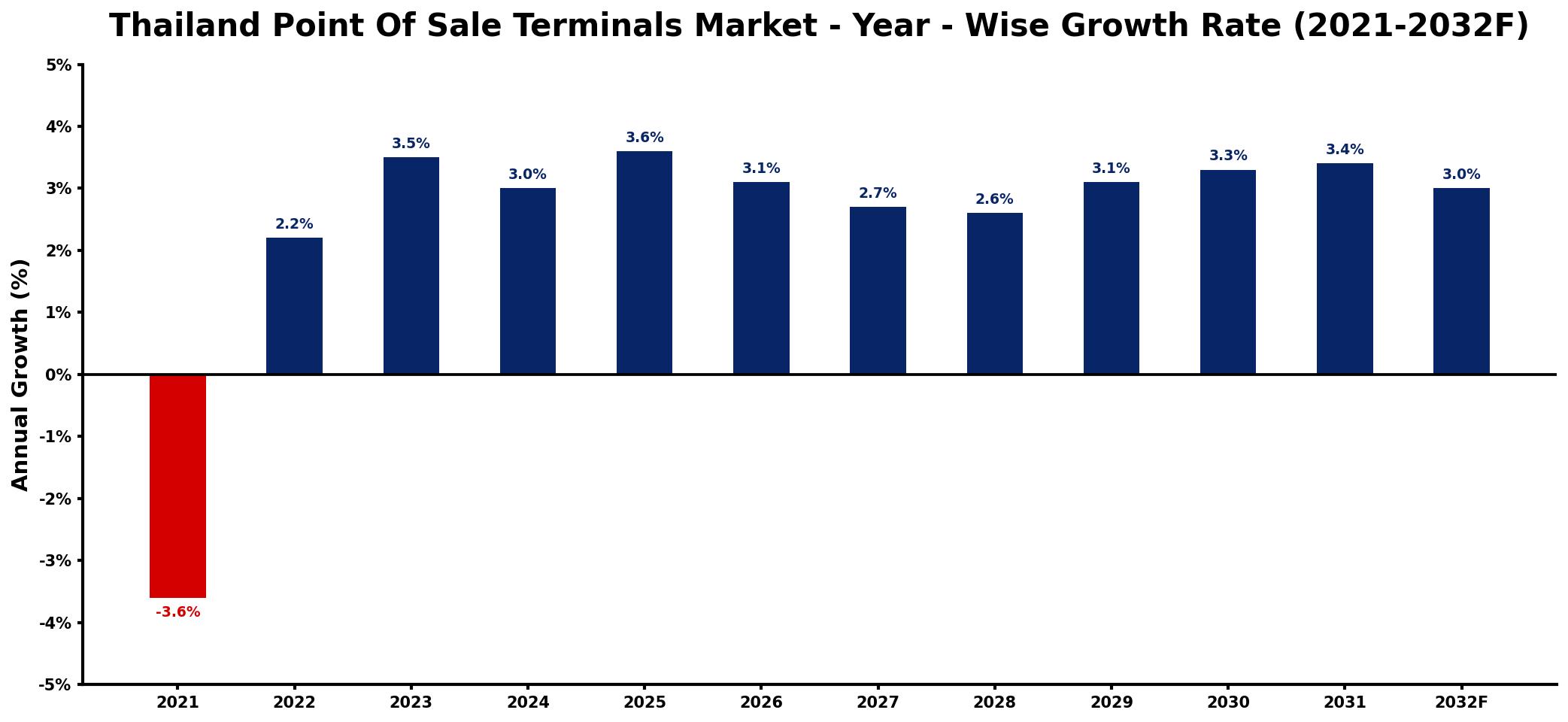
The table below presents the year‑wise growth rates along with the key drivers influencing the market
| Year | Growth Rate | Major Drivers |
| 2021 | -3.6% | decreased consumer spending patterns |
| 2022 | 2.2% | growing e-commerce transaction volume |
| 2023 | 3.5% | increased digital payment adoption |
| 2024 | 3.0% | expansion of retail outlets |
| 2025 | 3.6% | rising demand for contactless payments |
| 2026 | 3.1% | enhanced mobile payment solutions |
| 2027 | 2.7% | growing interest in fintech innovations |
| 2028 | 2.6% | increased investments in technology |
| 2029 | 3.1% | improved raw material availability |
| 2030 | 3.3% | enhanced cybersecurity measures implemented |
| 2031 | 3.4% | growing urbanization and infrastructure |
| 2032 | 3.0% | increased focus on customer experience |
Note: Market size estimations and growth projections presented in this report are based on 6Wresearch's proprietary forecasting methodology, utilizing the latest available industry data, government publications, and primary research inputs.
Thailand Point Of Sale Terminals Market Synopsis
The most significant force shaping the Thailand Point Of Sale Terminals Market currently is the increasing adoption of contactless payment technologies. This transformation has been catalyzed by changing consumer behaviors and government support for a cashless economy, highlighting the need for sophisticated POS systems capable of processing various payment types securely.
Moreover, the retail and hospitality sectors are witnessing robust growth, further accelerating the demand for POS solutions. The ongoing trends towards integrating cloud-based systems and mobile POS technologies are essential in enhancing operational efficiency, thus driving the market forward.
Thailand Point Of Sale Terminals Market Key Takeaways
- Strong growth driven by increasing digital payment adoption in retail and hospitality.
- Contactless payment technology is reshaping consumer transaction preferences.
- Government initiatives are promoting financial inclusion and cashless transactions.
- Advancements in cloud and mobile POS technologies are enhancing market attractiveness.
- COVID-19 acted as a catalyst for the rapid evolution of payment processing systems.
Evaluation of Restraints in Thailand Point Of Sale Terminals Market
Despite its potential, the Thailand Point Of Sale Terminals Market contends with several restraints. The rapid pace of technological advancement poses significant challenges, particularly regarding data security and compliance with industry standards. Additionally, the competitive landscape necessitates continuous innovation and upgrades, which may strain the resources of smaller businesses trying to keep pace. This environment requires a delicate balance between adopting new technologies and maintaining secure and efficient operations.
Thailand Point Of Sale Terminals Market Trends
Current trends highlight an increasing inclination towards mobile and cloud-based POS solutions, enabling businesses to operate more flexibly. Integration with other digital tools, such as inventory management systems and customer relationship management (CRM) platforms, is becoming increasingly common. Moreover, the growing consumer preference for seamless and fast payment experiences is pushing vendors to innovate and refine their offerings continuously.
Thailand Point Of Sale Terminals Market Opportunities
Significant growth opportunities exist within the small and medium-sized business sector, which is increasingly seeking efficient POS solutions to enhance customer interactions. Additionally, the ongoing shift towards a cashless economy presents avenues for new entrants focusing on innovative technology solutions. Businesses that can offer robust analytics and customer insights through their POS systems stand to gain a competitive edge in this evolving marketplace.
Government Initiatives in the Thailand Point Of Sale Terminals Market
The Thai government has launched several initiatives aimed at promoting a cashless economy and enhancing financial inclusion. Programs that encourage digital payment adoption among small and medium-sized enterprises are pivotal in shaping the POS market. Investments in infrastructure that support e-payment solutions also reflect the government's commitment to modernizing the financial ecosystem, paving the way for a more efficient transaction landscape.
Future Insights of the Thailand Point Of Sale Terminals Market
Looking ahead to the period between 2026 and 2032, the Thailand Point Of Sale Terminals Market is expected to continue on its growth path as technological advancements further revolutionize payment processing. The integration of AI and machine learning into POS systems will enhance transaction security and user experience. As consumer preferences evolve, businesses will increasingly seek customizable solutions that offer not just payment processing but a comprehensive management tool to optimize sales and customer engagement.
Thailand Point Of Sale Terminals Market Latest Developments (2025 - 2026)
The industry is witnessing a surge in partnerships and collaborations aimed at enhancing POS technology capabilities. Several firms are focusing on developing integrated solutions that combine payment processing with inventory and customer relationship management features. The market is also seeing innovative launches tailored specifically for the hospitality sector, reflecting the unique needs of businesses catering to tourists and local patrons alike.
Thailand Point Of Sale Terminals Market - Key Attractiveness of the Report
- 10 Years of Market Numbers
- Historical Data Starting from 2022 to 2025
- Base Year: 2025
- Forecast Data until 2032
- Key Performance Indicators Impacting the Market
- Major Upcoming Developments and Projects
Key Highlights of the Report:
- Thailand Point Of Sale Terminals Market Outlook
- Market Size of Thailand Point Of Sale Terminals Market, 2025
- Forecast of Thailand Point Of Sale Terminals Market, 2032
- Historical Data and Forecast of Thailand Point Of Sale Terminals Revenues & Volume for the Period 2022-2032F
- Thailand Point Of Sale Terminals Market Trend Evolution
- Thailand Point Of Sale Terminals Market Drivers and Challenges
- Thailand Point Of Sale Terminals Price Trends
- Thailand Point Of Sale Terminals Porter's Five Forces
- Thailand Point Of Sale Terminals Industry Life Cycle
- Historical Data and Forecast of Thailand Point Of Sale Terminals Market Revenues & Volume By Product for the Period 2022-2032F
- Historical Data and Forecast of Thailand Point Of Sale Terminals Market Revenues & Volume By Fixed for the Period 2022-2032F
- Historical Data and Forecast of Thailand Point Of Sale Terminals Market Revenues & Volume By Mobile for the Period 2022-2032F
- Historical Data and Forecast of Thailand Point Of Sale Terminals Market Revenues & Volume By Component for the Period 2022-2032F
- Historical Data and Forecast of Thailand Point Of Sale Terminals Market Revenues & Volume By Hardware for the Period 2022-2032F
- Historical Data and Forecast of Thailand Point Of Sale Terminals Market Revenues & Volume By Software for the Period 2022-2032F
- Historical Data and Forecast of Thailand Point Of Sale Terminals Market Revenues & Volume By Services for the Period 2022-2032F
- Historical Data and Forecast of Thailand Point Of Sale Terminals Market Revenues & Volume By Deployment for the Period 2022-2032F
- Historical Data and Forecast of Thailand Point Of Sale Terminals Market Revenues & Volume By Cloud for the Period 2022-2032F
- Historical Data and Forecast of Thailand Point Of Sale Terminals Market Revenues & Volume By On-premise for the Period 2022-2032F
- Historical Data and Forecast of Thailand Point Of Sale Terminals Market Revenues & Volume By End Use for the Period 2022-2032F
- Historical Data and Forecast of Thailand Point Of Sale Terminals Market Revenues & Volume By Restaurants for the Period 2022-2032F
- Historical Data and Forecast of Thailand Point Of Sale Terminals Market Revenues & Volume By Retail for the Period 2022-2032F
- Historical Data and Forecast of Thailand Point Of Sale Terminals Market Revenues & Volume By Hospitality for the Period 2022-2032F
- Historical Data and Forecast of Thailand Point Of Sale Terminals Market Revenues & Volume By Healthcare for the Period 2022-2032F
- Historical Data and Forecast of Thailand Point Of Sale Terminals Market Revenues & Volume By Warehouse for the Period 2022-2032F
- Historical Data and Forecast of Thailand Point Of Sale Terminals Market Revenues & Volume By Entertainment for the Period 2022-2032F
- Historical Data and Forecast of Thailand Point Of Sale Terminals Market Revenues & Volume By Others for the Period 2022-2032F
- Thailand Point Of Sale Terminals Import Export Trade Statistics
- Market Opportunity Assessment By Product
- Market Opportunity Assessment By Component
- Market Opportunity Assessment By Deployment
- Market Opportunity Assessment By End Use
- Thailand Point Of Sale Terminals Top Companies Market Share
- Thailand Point Of Sale Terminals Competitive Benchmarking By Technical and Operational Parameters
- Thailand Point Of Sale Terminals Company Profiles
- Thailand Point Of Sale Terminals Key Strategic Recommendations






































