Thailand Predictive Maintenance Market Size & Growth Rate (2026-2032)
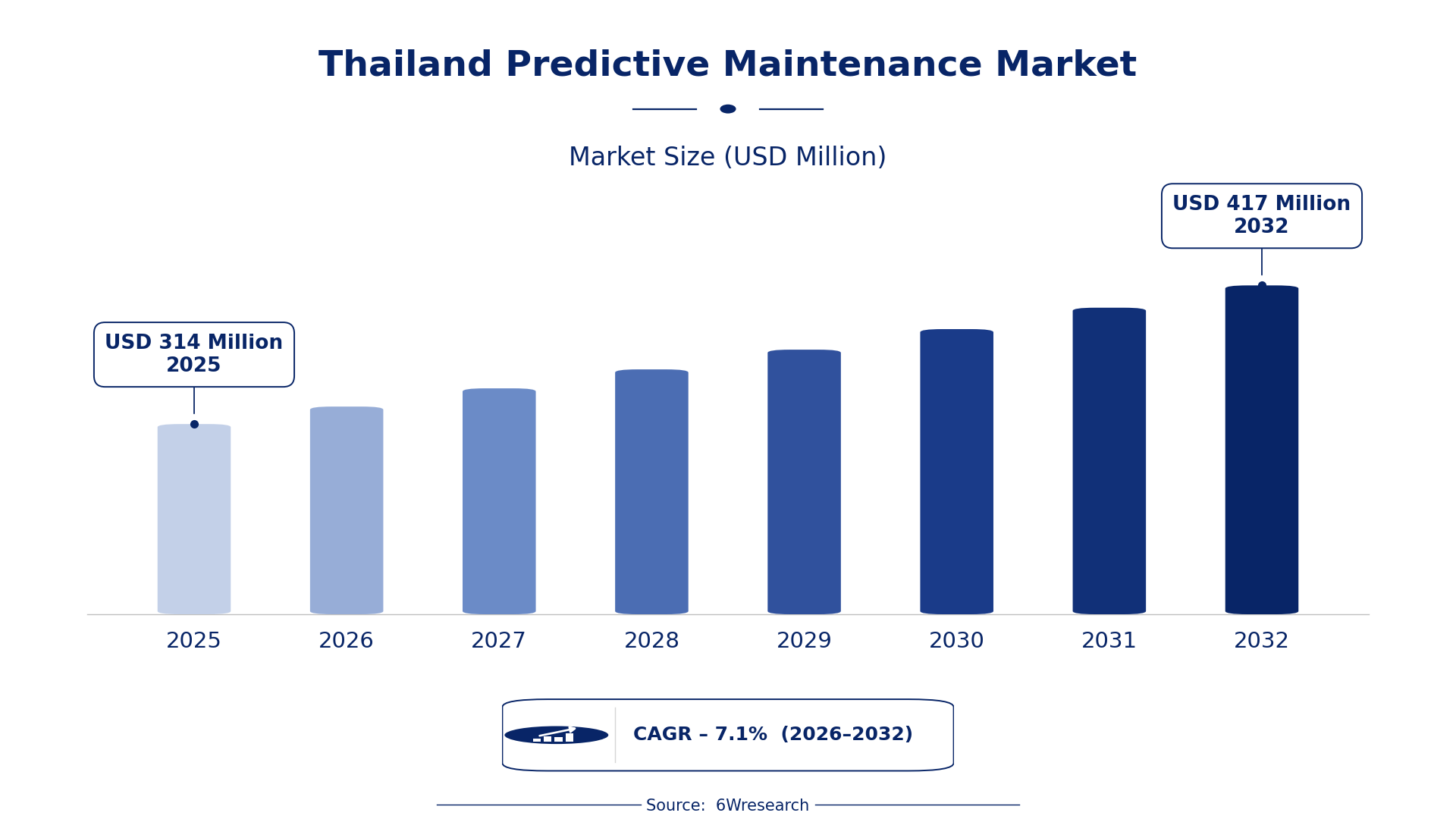
The Thailand Predictive Maintenance Market was estimated at USD 314 Million in 2025 and is projected to reach USD 417 Million by 2032, growing at a CAGR of 7.1% from 2026 to 2032.
Thailand Predictive Maintenance Market Synopsis
The Thailand Predictive Maintenance Market is currently experiencing notable expansion, driven by increased adoption across various industries such as manufacturing and energy. Companies are eager to implement predictive maintenance solutions to enhance equipment reliability, reduce operational costs, and minimize unplanned downtime.
This upward trend highlights a significant shift towards data-driven maintenance strategies. As organizations recognize the benefits of predictive analytics and IoT devices in condition monitoring, they are increasingly prioritizing proactive maintenance to ensure operational efficiency.
Thailand Predictive Maintenance Market Year-wise Growth Rate and Key Drivers
This graph illustrates the annual growth rates of the Thailand Predictive Maintenance Market from 2021 to 2032, highlighting a steady upward trajectory and projected expansion over the forecast period.

The table below presents the year‑wise growth rates along with the key drivers influencing the market
| Year | Growth Rate | Major Drivers |
| 2021 | -2.3% | Government delays in infrastructure project approvals hindered growth. |
| 2022 | 3.9% | Ministry of Industry supports smart manufacturing initiatives |
| 2023 | 5.2% | Increased investment in predictive analytics by local manufacturers |
| 2024 | 4.7% | Rising awareness of equipment failure costs among Thai firms |
| 2025 | 5.8% | Government incentives for technology adoption in SMEs |
| 2026 | 5.0% | Growing labor shortages drive demand for automated solutions |
| 2027 | 5.3% | Thai manufacturing sector adopts AI-driven maintenance solutions |
| 2028 | 5.2% | Increased focus on sustainability and resource efficiency |
| 2029 | 5.7% | Emergence of local startups in predictive maintenance technologies |
| 2030 | 6.3% | Thailand 4.0 initiative accelerates smart factory implementations |
| 2031 | 6.7% | Government partnerships boost technology transfer to enterprises |
| 2032 | 7.1% | Expanding telecom infrastructure enables real-time data monitoring |
Note: Market size estimations and growth projections presented in this report are based on 6Wresearch's proprietary forecasting methodology, utilizing the latest available industry data, government publications, and primary research inputs.
Thailand Predictive Maintenance Market Key Takeaways
Below are some of the specific key takeaways from the market, including:
- The market is being propelled by the integration of machine learning algorithms for predicting equipment failures.
- Industries are moving from reactive to proactive maintenance, emphasizing the need for cultural shifts within organizations.
- Data quality and integration with existing systems remain critical challenges for successful implementation.
- The COVID-19 pandemic has accelerated demand for predictive maintenance solutions as companies seek to optimize asset management.
- Government initiatives are beginning to shape the regulatory environment, fostering further growth in the sector.
Evaluation of Restraints in Thailand Predictive Maintenance Market
Despite the promising growth in the Thailand Predictive Maintenance Market, several restraints are hindering its full potential. One major challenge is the accuracy required in predicting equipment failures. Without reliable data, organizations struggle to optimize maintenance schedules effectively.
Integration issues with existing asset management systems also present significant hurdles. Organizations often face technical difficulties when transitioning from traditional maintenance strategies to data-driven approaches, necessitating a cultural and operational shift that can be met with resistance.
Thailand Predictive Maintenance Market Trends
The adoption of predictive analytics is increasingly becoming a staple in maintenance strategies across various sectors in Thailand. Companies are focusing on implementing advanced machine learning tools to enhance their predictive capabilities.
Additionally, the proliferation of IoT devices is transforming condition monitoring practices. These devices provide real-time data, allowing organizations to anticipate equipment failures before they occur, which is crucial for maintaining competitive advantage.
Thailand Predictive Maintenance Market Opportunities
Opportunities for growth in the Thailand Predictive Maintenance Market are abundant. Industries such as transportation and energy are particularly ripe for investment, as they increasingly seek to enhance operational efficiency through predictive maintenance solutions.
The rise of smart manufacturing initiatives presents another avenue for growth, as companies look to leverage advanced technologies for improved maintenance practices. Investing in training and development for employees will also create a more conducive environment for adopting predictive maintenance strategies.
Government Initiatives in the Thailand Predictive Maintenance Market
The Thai government is actively shaping the Predictive Maintenance Market through various initiatives aimed at enhancing industrial efficiency. As part of the national agenda, there is a clear focus on integrating technology into traditional sectors, supporting a transition to more proactive maintenance strategies.
- A recently completed initiative involved launching a national digital infrastructure upgrade program to support IoT integration across industries.
- Currently underway is a public-private partnership designed to promote the adoption of predictive maintenance technologies in the manufacturing sector.
- Planned initiatives include the introduction of regulatory frameworks that will mandate the use of predictive analytics for asset management in critical industries by 2028.
- The government is also investing in training programs aimed at developing a skilled workforce adept in using predictive maintenance tools.
Future Insights of the Thailand Predictive Maintenance Market
Looking ahead to 2026-2032, the Thailand Predictive Maintenance Market is likely to undergo significant transformation. As more industries recognize the value of predictive analytics, the shift towards proactive maintenance will accelerate.
on top of that, advancements in technology, particularly in machine learning and IoT, will enhance the predictive capabilities of maintenance systems. Companies that invest early in these technologies will position themselves to gain a competitive edge in the coming years.
Thailand Predictive Maintenance Market Latest Developments
In the past year, the Thailand Predictive Maintenance Market has seen a surge in activity as companies increasingly recognize the need for effective asset management solutions. The integration of advanced analytics and IoT technologies is being prioritized to enhance operational efficiency.
- A major technology vendor launched a new predictive maintenance platform in early 2025, designed to integrate seamlessly with existing asset management systems.
- An ongoing initiative began in mid-2025, focusing on the deployment of IoT devices across various manufacturing facilities to enhance condition monitoring.
- A planned rollout expected to start in the second half of 2026 aims to provide training workshops for organizations transitioning to predictive maintenance practices.
- A leading regional operator is currently collaborating with technology providers to upgrade their predictive maintenance capabilities, expected to be completed by late 2025.
Thailand Predictive Maintenance Market - Key Attractiveness of the Report
- 10 Years of Market Numbers
- Historical Data Starting from 2022 to 2025
- Base Year: 2025
- Forecast Data until 2032
- Key Performance Indicators Impacting the Market
- Major Upcoming Developments and Projects
Key Highlights of the Report:
- Thailand Predictive Maintenance Market Outlook
- Market Size of Thailand Predictive Maintenance Market, 2025
- Forecast of Thailand Predictive Maintenance Market, 2032
- Historical Data and Forecast of Thailand Predictive Maintenance Revenues & Volume for the Period 2022-2032F
- Thailand Predictive Maintenance Market Trend Evolution
- Thailand Predictive Maintenance Market Drivers and Challenges
- Thailand Predictive Maintenance Price Trends
- Thailand Predictive Maintenance Porter's Five Forces
- Thailand Predictive Maintenance Industry Life Cycle
- Historical Data and Forecast of Thailand Predictive Maintenance Market Revenues & Volume By Component for the Period 2022-2032F
- Historical Data and Forecast of Thailand Predictive Maintenance Market Revenues & Volume By Solutions for the Period 2022-2032F
- Historical Data and Forecast of Thailand Predictive Maintenance Market Revenues & Volume By Services for the Period 2022-2032F
- Historical Data and Forecast of Thailand Predictive Maintenance Market Revenues & Volume By Organization Size for the Period 2022-2032F
- Historical Data and Forecast of Thailand Predictive Maintenance Market Revenues & Volume By Large Enterprises for the Period 2022-2032F
- Historical Data and Forecast of Thailand Predictive Maintenance Market Revenues & Volume By SME for the Period 2022-2032F
- Historical Data and Forecast of Thailand Predictive Maintenance Market Revenues & Volume By Deployment Mode for the Period 2022-2032F
- Historical Data and Forecast of Thailand Predictive Maintenance Market Revenues & Volume By On-premises for the Period 2022-2032F
- Historical Data and Forecast of Thailand Predictive Maintenance Market Revenues & Volume By Cloud for the Period 2022-2032F
- Historical Data and Forecast of Thailand Predictive Maintenance Market Revenues & Volume By Vertical for the Period 2022-2032F
- Historical Data and Forecast of Thailand Predictive Maintenance Market Revenues & Volume By Government and Defense for the Period 2022-2032F
- Historical Data and Forecast of Thailand Predictive Maintenance Market Revenues & Volume By Manufacturing for the Period 2022-2032F
- Historical Data and Forecast of Thailand Predictive Maintenance Market Revenues & Volume By Energy and Utilities for the Period 2022-2032F
- Historical Data and Forecast of Thailand Predictive Maintenance Market Revenues & Volume By Transportation and Logistics for the Period 2022-2032F
- Historical Data and Forecast of Thailand Predictive Maintenance Market Revenues & Volume By Healthcare and Life Sciences for the Period 2022-2032F
- Thailand Predictive Maintenance Import Export Trade Statistics
- Market Opportunity Assessment By Component
- Market Opportunity Assessment By Organization Size
- Market Opportunity Assessment By Deployment Mode
- Market Opportunity Assessment By Vertical
- Thailand Predictive Maintenance Top Companies Market Share
- Thailand Predictive Maintenance Competitive Benchmarking By Technical and Operational Parameters
- Thailand Predictive Maintenance Company Profiles
- Thailand Predictive Maintenance Key Strategic Recommendations






































