Thailand Pure Wool Market Size, Share & Growth Rate
The Thailand Pure Wool Market was estimated at USD 196 Million in 2025 and is projected to reach USD 223 Million by 2032, growing at a CAGR of 1.9% from 2026 to 2032. This growth trajectory can be attributed to a rising awareness of sustainability among consumers, who are increasingly drawn to natural fibers like pure wool. Additionally, the premium fashion segment in Thailand is adopting pure wool for its superior quality, driving demand for locally sourced and ethically produced wool products.
Thailand Pure Wool Market Year-wise Growth Rate and Key Drivers
This graph highlights how the Thailand Pure Wool Market has steadily grown over the years, supported by major growth factors.
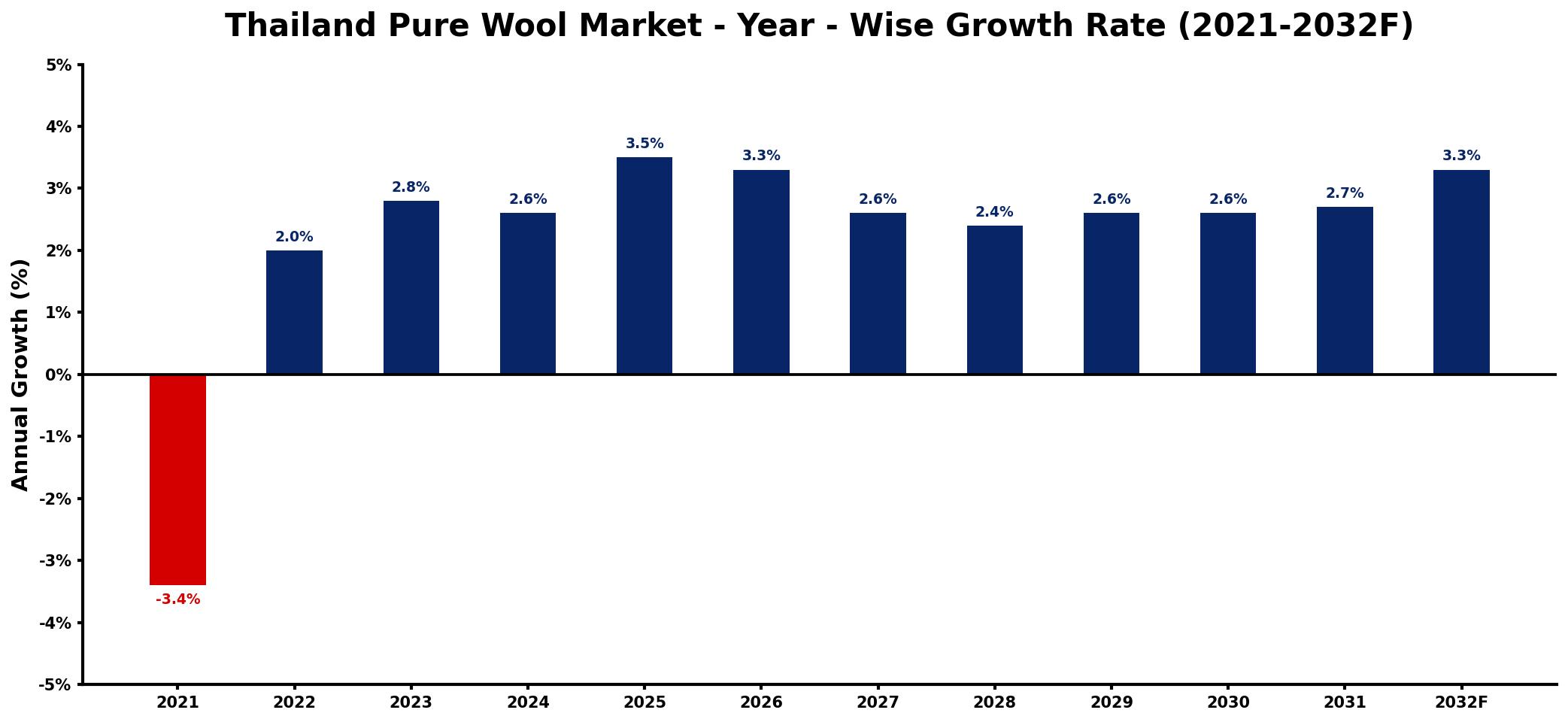
The table below presents the year‑wise growth rates along with the key drivers influencing the market
| Year | Growth Rate | Major Drivers |
| 2021 | -3.4% | decreased consumer spending on apparel |
| 2022 | 2.0% | growing demand for sustainable textiles |
| 2023 | 2.8% | increased investments in renewable fibers |
| 2024 | 2.6% | expansion of eco-friendly production methods |
| 2025 | 3.5% | rising popularity of natural fabrics |
| 2026 | 3.3% | enhanced marketing strategies for textiles |
| 2027 | 2.6% | growth in online retail channels |
| 2028 | 2.4% | increased focus on ethical sourcing |
| 2029 | 2.6% | growing regional consumption patterns |
| 2030 | 2.6% | rising consumer awareness on sustainability |
| 2031 | 2.7% | strengthening underlying market demand |
| 2032 | 3.3% | increased research on fiber innovations |
Note: Market size estimations and growth projections presented in this report are based on 6Wresearch's proprietary forecasting methodology, utilizing the latest available industry data, government publications, and primary research inputs.
Thailand Pure Wool Market Synopsis
The pure wool market in Thailand is an emerging sector that is steadily carving out a unique space within the country's broader textile industry. Despite the nation's historical disconnection from wool production, there is a notable shift towards exploring local wool farming, catering primarily to niche markets focused on high-quality fashion and textiles.
Thai producers are emphasizing sustainable and ethical practices in wool farming, reflecting a global trend that prioritizes environmentally-friendly materials. This commitment to quality and craftsmanship is resonating with both domestic consumers and international markets, gradually establishing Thailand as a reputable source of premium wool products.
Thailand Pure Wool Market Key Takeaways
- The market is driven by increasing consumer demand for sustainable and natural fibers.
- Local wool production remains limited, presenting both challenges and opportunities for growth.
- Awareness of wool's unique properties, such as insulation and moisture-wicking capabilities, is growing.
- The export market for Thai pure wool products is expanding, reflecting a commitment to quality.
- High-end fashion industries are significantly contributing to market development and consumer interest.
Evaluation of Restraints in Thailand Pure Wool Market
The Thailand pure wool market faces inherent limitations that hinder its growth potential. Firstly, the climatic conditions in Thailand are not ideal for raising wool-producing sheep, which constrains local wool supply. As a result, manufacturers must rely heavily on imports, which increases costs and complicates supply chain logistics. Additionally, consumer familiarity with alternative fabrics, such as cotton and synthetics, poses a challenge in convincing them to transition to pure wool products. Thus, there remains a pressing need to build awareness of the unique benefits that pure wool offers, particularly as interest in sustainable practices rises.
Thailand Pure Wool Market Trends
A few key trends are currently shaping the Thailand pure wool market. The rise of eco-conscious consumerism is paramount, as more buyers seek products that align with their values regarding sustainability. Innovations in wool processing technology are also emerging, enhancing the quality and efficiency of wool products. Additionally, collaborations between local producers and fashion designers are fostering a creative environment that highlights the luxury of pure wool, further solidifying its place in premium fashion markets.
Thailand Pure Wool Market Opportunities
The Thailand pure wool market presents a wealth of opportunities for investment and growth. With the increasing global demand for sustainable fashion, local producers can capitalize on their unique position by enhancing their branding around ethical practices. There is also significant potential for developing niche products, such as specialized garments that cater to climate-specific needs. By focusing on quality craftsmanship and establishing partnerships with designers, stakeholders can position themselves at the forefront of this evolving market.
Government Initiatives in the Thailand Pure Wool Market
The Thai government is increasingly recognizing the importance of the textile and agricultural sectors, and initiatives are being introduced to support sustainable practices in wool production. Programs aimed at promoting local farming of wool-bearing sheep and enhancing knowledge of sustainable textile production are being explored. Furthermore, incentives for businesses that prioritize ethical sourcing are becoming more prevalent, demonstrating a commitment to fostering a conducive environment for the growth of the pure wool market.
Future Insights of the Thailand Pure Wool Market
Looking ahead to the period from 2026 to 2032, the Thailand pure wool market is expected to evolve in response to shifting consumer preferences towards sustainability and premium quality. As global textile markets continue to emphasize eco-friendly materials, Thai producers who successfully align their offerings with these trends will likely experience robust growth. Continued efforts to educate consumers on the benefits of pure wool, alongside improvements in local production capabilities, will be critical in sustaining this upward momentum.
Thailand Pure Wool Market Latest Developments (2025 - 2026)
Recent developments in the Thailand pure wool market indicate a growing collaboration between local producers and international fashion brands, aimed at promoting Thai wool products abroad. Additionally, initiatives to improve supply chain efficiencies are being implemented, reducing costs for both producers and consumers. As the market navigates recovery from the impacts of the COVID-19 pandemic, there is renewed enthusiasm for local craftsmanship, with fashion events highlighting sustainable and luxury wool products.
Thailand Pure Wool Market - Key Attractiveness of the Report
- 10 Years of Market Numbers
- Historical Data Starting from 2022 to 2025
- Base Year: 2025
- Forecast Data until 2032
- Key Performance Indicators Impacting the Market
- Major Upcoming Developments and Projects
Key Highlights of the Report:
- Thailand Pure Wool Market Outlook
- Market Size of Thailand Pure Wool Market, 2025
- Forecast of Thailand Pure Wool Market, 2032
- Historical Data and Forecast of Thailand Pure Wool Revenues & Volume for the Period 2022-2032F
- Thailand Pure Wool Market Trend Evolution
- Thailand Pure Wool Market Drivers and Challenges
- Thailand Pure Wool Price Trends
- Thailand Pure Wool Porter's Five Forces
- Thailand Pure Wool Industry Life Cycle
- Historical Data and Forecast of Thailand Pure Wool Market Revenues & Volume By Type for the Period 2022-2032F
- Historical Data and Forecast of Thailand Pure Wool Market Revenues & Volume By Sheep Wool for the Period 2022-2032F
- Historical Data and Forecast of Thailand Pure Wool Market Revenues & Volume By Alpaca Wool for the Period 2022-2032F
- Historical Data and Forecast of Thailand Pure Wool Market Revenues & Volume By Merino Wool for the Period 2022-2032F
- Historical Data and Forecast of Thailand Pure Wool Market Revenues & Volume By Cashmere Wool for the Period 2022-2032F
- Historical Data and Forecast of Thailand Pure Wool Market Revenues & Volume By Mohair Wool for the Period 2022-2032F
- Historical Data and Forecast of Thailand Pure Wool Market Revenues & Volume By Angora Wool for the Period 2022-2032F
- Historical Data and Forecast of Thailand Pure Wool Market Revenues & Volume By Form for the Period 2022-2032F
- Historical Data and Forecast of Thailand Pure Wool Market Revenues & Volume By Woven for the Period 2022-2032F
- Historical Data and Forecast of Thailand Pure Wool Market Revenues & Volume By Non-Woven for the Period 2022-2032F
- Historical Data and Forecast of Thailand Pure Wool Market Revenues & Volume By Others for the Period 2022-2032F
- Historical Data and Forecast of Thailand Pure Wool Market Revenues & Volume By Application for the Period 2022-2032F
- Historical Data and Forecast of Thailand Pure Wool Market Revenues & Volume By Textiles and Apparels for the Period 2022-2032F
- Historical Data and Forecast of Thailand Pure Wool Market Revenues & Volume By Footwear for the Period 2022-2032F
- Historical Data and Forecast of Thailand Pure Wool Market Revenues & Volume By Mattress & Quilts for the Period 2022-2032F
- Historical Data and Forecast of Thailand Pure Wool Market Revenues & Volume By Others for the Period 2022-2032F
- Thailand Pure Wool Import Export Trade Statistics
- Market Opportunity Assessment By Type
- Market Opportunity Assessment By Form
- Market Opportunity Assessment By Application
- Thailand Pure Wool Top Companies Market Share
- Thailand Pure Wool Competitive Benchmarking By Technical and Operational Parameters
- Thailand Pure Wool Company Profiles
- Thailand Pure Wool Key Strategic Recommendations






































