Thailand Radar Market: Import Trend Analysis
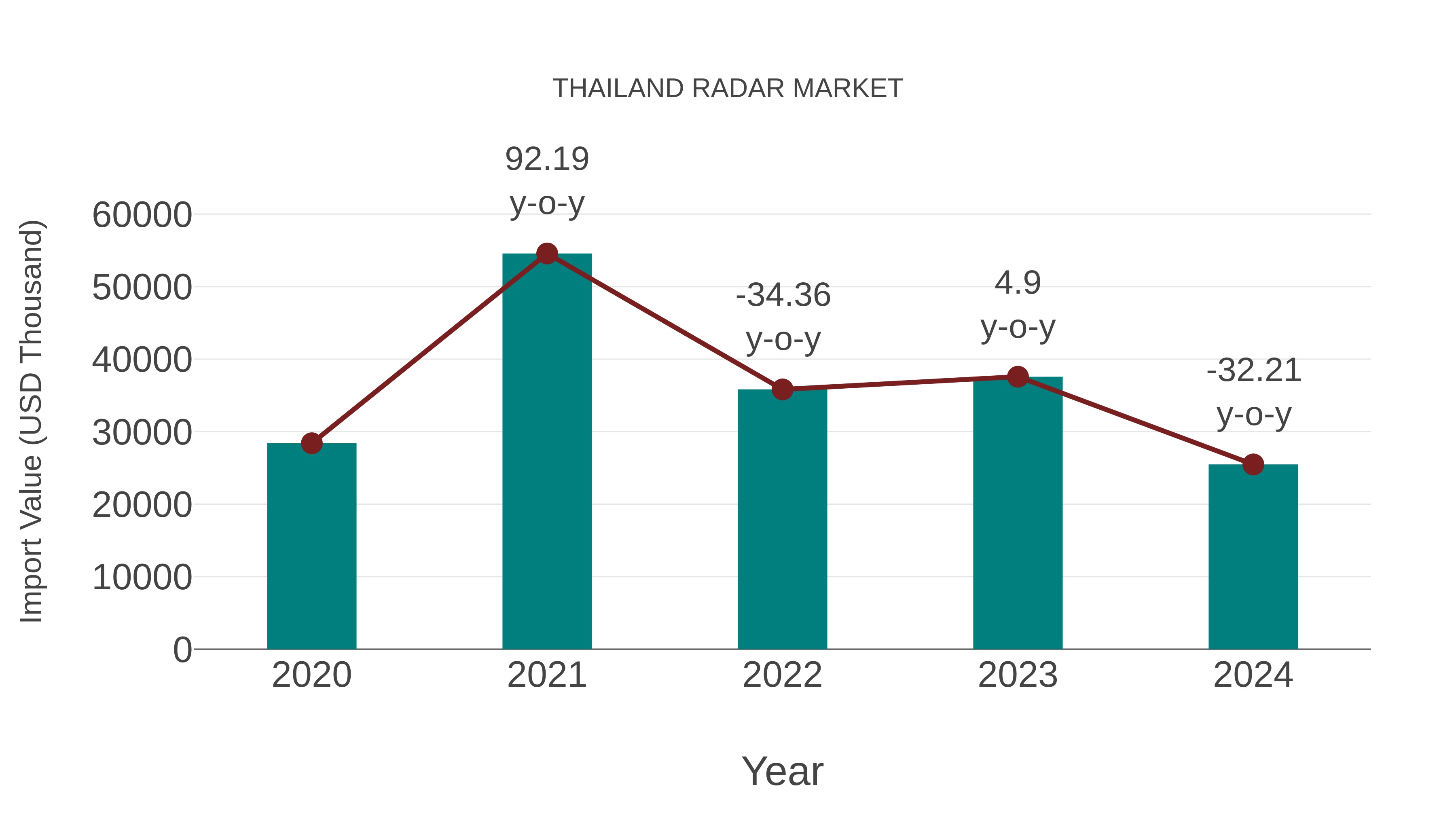
Thailand import trend for the radar market experienced a decline, with a growth rate of -32.21% from 2023 to 2024 and a compound annual growth rate (CAGR) of -2.68% from 2020 to 2024. This negative momentum could be attributed to shifts in demand dynamics or changes in market competitiveness impacting import volumes during the period.
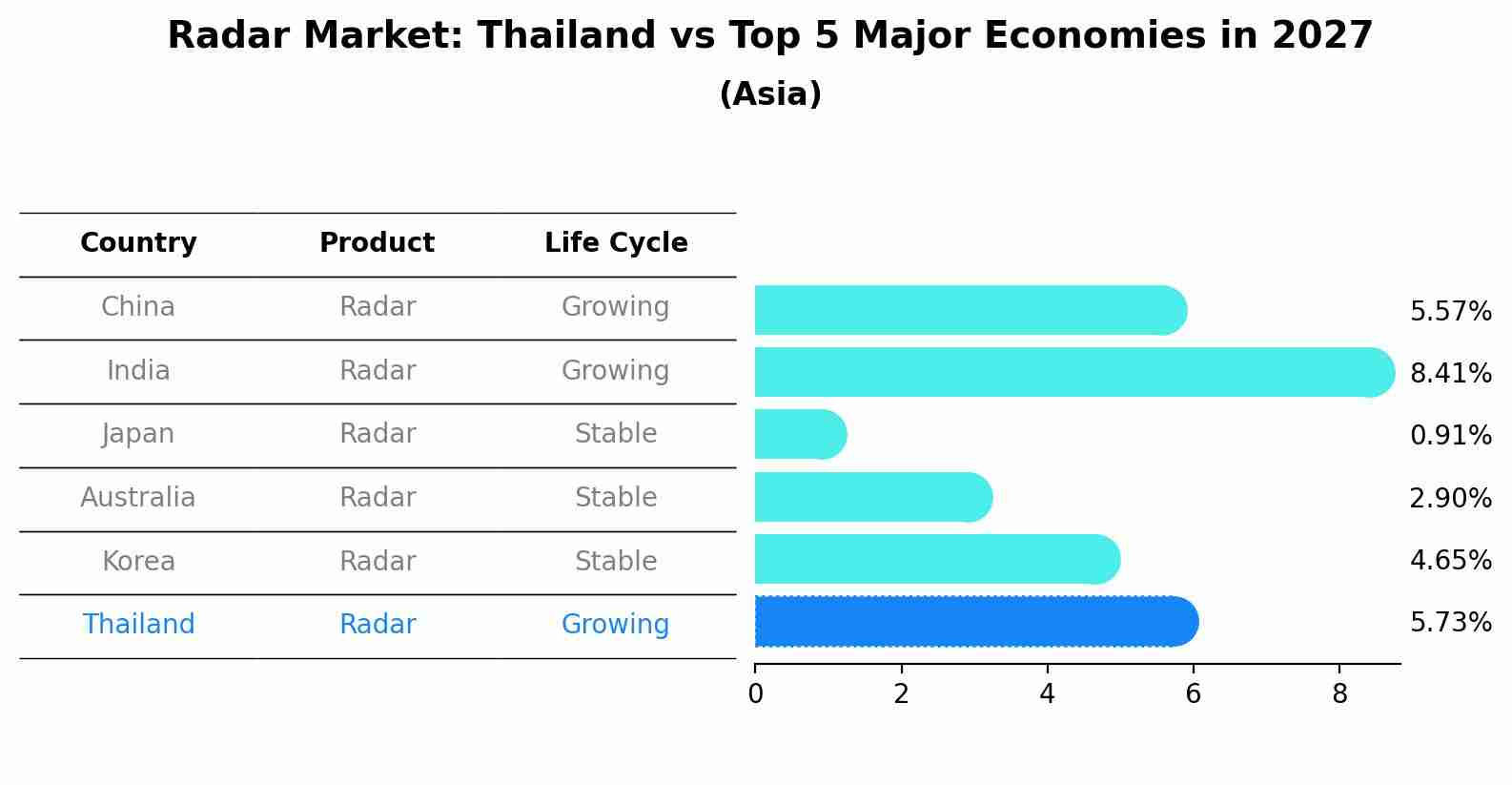
Radar Market: Thailand vs Top 5 Major Economies in 2027 (Asia)
The Radar market in Thailand is projected to grow at a growing growth rate of 5.73% by 2027, highlighting the country's increasing focus on advanced technologies within the Asia region, where China holds the dominant position, followed closely by India, Japan, Australia and South Korea, shaping overall regional demand.
Thailand Radar Market Synopsis
The radar market in Thailand has been witnessing significant growth in recent years. Radar is a critical technology used for detection, tracking, and monitoring various objects, including aircraft, ships, vehicles, and weather patterns. In Thailand, the market for radar systems is driven by factors such as the country`s focus on enhancing its defense capabilities, modernizing its infrastructure, maritime security needs, and the adoption of radar technology in meteorology and aviation. The market offers a wide range of radar systems, including ground-based, airborne, and maritime radar, catering to diverse applications in defense, transportation, and weather monitoring.
Market Drivers
Several factors contribute to the growth of the radar market in Thailand. Firstly, the country`s efforts to modernize its defense and security infrastructure have led to investments in advanced radar systems. Radar plays a crucial role in air defense, surveillance, and border security, driving the demand for state-of-the-art radar technologies. Additionally, the development of smart cities and transportation infrastructure requires radar systems for traffic management, surveillance, and safety purposes. Moreover, Thailand geographical location and its significance in regional trade and maritime activities have resulted in a demand for radar systems for coastal surveillance and maritime security.
Challenges of the Market
Despite its positive growth trajectory, the radar market in Thailand faces certain challenges. One of the primary challenges is the complexity and cost of radar systems. Advanced radar technologies can be expensive to develop, procure, and maintain, especially for a developing economy like Thailand. Balancing the need for cutting-edge radar capabilities with budget constraints can be a challenge for defense and government authorities. Additionally, competition from global radar manufacturers and restrictions on technology transfers may impact the localization and production of radar systems in the country.
Covid-19 Impact on the Market
The COVID-19 pandemic had a mixed impact on the radar market in Thailand. During the initial phases of the pandemic, there may have been delays in procurement and investments in radar systems due to uncertainties and shifting budget priorities. However, the pandemic also highlighted the importance of surveillance and security measures, potentially driving the demand for radar systems for monitoring and controlling the movement of people and goods. The market`s resilience in critical sectors such as defense and security likely contributed to its steady growth.
Key Players of the Market
The radar market in Thailand is supported by both domestic and international key players. Major global manufacturers in the radar technology industry have a presence in the country, offering a wide range of radar systems and solutions. These include companies like Raytheon Technologies Corporation, Lockheed Martin Corporation, Thales Group, and Saab AB. Additionally, local manufacturers and technology companies are also involved in radar system development and integration to cater to the domestic market`s specific needs.
Key Highlights of the Report:
- Thailand Radar Market Outlook
- Market Size of Thailand Radar Market, 2025
- Forecast of Thailand Radar Market, 2032
- Historical Data and Forecast of Thailand Radar Revenues & Volume for the Period 2022-2032F
- Thailand Radar Market Trend Evolution
- Thailand Radar Market Drivers and Challenges
- Thailand Radar Price Trends
- Thailand Radar Porter's Five Forces
- Thailand Radar Industry Life Cycle
- Historical Data and Forecast of Thailand Radar Market Revenues & Volume By Component for the Period 2022-2032F
- Historical Data and Forecast of Thailand Radar Market Revenues & Volume By Antenna for the Period 2022-2032F
- Historical Data and Forecast of Thailand Radar Market Revenues & Volume By Transmitter for the Period 2022-2032F
- Historical Data and Forecast of Thailand Radar Market Revenues & Volume By Receiver for the Period 2022-2032F
- Historical Data and Forecast of Thailand Radar Market Revenues & Volume By Others for the Period 2022-2032F
- Historical Data and Forecast of Thailand Radar Market Revenues & Volume By Service for the Period 2022-2032F
- Historical Data and Forecast of Thailand Radar Market Revenues & Volume By Installation/Integration for the Period 2022-2032F
- Historical Data and Forecast of Thailand Radar Market Revenues & Volume By Support & Maintenance for the Period 2022-2032F
- Historical Data and Forecast of Thailand Radar Market Revenues & Volume By Training & Consulting for the Period 2022-2032F
- Historical Data and Forecast of Thailand Radar Market Revenues & Volume By Platform for the Period 2022-2032F
- Historical Data and Forecast of Thailand Radar Market Revenues & Volume By Ground-based for the Period 2022-2032F
- Historical Data and Forecast of Thailand Radar Market Revenues & Volume By Naval for the Period 2022-2032F
- Historical Data and Forecast of Thailand Radar Market Revenues & Volume By Airborne for the Period 2022-2032F
- Historical Data and Forecast of Thailand Radar Market Revenues & Volume By Space-based for the Period 2022-2032F
- Historical Data and Forecast of Thailand Radar Market Revenues & Volume By Frequency Band for the Period 2022-2032F
- Historical Data and Forecast of Thailand Radar Market Revenues & Volume By L-band for the Period 2022-2032F
- Historical Data and Forecast of Thailand Radar Market Revenues & Volume By S-band for the Period 2022-2032F
- Historical Data and Forecast of Thailand Radar Market Revenues & Volume By C-band for the Period 2022-2032F
- Historical Data and Forecast of Thailand Radar Market Revenues & Volume By X-band for the Period 2022-2032F
- Historical Data and Forecast of Thailand Radar Market Revenues & Volume By Ku-band for the Period 2022-2032F
- Historical Data and Forecast of Thailand Radar Market Revenues & Volume By Ka-band for the Period 2022-2032F
- Historical Data and Forecast of Thailand Radar Market Revenues & Volume By Others for the Period 2022-2032F
- Historical Data and Forecast of Thailand Radar Market Revenues & Volume By Range for the Period 2022-2032F
- Historical Data and Forecast of Thailand Radar Market Revenues & Volume By Long for the Period 2022-2032F
- Historical Data and Forecast of Thailand Radar Market Revenues & Volume By Medium for the Period 2022-2032F
- Historical Data and Forecast of Thailand Radar Market Revenues & Volume By Short for the Period 2022-2032F
- Historical Data and Forecast of Thailand Radar Market Revenues & Volume By End-Users for the Period 2022-2032F
- Historical Data and Forecast of Thailand Radar Market Revenues & Volume By Military Applications for the Period 2022-2032F
- Historical Data and Forecast of Thailand Radar Market Revenues & Volume By Air Traffic Control for the Period 2022-2032F
- Historical Data and Forecast of Thailand Radar Market Revenues & Volume By Remote Sensing for the Period 2022-2032F
- Historical Data and Forecast of Thailand Radar Market Revenues & Volume By Ground Traffic Control for the Period 2022-2032F
- Historical Data and Forecast of Thailand Radar Market Revenues & Volume By Others for the Period 2022-2032F
- Thailand Radar Import Export Trade Statistics
- Market Opportunity Assessment By Component
- Market Opportunity Assessment By Service
- Market Opportunity Assessment By Platform
- Market Opportunity Assessment By Frequency Band
- Market Opportunity Assessment By Range
- Market Opportunity Assessment By End-Users
- Thailand Radar Top Companies Market Share
- Thailand Radar Competitive Benchmarking By Technical and Operational Parameters
- Thailand Radar Company Profiles
- Thailand Radar Key Strategic Recommendations






































