Thailand Radio Broadcast Receivers Market Size, Share & Growth Rate
The Thailand Radio Broadcast Receivers Market was estimated at USD 231 Million in 2025 and is projected to reach USD 264 Million by 2032, growing at a CAGR of 1.9% from 2026 to 2032. This growth trajectory is largely propelled by the enduring cultural significance of radio as a medium, particularly in rural communities where access to other forms of media may be limited. Additionally, the automotive sector's reliance on radio receivers for in-car entertainment amplifies demand, ensuring that this market remains robust in a transitioning media landscape.
Thailand Radio Broadcast Receivers Market Year-wise Growth Rate and Key Drivers
This graph highlights how the Thailand Radio Broadcast Receivers Market has steadily grown over the years, supported by major growth factors.
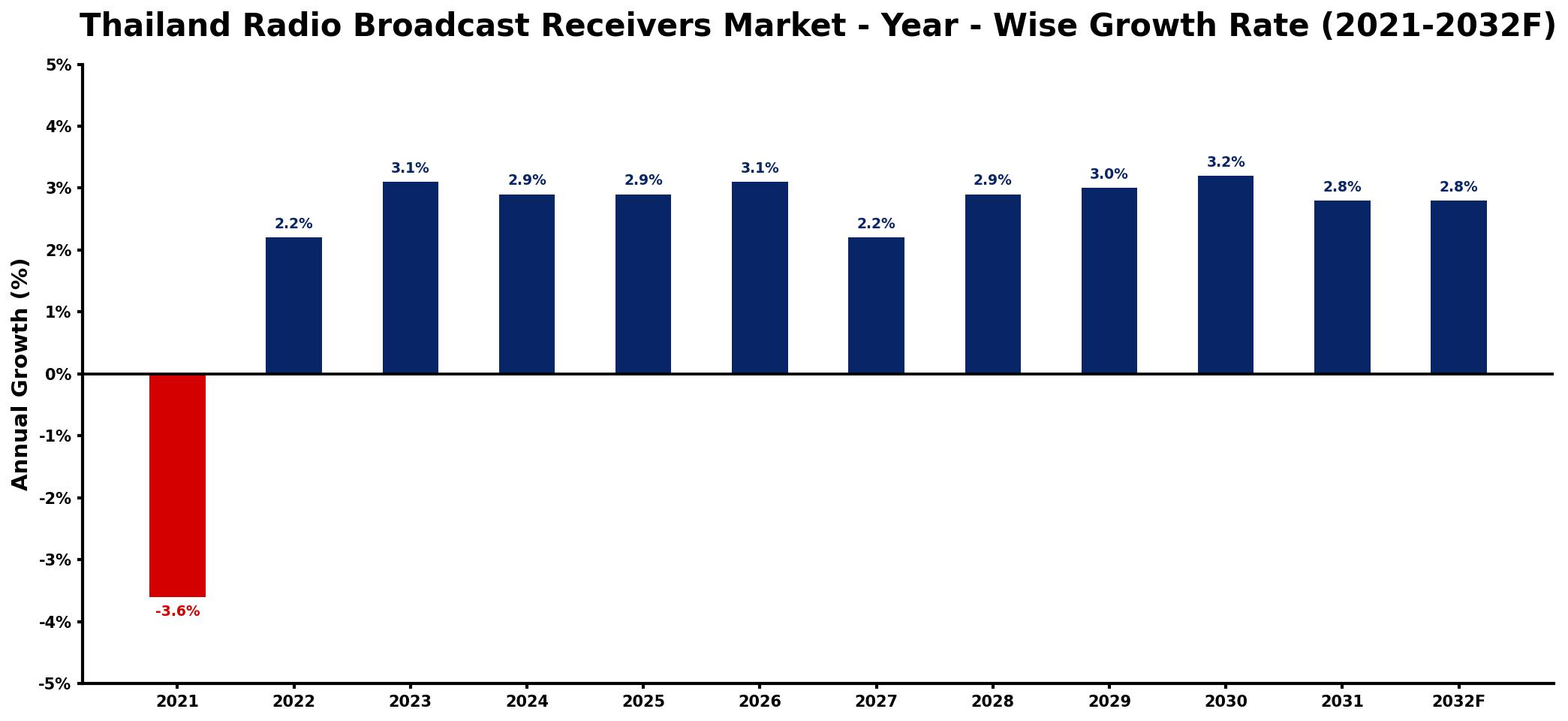
The table below presents the year‑wise growth rates along with the key drivers influencing the market
| Year | Growth Rate | Major Drivers |
| 2021 | -3.6% | decrease in consumer spending habits |
| 2022 | 2.2% | rising disposable income levels |
| 2023 | 3.1% | increased demand for entertainment |
| 2024 | 2.9% | growth in digital content consumption |
| 2025 | 2.9% | expansion of local content production |
| 2026 | 3.1% | surge in mobile connectivity adoption |
| 2027 | 2.2% | enhanced advertising revenue streams |
| 2028 | 2.9% | increased production capacity utilization |
| 2029 | 3.0% | increased penetration of smart devices |
| 2030 | 3.2% | rise in multi-platform content availability |
| 2031 | 2.8% | growing interest in localized programming |
| 2032 | 2.8% | expanding industrial usage applications |
Note: Market size estimations and growth projections presented in this report are based on 6Wresearch's proprietary forecasting methodology, utilizing the latest available industry data, government publications, and primary research inputs.
Thailand Radio Broadcast Receivers Market Synopsis
In Thailand, radio broadcasting continues to be a cornerstone of entertainment and information dissemination, despite the rise of digital media. The accessibility and affordability of radio receivers have solidified their role in Thai households and vehicles alike. As such, the radio remains a trusted source of news and local content, especially for audiences in remote areas.
This market is not only characterized by the enduring appeal of traditional broadcasting but is also witnessing a transformation driven by digital integration. As consumers increasingly seek personalized content, radio stations are adapting by incorporating online streaming and podcasting into their offerings. This strategic shift reflects a commitment to maintain relevance in an evolving media environment.
Thailand Radio Broadcast Receivers Market Key Takeaways
- The radio broadcasting sector is vital for information and entertainment, particularly in rural Thailand.
- Digital transformation initiatives are reshaping how content is delivered to consumers.
- Affordability of radio receivers ensures steady demand, even amid competition from digital platforms.
- Government support for local content creation enhances radios cultural significance.
- The automotive industry's dependence on radio integration fosters market resilience.
Evaluation of Restraints in Thailand Radio Broadcast Receivers Market
Despite its strengths, the Thailand Radio Broadcast Receivers Market faces notable restraints that could inhibit growth. The ongoing shift towards digital broadcasting is necessitating investment in advanced receiver technologies, posing a financial challenge for some industry players. Moreover, the fierce competition from online streaming services threatens traditional radios listener base, as younger consumers gravitate towards on-demand audio content. Adapting to these evolving consumer preferences while maintaining the essence of radio will be crucial for market stakeholders.
Thailand Radio Broadcast Receivers Market Trends
Emerging trends indicate a growing integration of smart technology into radio receivers, aligning with consumer expectations for enhanced interactivity and personalization. Additionally, sustainability trends are influencing manufacturers to consider eco-friendly materials and energy-efficient designs. The rise of community-driven content is also notable, as local broadcasters seek to engage listeners with culturally relevant programming that resonates on a personal level.
Thailand Radio Broadcast Receivers Market Opportunities
Investment opportunities within the Thailand Radio Broadcast Receivers Market are centered around technological innovation and digital content delivery. Companies can capitalize on the growing trend of hybrid radio platforms that combine traditional and digital broadcasting methods. Furthermore, partnerships with automotive manufacturers present potential for integrated solutions that enhance in-car listening experiences, thereby expanding market reach. Lastly, creating content that appeals to niche audiences can unlock new revenue streams for broadcasters.
Government Initiatives in the Thailand Radio Broadcast Receivers Market
The Thai government has initiated several programs to enhance the radio broadcasting landscape, focusing on promoting local content and community radio stations. These initiatives aim to preserve cultural heritage while providing a platform for diverse voices across the nation. Furthermore, regulatory support for transitioning to digital broadcasting technologies reflects a commitment to modernizing the industry, ensuring that radio remains a relevant medium in Thailand's fast-evolving communication environment.
Future Insights of the Thailand Radio Broadcast Receivers Market
Looking ahead to the period from 2026 to 2032, the Thailand Radio Broadcast Receivers Market is poised for a period of adaptation and growth. The continuing digital evolution will prompt radio broadcasters to innovate while retaining their core identity. As the market embraces digital transformation, including the integration of podcasting and online streaming, traditional radio is likely to evolve rather than diminish. Consequently, radio receivers will adapt to these changes, offering features that cater to an increasingly tech-savvy audience.
Thailand Radio Broadcast Receivers Market Latest Developments (2025 - 2026)
Recent developments in the Thailand Radio Broadcast Receivers Market highlight a significant shift toward digital content offerings. Broadcasters have begun to enhance their online presence with the introduction of mobile applications that provide streaming services and on-demand content. Furthermore, collaborations between radio stations and tech firms are emerging, aimed at creating innovative listening experiences that attract younger audiences. This evolving landscape signifies a proactive response to changing consumer behaviors, ensuring the medium remains influential.
Thailand Radio Broadcast Receivers Market - Key Attractiveness of the Report
- 10 Years of Market Numbers
- Historical Data Starting from 2022 to 2025
- Base Year: 2025
- Forecast Data until 2032
- Key Performance Indicators Impacting the Market
- Major Upcoming Developments and Projects
Key Highlights of the Report:
- Thailand Radio Broadcast Receivers Market Outlook
- Market Size of Thailand Radio Broadcast Receivers Market, 2025
- Forecast of Thailand Radio Broadcast Receivers Market, 2032
- Historical Data and Forecast of Thailand Radio Broadcast Receivers Revenues & Volume for the Period 2022-2032F
- Thailand Radio Broadcast Receivers Market Trend Evolution
- Thailand Radio Broadcast Receivers Market Drivers and Challenges
- Thailand Radio Broadcast Receivers Price Trends
- Thailand Radio Broadcast Receivers Porter's Five Forces
- Thailand Radio Broadcast Receivers Industry Life Cycle
- Historical Data and Forecast of Thailand Radio Broadcast Receivers Market Revenues & Volume By Equipment for the Period 2022-2032F
- Historical Data and Forecast of Thailand Radio Broadcast Receivers Market Revenues & Volume By Modulators for the Period 2022-2032F
- Historical Data and Forecast of Thailand Radio Broadcast Receivers Market Revenues & Volume By Transmitters And Receivers for the Period 2022-2032F
- Historical Data and Forecast of Thailand Radio Broadcast Receivers Market Revenues & Volume By Encoders for the Period 2022-2032F
- Historical Data and Forecast of Thailand Radio Broadcast Receivers Market Revenues & Volume By Switches for the Period 2022-2032F
- Historical Data and Forecast of Thailand Radio Broadcast Receivers Market Revenues & Volume By Filters for the Period 2022-2032F
- Historical Data and Forecast of Thailand Radio Broadcast Receivers Market Revenues & Volume By Amplifiers for the Period 2022-2032F
- Historical Data and Forecast of Thailand Radio Broadcast Receivers Market Revenues & Volume By Frequency for the Period 2022-2032F
- Historical Data and Forecast of Thailand Radio Broadcast Receivers Market Revenues & Volume By Low Frequency for the Period 2022-2032F
- Historical Data and Forecast of Thailand Radio Broadcast Receivers Market Revenues & Volume By Medium Frequency for the Period 2022-2032F
- Historical Data and Forecast of Thailand Radio Broadcast Receivers Market Revenues & Volume By High Frequency for the Period 2022-2032F
- Thailand Radio Broadcast Receivers Import Export Trade Statistics
- Market Opportunity Assessment By Equipment
- Market Opportunity Assessment By Frequency
- Thailand Radio Broadcast Receivers Top Companies Market Share
- Thailand Radio Broadcast Receivers Competitive Benchmarking By Technical and Operational Parameters
- Thailand Radio Broadcast Receivers Company Profiles
- Thailand Radio Broadcast Receivers Key Strategic Recommendations






































