Thailand Radio Remote Control Equipment Market Size, Share & Growth Rate
The Thailand Radio Remote Control Equipment Market was estimated at USD 96 Million in 2025 and is projected to reach USD 110 Million by 2032, growing at a CAGR of 2.0% from 2026 to 2032. This growth trajectory can be attributed to the surging demand for automation across various industries, coupled with the rising popularity of remote-controlled devices in both recreational and industrial applications. As technological advancements continue to evolve, the market is expected to witness further innovation, driving the adoption of advanced remote control solutions.
Thailand Radio Remote Control Equipment Market Year-wise Growth Rate and Key Drivers
This graph highlights how the Thailand Radio Remote Control Equipment Market has steadily grown over the years, supported by major growth factors.
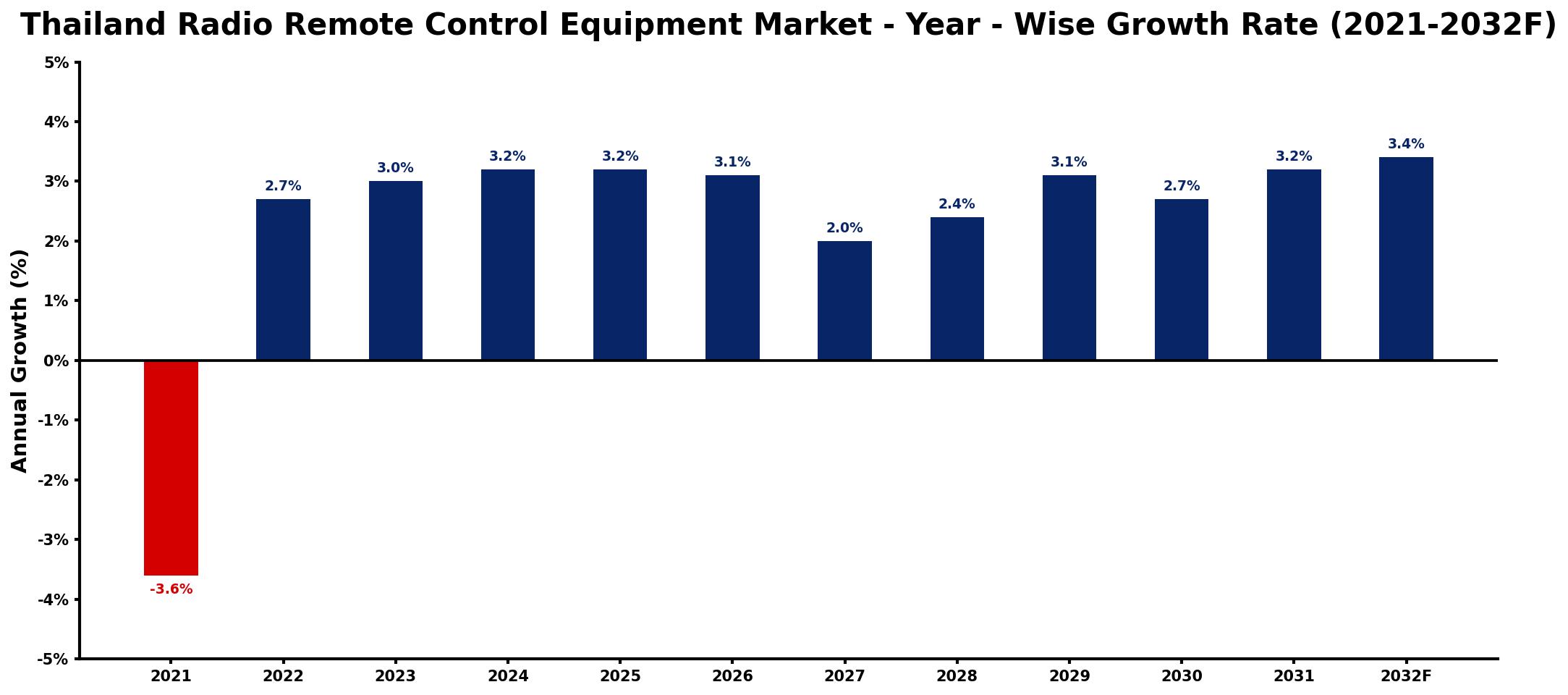
The table below presents the year‑wise growth rates along with the key drivers influencing the market
| Year | Growth Rate | Major Drivers |
| 2021 | -3.6% | decrease in consumer spending habits |
| 2022 | 2.7% | rise in technological investments |
| 2023 | 3.0% | expansion of wireless applications |
| 2024 | 3.2% | growth in automation sectors |
| 2025 | 3.2% | increase in IoT adoption rates |
| 2026 | 3.1% | development of smart home solutions |
| 2027 | 2.0% | emergence of new market players |
| 2028 | 2.4% | enhancement of connectivity infrastructure |
| 2029 | 3.1% | surge in outdoor recreational activities |
| 2030 | 2.7% | growing interest in hobbyist communities |
| 2031 | 3.2% | advancements in battery technology |
| 2032 | 3.4% | growing regional consumption patterns |
Note: Market size estimations and growth projections presented in this report are based on 6Wresearch's proprietary forecasting methodology, utilizing the latest available industry data, government publications, and primary research inputs.
Thailand Radio Remote Control Equipment Market Synopsis
A key force shaping the Thailand Radio Remote Control Equipment Market is the increasing integration of automation in industrial operations. This shift is significantly enhancing the demand for radio remote control devices, particularly in sectors such as manufacturing, logistics, and construction. As companies strive for operational efficiency and safety, the reliance on these systems is becoming paramount.
Moreover, the growing popularity of remote-controlled hobbies and toys among consumers contributes to market expansion. This trend is particularly pronounced in urban areas, where leisure activities using radio remote control equipment have gained substantial traction, further stimulating market dynamics.
Thailand Radio Remote Control Equipment Market Key Takeaways
- The market is experiencing steady growth driven by automation and robotics adoption.
- Remote control equipment enhances safety and efficiency in various industrial applications.
- Technological advancements are fostering innovation, including IoT connectivity features.
- The demand is anticipated to rebound post-COVID-19 as industries prioritize remote operations.
- Consumer interest in remote-controlled hobbies is becoming a significant market driver.
Evaluation of Restraints in Thailand Radio Remote Control Equipment Market
Despite the promising growth outlook, the Thailand Radio Remote Control Equipment Market faces several limitations. A significant challenge is the increasing competition from advanced wireless and IoT-based control solutions, which can potentially overshadow traditional remote control systems. Companies must invest in technological upgrades and feature enhancements to remain competitive. Additionally, the need for secure, interference-free operations necessitates ongoing improvements in product offerings, further straining resources and focus.
Thailand Radio Remote Control Equipment Market Trends
Current trends indicate a marked shift towards smart remote control technologies that incorporate IoT capabilities and remote monitoring. These innovations enable users to operate machinery from greater distances with enhanced oversight and operational safety. Furthermore, the integration of these technologies into various sectors is reshaping traditional operational frameworks, allowing for real-time data analysis and increased efficiency.
Thailand Radio Remote Control Equipment Market Opportunities
The future of the Thailand Radio Remote Control Equipment Market is rich with growth opportunities, particularly in sectors focused on automation and robotics. Investment in smart agriculture and construction solutions that require remote operation capabilities can unlock new revenue streams. Additionally, expanding the consumer electronics segment, particularly with innovative toy offerings, represents a significant opportunity for market players to diversify their product lines.
Government Initiatives in the Thailand Radio Remote Control Equipment Market
The Thai government is actively promoting initiatives to enhance the industrial landscape, particularly through the promotion of automation and robotics in manufacturing. Public spending in infrastructure projects includes a focus on integrating advanced remote control solutions, demonstrating a commitment to improving operational safety and efficiency. Various incentives for technology adoption may also emerge, providing a favorable environment for market growth.
Future Insights of the Thailand Radio Remote Control Equipment Market
Looking ahead to 2026-2032, the Thailand Radio Remote Control Equipment Market is poised for sustained growth, driven by the ongoing digital transformation across industries. The rising demand for automation will likely bolster the market as companies prioritize safety, efficiency, and remote operations. Additionally, as consumer preferences continue to evolve towards smarter technology solutions, manufacturers will need to focus on innovation to meet these changing demands.
Thailand Radio Remote Control Equipment Market Latest Developments (2025 - 2026)
Recent developments in the Thailand Radio Remote Control Equipment Market reflect a strategic pivot towards enhancing product offerings with IoT features. Companies have begun to unveil new products aimed at improving remote monitoring capabilities, effectively responding to the changing landscape post-COVID-19. There is an increasing emphasis on creating solutions that cater to the growing automation demands across various sectors.
Thailand Radio Remote Control Equipment Market - Key Attractiveness of the Report
- 10 Years of Market Numbers
- Historical Data Starting from 2022 to 2025
- Base Year: 2025
- Forecast Data until 2032
- Key Performance Indicators Impacting the Market
- Major Upcoming Developments and Projects
Key Highlights of the Report:
- Thailand Radio Remote Control Equipment Market Outlook
- Market Size of Thailand Radio Remote Control Equipment Market, 2025
- Forecast of Thailand Radio Remote Control Equipment Market, 2032
- Historical Data and Forecast of Thailand Radio Remote Control Equipment Revenues & Volume for the Period 2022-2032F
- Thailand Radio Remote Control Equipment Market Trend Evolution
- Thailand Radio Remote Control Equipment Market Drivers and Challenges
- Thailand Radio Remote Control Equipment Price Trends
- Thailand Radio Remote Control Equipment Porter's Five Forces
- Thailand Radio Remote Control Equipment Industry Life Cycle
- Historical Data and Forecast of Thailand Radio Remote Control Equipment Market Revenues & Volume By Type for the Period 2022-2032F
- Historical Data and Forecast of Thailand Radio Remote Control Equipment Market Revenues & Volume By Pushbutton for the Period 2022-2032F
- Historical Data and Forecast of Thailand Radio Remote Control Equipment Market Revenues & Volume By Joystick for the Period 2022-2032F
- Historical Data and Forecast of Thailand Radio Remote Control Equipment Market Revenues & Volume By Application for the Period 2022-2032F
- Historical Data and Forecast of Thailand Radio Remote Control Equipment Market Revenues & Volume By Industry & Logistics for the Period 2022-2032F
- Historical Data and Forecast of Thailand Radio Remote Control Equipment Market Revenues & Volume By Construction Crane for the Period 2022-2032F
- Historical Data and Forecast of Thailand Radio Remote Control Equipment Market Revenues & Volume By Mobile Hydraulics for the Period 2022-2032F
- Historical Data and Forecast of Thailand Radio Remote Control Equipment Market Revenues & Volume By Forestry for the Period 2022-2032F
- Historical Data and Forecast of Thailand Radio Remote Control Equipment Market Revenues & Volume By Mining for the Period 2022-2032F
- Historical Data and Forecast of Thailand Radio Remote Control Equipment Market Revenues & Volume By Others for the Period 2022-2032F
- Thailand Radio Remote Control Equipment Import Export Trade Statistics
- Market Opportunity Assessment By Type
- Market Opportunity Assessment By Application
- Thailand Radio Remote Control Equipment Top Companies Market Share
- Thailand Radio Remote Control Equipment Competitive Benchmarking By Technical and Operational Parameters
- Thailand Radio Remote Control Equipment Company Profiles
- Thailand Radio Remote Control Equipment Key Strategic Recommendations






































