Thailand Radioactive Waste Management Market Size, Share & Growth Rate
The Thailand Radioactive Waste Management Market was estimated at USD 248 Million in 2025 and is projected to reach USD 283 Million by 2032, growing at a CAGR of 1.9% from 2026 to 2032. This growth trajectory is primarily fueled by the increasing volume of radioactive waste generated from both nuclear power facilities and the expanding applications of radioactive materials in the healthcare sector. As Thailand fortifies its regulatory frameworks and invests in advanced disposal technologies, the market is set to evolve in alignment with these critical needs.
Thailand Radioactive Waste Management Market Year-wise Growth Rate and Key Drivers
This graph highlights how the Thailand Radioactive Waste Management Market has steadily grown over the years, supported by major growth factors.
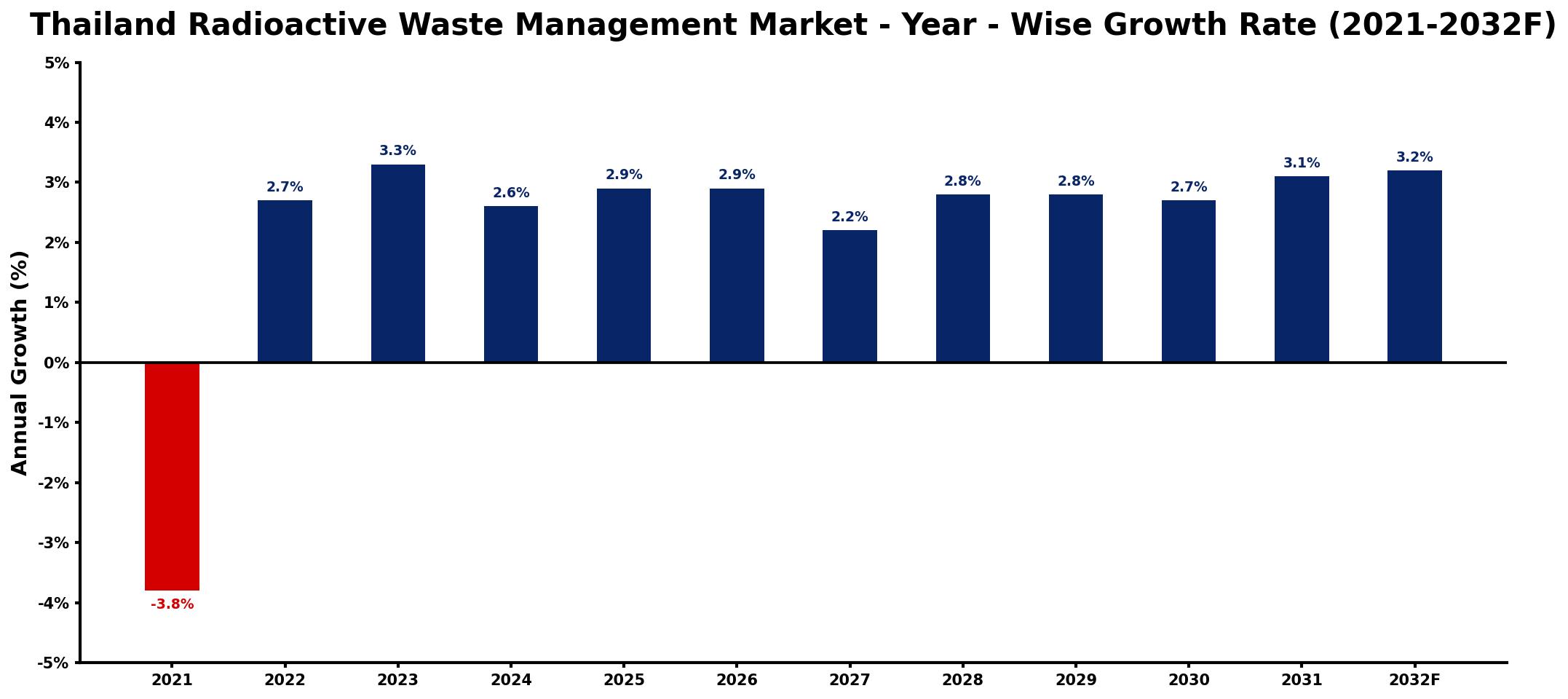
The table below presents the year‑wise growth rates along with the key drivers influencing the market
| Year | Growth Rate | Major Drivers |
| 2021 | -3.8% | decreased investment in infrastructure |
| 2022 | 2.7% | growing public safety awareness |
| 2023 | 3.3% | increased regulatory compliance initiatives |
| 2024 | 2.6% | expansion of industrial applications |
| 2025 | 2.9% | rising demand for energy solutions |
| 2026 | 2.9% | growth in environmental technologies |
| 2027 | 2.2% | increased overall sector activity |
| 2028 | 2.8% | increased collaboration among stakeholders |
| 2029 | 2.8% | development of sustainable practices |
| 2030 | 2.7% | growing international cooperation efforts |
| 2031 | 3.1% | increased production capacity utilization |
| 2032 | 3.2% | emerging technologies in processing |
Note: Market size estimations and growth projections presented in this report are based on 6Wresearch's proprietary forecasting methodology, utilizing the latest available industry data, government publications, and primary research inputs.
Thailand Radioactive Waste Management Market Synopsis
Recent advancements and regulatory initiatives in Thailand have spotlighted the importance of effective radioactive waste management. The countrys commitment to nuclear energy and medical applications necessitates a robust framework for managing waste safely and efficiently, underscoring the criticality of this sector.
With the rise in nuclear power production and medical technologies utilizing radioactive materials, Thailand is at a pivotal point in developing comprehensive management solutions. Establishing sustainable practices is vital not just for compliance, but also for addressing public concerns and ensuring environmental safety.
Thailand Radioactive Waste Management Market Key Takeaways
- Thailand's commitment to nuclear energy expansion is driving the need for advanced radioactive waste solutions.
- The healthcare sectors increased use of radioactive materials amplifies demand for effective waste management.
- Regulatory frameworks are evolving to ensure compliance with international safety standards.
- Public acceptance and environmental considerations are crucial factors influencing market dynamics.
- Investments in technology and infrastructure are essential to meet future waste management challenges.
Evaluation of Restraints in Thailand Radioactive Waste Management Market
Despite the markets growth potential, several restraints challenge its development. The establishment of safe storage and disposal facilities compliant with international standards poses significant hurdles. Public opposition, fueled by environmental concerns, often complicates the site selection process for waste management facilities. Moreover, ensuring the long-term integrity and security of storage sites is a pressing issue, as these locations must remain safe for thousands of years. The complex interplay between regulatory scrutiny and the need for public trust creates an intricate landscape for companies operating in this sector.
Thailand Radioactive Waste Management Market Trends
Emerging trends in the Thailand radioactive waste management market include the integration of advanced technologies such as remote monitoring and automated waste sorting systems. These innovations not only enhance operational efficiency but also improve safety protocols. Additionally, the increasing collaboration between government entities and private sectors aims to foster sustainable practices in waste handling, signaling a shift towards comprehensive solutions. The focus on public engagement and educational initiatives is also gaining traction, addressing community concerns and building trust in nuclear waste management efforts.
Thailand Radioactive Waste Management Market Opportunities
The sector presents substantial growth opportunities, particularly for companies specializing in cutting-edge waste management technologies. As Thailand develops new nuclear power facilities, demand for reliable waste disposal solutions will increase. Additionally, the healthcare industry's reliance on radioactive materials creates a continuous need for advanced waste management processes. Investments in training and development for professionals in this field will further bolster the market. Collaborations with international organizations can also provide access to best practices and innovative methodologies, enhancing the overall framework for waste management.
Government Initiatives in the Thailand Radioactive Waste Management Market
The Thai government is actively engaged in shaping the radioactive waste management landscape through policy development and regulatory oversight. Initiatives aimed at enhancing safety standards and promoting public awareness are at the forefront of government efforts. Public spending has been directed towards infrastructure improvements and technological advancements in waste management practices. Furthermore, collaborative programs with international bodies are being encouraged to facilitate knowledge exchange and best practices, ensuring that Thailand adheres to global standards in radioactive waste management.
Future Insights of the Thailand Radioactive Waste Management Market
Looking ahead to 2026-2032, the Thailand radioactive waste management market is poised for progressive transformation. The ongoing expansion of nuclear energy initiatives will necessitate a robust framework for waste disposal and management. Furthermore, as public awareness and regulatory pressures increase, companies will be required to adopt more sustainable and transparent practices. The integration of innovative technologies will likely become commonplace, enhancing efficiency and safety. Overall, the market's evolution will be driven by a combination of regulatory demands, public trust, and technological advancements, positioning it for steady growth.
Thailand Radioactive Waste Management Market Latest Developments (2025 - 2026)
In recent months, the Thailand radioactive waste management sector has witnessed significant developments aimed at bolstering safety and efficiency. New regulatory guidelines are being introduced to enhance compliance with international safety standards. Additionally, there is a marked increase in public-private partnerships focused on advancing waste management technologies. Furthermore, ongoing community engagement efforts are aimed at addressing public concerns and promoting transparency in radioactive waste handling practices, reflecting a commitment to responsible management.
Thailand Radioactive Waste Management Market - Key Attractiveness of the Report
- 10 Years of Market Numbers
- Historical Data Starting from 2022 to 2025
- Base Year: 2025
- Forecast Data until 2032
- Key Performance Indicators Impacting the Market
- Major Upcoming Developments and Projects
Key Highlights of the Report:
- Thailand Radioactive Waste Management Market Outlook
- Market Size of Thailand Radioactive Waste Management Market, 2025
- Forecast of Thailand Radioactive Waste Management Market, 2032
- Historical Data and Forecast of Thailand Radioactive Waste Management Revenues & Volume for the Period 2022-2032F
- Thailand Radioactive Waste Management Market Trend Evolution
- Thailand Radioactive Waste Management Market Drivers and Challenges
- Thailand Radioactive Waste Management Price Trends
- Thailand Radioactive Waste Management Porter's Five Forces
- Thailand Radioactive Waste Management Industry Life Cycle
- Historical Data and Forecast of Thailand Radioactive Waste Management Market Revenues & Volume By Type for the Period 2022-2032F
- Historical Data and Forecast of Thailand Radioactive Waste Management Market Revenues & Volume By Exempt Waste and Very Low-Level Waste(VLLW) for the Period 2022-2032F
- Historical Data and Forecast of Thailand Radioactive Waste Management Market Revenues & Volume By Low-Level Waste(LLW) for the Period 2022-2032F
- Historical Data and Forecast of Thailand Radioactive Waste Management Market Revenues & Volume By Intermediate-Level Waste(ILW) for the Period 2022-2032F
- Historical Data and Forecast of Thailand Radioactive Waste Management Market Revenues & Volume By High-Level Waste(HLW) for the Period 2022-2032F
- Historical Data and Forecast of Thailand Radioactive Waste Management Market Revenues & Volume By Application for the Period 2022-2032F
- Historical Data and Forecast of Thailand Radioactive Waste Management Market Revenues & Volume By Industrial for the Period 2022-2032F
- Historical Data and Forecast of Thailand Radioactive Waste Management Market Revenues & Volume By Utility for the Period 2022-2032F
- Thailand Radioactive Waste Management Import Export Trade Statistics
- Market Opportunity Assessment By Type
- Market Opportunity Assessment By Application
- Thailand Radioactive Waste Management Top Companies Market Share
- Thailand Radioactive Waste Management Competitive Benchmarking By Technical and Operational Parameters
- Thailand Radioactive Waste Management Company Profiles
- Thailand Radioactive Waste Management Key Strategic Recommendations






































