Thailand Recycled Plastics Market: Import Trend Analysis
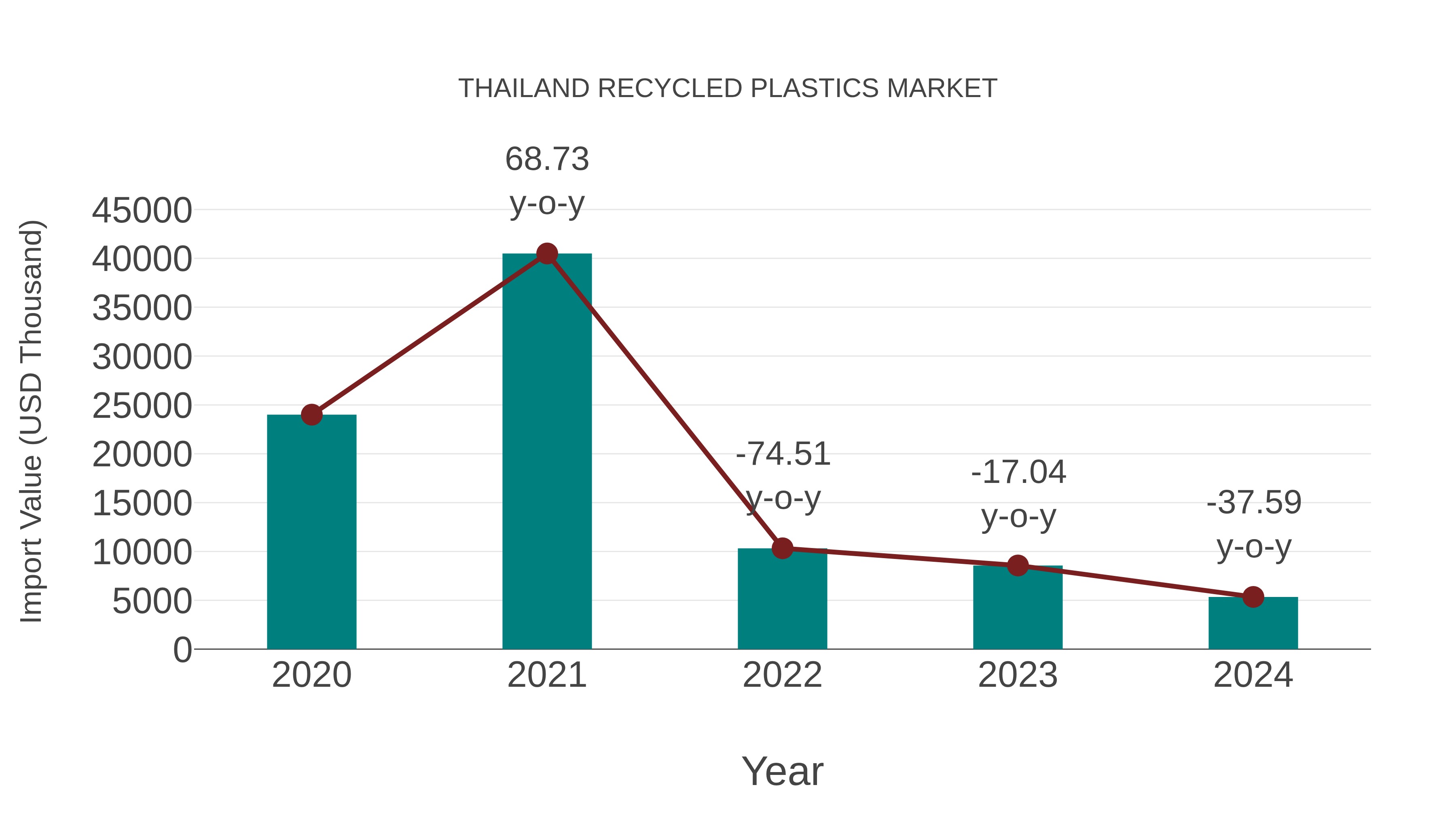
Thailand import trend for recycled plastics experienced a notable decline, with a growth rate of -37.59% from 2023 to 2024 and a CAGR of -31.31% from 2020 to 2024. This significant decrease could be attributed to shifting demand patterns or changes in trade policies impacting the market stability during this period.
Thailand Recycled Plastics Market Synopsis
The Thailand recycled plastics market is witnessing increasing attention due to growing environmental concerns and sustainable practices. As part of a global shift towards reducing plastic waste, Thailand is focusing on recycling and reusing plastic materials. Both government initiatives and private sector investments have contributed to the growth of this market. Recycled plastics are used in various industries, including packaging, construction, and automotive, as companies seek to reduce their environmental footprint and meet sustainability goals.
Drivers of the Market
The Thailand recycled plastics market is experiencing robust growth driven by several key drivers. Firstly, there is a growing awareness of environmental sustainability and the need to reduce plastic waste. As a result, both consumers and businesses are increasingly turning to recycled plastics as an eco-friendly alternative to virgin plastics. Government regulations and initiatives promoting plastic recycling and circular economy practices are further propelling market growth. Moreover, the demand for recycled plastics is increasing in various industries, including packaging, automotive, and construction, as companies seek to incorporate recycled materials into their products. The availability of advanced recycling technologies and processes also contributes to the market`s expansion.
Challenges of the Market
The Thailand recycled plastics market confronts various challenges in its quest for growth and sustainability. One major challenge is the inadequate collection and sorting infrastructure for plastic waste, leading to inconsistent and unreliable supply of raw materials for recycling. Additionally, the quality and purity of recycled plastics may not always meet the required standards, limiting their applications and market acceptance. Competition from low-cost virgin plastic production can also affect the pricing and market share of recycled plastics. Moreover, consumer awareness and adoption of eco-friendly practices are still developing, which can impede the market`s growth.
COVID-19 Impact on the Market
The Thailand recycled plastics market faced challenges during the pandemic as the recycling supply chain was disrupted, leading to reduced collection and processing of recyclable materials. However, there was a growing awareness of environmental issues, prompting businesses and consumers to prioritize recycled plastics. Government initiatives and regulations aimed at reducing plastic waste also supported the market`s recovery. Investments in advanced recycling technologies and sustainable packaging solutions became key trends.
Key Players in the Market
The recycled plastics market in Thailand has players like Thai Plastic Recycle Group Co., Ltd., which specializes in recycling and producing recycled plastic materials for various industries, promoting sustainability and environmental responsibility.
Key Highlights of the Report:
- Thailand Recycled Plastics Market Outlook
- Market Size of Thailand Recycled Plastics Market, 2025
- Forecast of Thailand Recycled Plastics Market, 2032
- Historical Data and Forecast of Thailand Recycled Plastics Revenues & Volume for the Period 2022-2032F
- Thailand Recycled Plastics Market Trend Evolution
- Thailand Recycled Plastics Market Drivers and Challenges
- Thailand Recycled Plastics Price Trends
- Thailand Recycled Plastics Porter's Five Forces
- Thailand Recycled Plastics Industry Life Cycle
- Historical Data and Forecast of Thailand Recycled Plastics Market Revenues & Volume By Plastic Type for the Period 2022-2032F
- Historical Data and Forecast of Thailand Recycled Plastics Market Revenues & Volume By Polyethylene Terephthalate (Pet) for the Period 2022-2032F
- Historical Data and Forecast of Thailand Recycled Plastics Market Revenues & Volume By High Density Polyethylene (Hdpe) for the Period 2022-2032F
- Historical Data and Forecast of Thailand Recycled Plastics Market Revenues & Volume By Polypropylene (Pp) for the Period 2022-2032F
- Historical Data and Forecast of Thailand Recycled Plastics Market Revenues & Volume By Low Density Polyethylene (Ldpe) for the Period 2022-2032F
- Historical Data and Forecast of Thailand Recycled Plastics Market Revenues & Volume By Others for the Period 2022-2032F
- Historical Data and Forecast of Thailand Recycled Plastics Market Revenues & Volume By Application for the Period 2022-2032F
- Historical Data and Forecast of Thailand Recycled Plastics Market Revenues & Volume By Non-food Contact Packaging for the Period 2022-2032F
- Historical Data and Forecast of Thailand Recycled Plastics Market Revenues & Volume By Food Contact Packaging for the Period 2022-2032F
- Historical Data and Forecast of Thailand Recycled Plastics Market Revenues & Volume By Construction for the Period 2022-2032F
- Historical Data and Forecast of Thailand Recycled Plastics Market Revenues & Volume By Automotive for the Period 2022-2032F
- Historical Data and Forecast of Thailand Recycled Plastics Market Revenues & Volume By Others for the Period 2022-2032F
- Historical Data and Forecast of Thailand Recycled Plastics Market Revenues & Volume By Raw Material for the Period 2022-2032F
- Historical Data and Forecast of Thailand Recycled Plastics Market Revenues & Volume By Plastic Bottles for the Period 2022-2032F
- Historical Data and Forecast of Thailand Recycled Plastics Market Revenues & Volume By Plastic Films for the Period 2022-2032F
- Historical Data and Forecast of Thailand Recycled Plastics Market Revenues & Volume By Rigid Plastic And Foam for the Period 2022-2032F
- Historical Data and Forecast of Thailand Recycled Plastics Market Revenues & Volume By Fibres for the Period 2022-2032F
- Historical Data and Forecast of Thailand Recycled Plastics Market Revenues & Volume By Others for the Period 2022-2032F
- Thailand Recycled Plastics Import Export Trade Statistics
- Market Opportunity Assessment By Plastic Type
- Market Opportunity Assessment By Application
- Market Opportunity Assessment By Raw Material
- Thailand Recycled Plastics Top Companies Market Share
- Thailand Recycled Plastics Competitive Benchmarking By Technical and Operational Parameters
- Thailand Recycled Plastics Company Profiles
- Thailand Recycled Plastics Key Strategic Recommendations






































