Thailand RegTech Market Size & Growth Rate (2026-2032)
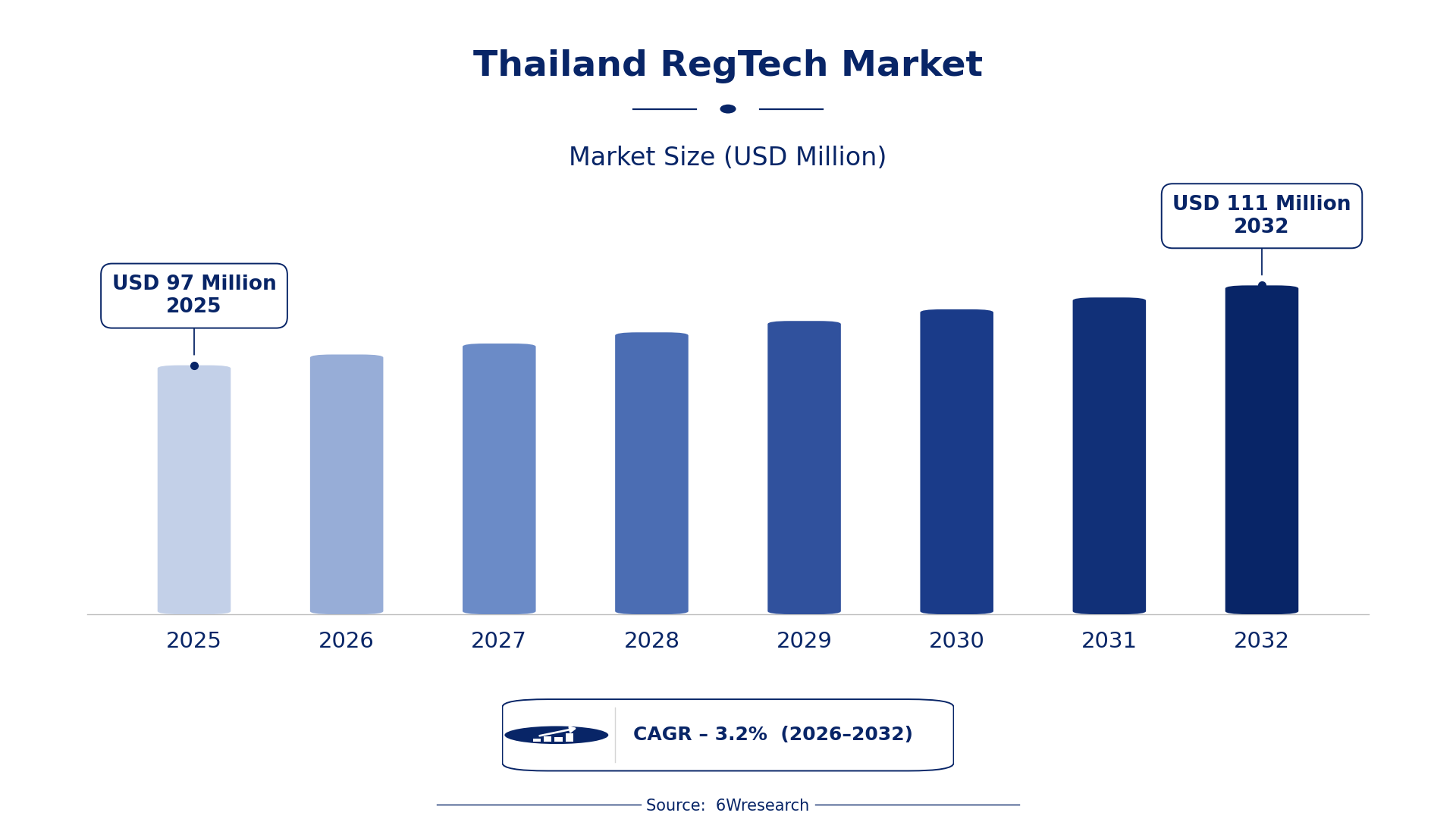
The Thailand RegTech Market was estimated at USD 97 Million in 2025 and is projected to reach USD 111 Million by 2032, growing at a CAGR of 3.2% from 2026 to 2032.
Thailand RegTech Market Synopsis
In Thailand, financial institutions are increasingly turning to RegTech solutions to meet the demands of a complex regulatory environment. These technologies not only enhance compliance efficiency but also help organizations manage risk more effectively through automation and advanced data analytics.
As the Thai financial sector strives for greater transparency and accountability, the demand for regulatory technology is on the rise. The urgency for real-time compliance solutions has never been higher, prompting a significant shift towards adopting innovative tools that facilitate regulatory adherence.
Thailand RegTech Market Year-wise Growth Rate and Key Drivers
This graph illustrates the annual growth rates of the Thailand RegTech Market from 2021 to 2032, highlighting a steady upward trajectory and projected expansion over the forecast period.
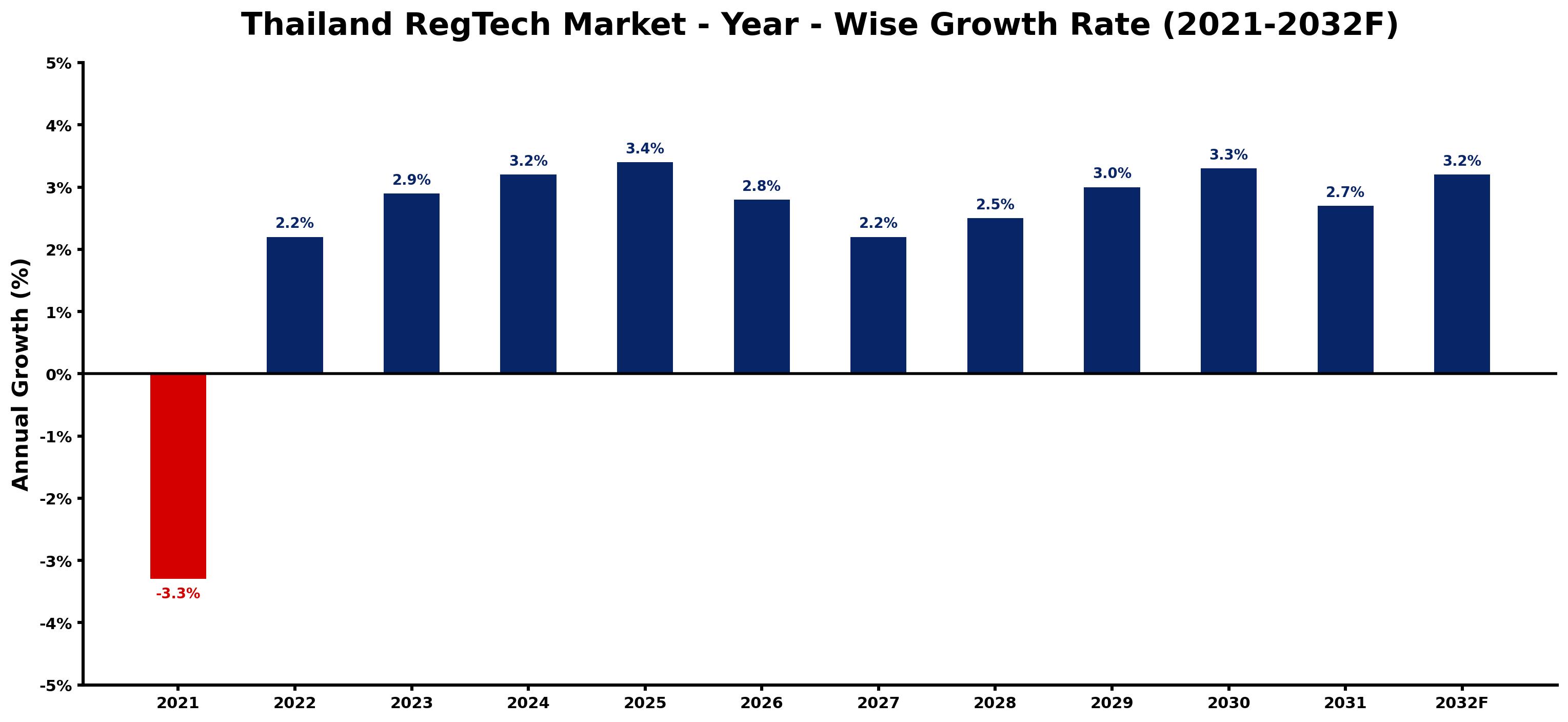
The table below presents the year‑wise growth rates along with the key drivers influencing the market
| Year | Growth Rate | Major Drivers |
| 2021 | -3.3% | Delayed regulations from the Thai Securities and Exchange Commission |
| 2022 | 2.2% | Implementation of Thailand's AML Act drives compliance solutions. |
| 2023 | 2.9% | Increased demand for KYC tools amid rising fintech growth. |
| 2024 | 3.2% | Enhanced regulatory scrutiny on digital transactions boosts innovation. |
| 2025 | 3.4% | Supportive government policies facilitate investment in RegTech startups. |
| 2026 | 2.8% | Collaboration between banks and tech firms accelerates solutions. |
| 2027 | 2.2% | Strong growth in e-commerce heightens need for fraud prevention. |
| 2028 | 2.5% | Local fintech events promote awareness of regulatory technologies. |
| 2029 | 3.0% | Digital transformation initiatives in banking increase RegTech adoption. |
| 2030 | 3.3% | Rise in cross-border transactions necessitates robust compliance frameworks. |
| 2031 | 2.7% | Government incentives for tech development foster a vibrant market. |
| 2032 | 3.2% | Evolving cybersecurity laws demand advanced compliance technologies. |
Note: Market size estimations and growth projections presented in this report are based on 6Wresearch's proprietary forecasting methodology, utilizing the latest available industry data, government publications, and primary research inputs.
Thailand RegTech Market Key Takeaways
Below are some of the specific key takeaways from the market, including:
- The Thailand RegTech Market is seeing increased demand due to evolving regulatory requirements.
- Automation and data analytics are critical components driving market growth.
- Financial institutions are focusing on technology to enhance compliance and risk management.
- Real-time compliance solutions remain a key challenge for organizations.
- The COVID-19 pandemic has accelerated the adoption of RegTech solutions in Thailand.
Evaluation of Restraints in Thailand RegTech Market
The Thailand RegTech market faces notable restraints that hinder its full potential. One of the primary challenges is the ever-changing regulatory landscape, which demands organizations stay agile and responsive. Many financial institutions struggle to adapt quickly to new regulations, risking non-compliance. Additionally, ensuring robust data management while maintaining security and privacy standards presents ongoing concerns. The delicate balance between meeting immediate compliance needs and implementing comprehensive regulatory frameworks complicates matters further.
Thailand RegTech Market Trends
Key trends are shaping the Thailand RegTech market, including a growing emphasis on automation. Financial institutions are increasingly adopting AI-driven solutions to streamline compliance processes. on top of that, the push for greater transparency is leading organizations to invest in technologies that enhance reporting capabilities. As remote work becomes the norm, RegTech tools are also evolving to support distributed teams while maintaining compliance integrity.
Thailand RegTech Market Opportunities
Investment opportunities are emerging as the demand for more sophisticated compliance solutions rises. Companies that can offer innovative RegTech platforms, particularly those focused on real-time compliance and risk management, stand to gain significantly. on top of that, partnerships between technology vendors and financial institutions present avenues for collaborative growth. As regulatory frameworks become more defined, businesses that can adapt swiftly to these changes will find themselves ahead of the curve.
Government Initiatives in the Thailand RegTech Market
The Thai government is actively shaping the RegTech market through various initiatives aimed at enhancing regulatory compliance and technological adoption. Policymakers recognize the importance of aligning financial regulations with technological advancements, making it a priority for the country’s financial sector. These efforts reflect a commitment to building a secure and efficient regulatory environment that supports both businesses and consumers.
- A national digital infrastructure upgrade programme launched in early 2025 aims to enhance connectivity and data sharing among financial institutions.
- Currently ongoing is a regulatory framework initiative that emphasizes the integration of AI technologies into compliance processes, set to roll out by the end of 2026.
- In 2024, a public-private partnership was formed to develop standards for data security in RegTech solutions, focusing on privacy and integrity.
- A planned initiative for 2027 seeks to establish a centralized compliance monitoring platform for financial institutions to streamline reporting and oversight.
Future Insights of the Thailand RegTech Market
Looking ahead to 2026-2032, the Thailand RegTech market is set to continue its trajectory of gradual growth. As financial institutions further embrace technology-driven solutions, the emphasis will shift toward developing integrated platforms that address a broader range of compliance needs. The convergence of regulatory requirements with technological innovation will foster an environment ripe for investment and collaboration, allowing businesses to stay ahead in a competitive landscape.
Thailand RegTech Market Latest Developments
In the past year, the Thailand RegTech market has witnessed a surge in activity, driven by the need for enhanced compliance solutions. Organizations have been increasingly focusing on adopting advanced technologies to streamline their regulatory processes. This momentum is expected to accelerate as businesses recognize the critical importance of agility in compliance.
- A major technology vendor launched an AI-powered compliance analytics tool in Q1 2025, aimed at helping organizations automate their reporting processes.
- In early 2025, a leading financial institution announced a partnership with a RegTech firm to enhance its risk management capabilities through advanced data analytics.
- Currently ongoing is a project that integrates blockchain technology into compliance frameworks, targeting completion by mid-2026.
- An upcoming initiative expected to kick off in late 2026 focuses on developing a comprehensive training program for financial professionals on RegTech tools and compliance strategies.
Thailand RegTech Market - Key Attractiveness of the Report
- 10 Years of Market Numbers
- Historical Data Starting from 2022 to 2025
- Base Year: 2025
- Forecast Data until 2032
- Key Performance Indicators Impacting the Market
- Major Upcoming Developments and Projects
Key Highlights of the Report:
- Thailand RegTech Market Outlook
- Market Size of Thailand RegTech Market, 2025
- Forecast of Thailand RegTech Market, 2032
- Historical Data and Forecast of Thailand RegTech Revenues & Volume for the Period 2022-2032F
- Thailand RegTech Market Trend Evolution
- Thailand RegTech Market Drivers and Challenges
- Thailand RegTech Price Trends
- Thailand RegTech Porter's Five Forces
- Thailand RegTech Industry Life Cycle
- Historical Data and Forecast of Thailand RegTech Market Revenues & Volume By Component for the Period 2022-2032F
- Historical Data and Forecast of Thailand RegTech Market Revenues & Volume By Solutions for the Period 2022-2032F
- Historical Data and Forecast of Thailand RegTech Market Revenues & Volume By Services for the Period 2022-2032F
- Historical Data and Forecast of Thailand RegTech Market Revenues & Volume By Application for the Period 2022-2032F
- Historical Data and Forecast of Thailand RegTech Market Revenues & Volume By Risk & Compliance Management for the Period 2022-2032F
- Historical Data and Forecast of Thailand RegTech Market Revenues & Volume By Identity Management for the Period 2022-2032F
- Historical Data and Forecast of Thailand RegTech Market Revenues & Volume By Regulatory Reporting for the Period 2022-2032F
- Historical Data and Forecast of Thailand RegTech Market Revenues & Volume By AML and Fraud Management for the Period 2022-2032F
- Historical Data and Forecast of Thailand RegTech Market Revenues & Volume By Regulatory Intelligence for the Period 2022-2032F
- Historical Data and Forecast of Thailand RegTech Market Revenues & Volume By Organization Size for the Period 2022-2032F
- Historical Data and Forecast of Thailand RegTech Market Revenues & Volume By SMEs for the Period 2022-2032F
- Historical Data and Forecast of Thailand RegTech Market Revenues & Volume By Large Enterprises for the Period 2022-2032F
- Historical Data and Forecast of Thailand RegTech Market Revenues & Volume By Deployment Mode for the Period 2022-2032F
- Historical Data and Forecast of Thailand RegTech Market Revenues & Volume By On-Premises for the Period 2022-2032F
- Historical Data and Forecast of Thailand RegTech Market Revenues & Volume By Cloud for the Period 2022-2032F
- Historical Data and Forecast of Thailand RegTech Market Revenues & Volume By Vertical for the Period 2022-2032F
- Historical Data and Forecast of Thailand RegTech Market Revenues & Volume By Banking for the Period 2022-2032F
- Historical Data and Forecast of Thailand RegTech Market Revenues & Volume By Insurance for the Period 2022-2032F
- Historical Data and Forecast of Thailand RegTech Market Revenues & Volume By Non-Financial for the Period 2022-2032F
- Thailand RegTech Import Export Trade Statistics
- Market Opportunity Assessment By Component
- Market Opportunity Assessment By Application
- Market Opportunity Assessment By Organization Size
- Market Opportunity Assessment By Deployment Mode
- Market Opportunity Assessment By Vertical
- Thailand RegTech Top Companies Market Share
- Thailand RegTech Competitive Benchmarking By Technical and Operational Parameters
- Thailand RegTech Company Profiles
- Thailand RegTech Key Strategic Recommendations






































