Thailand Retail and Wholesale Market: Import Trend Analysis
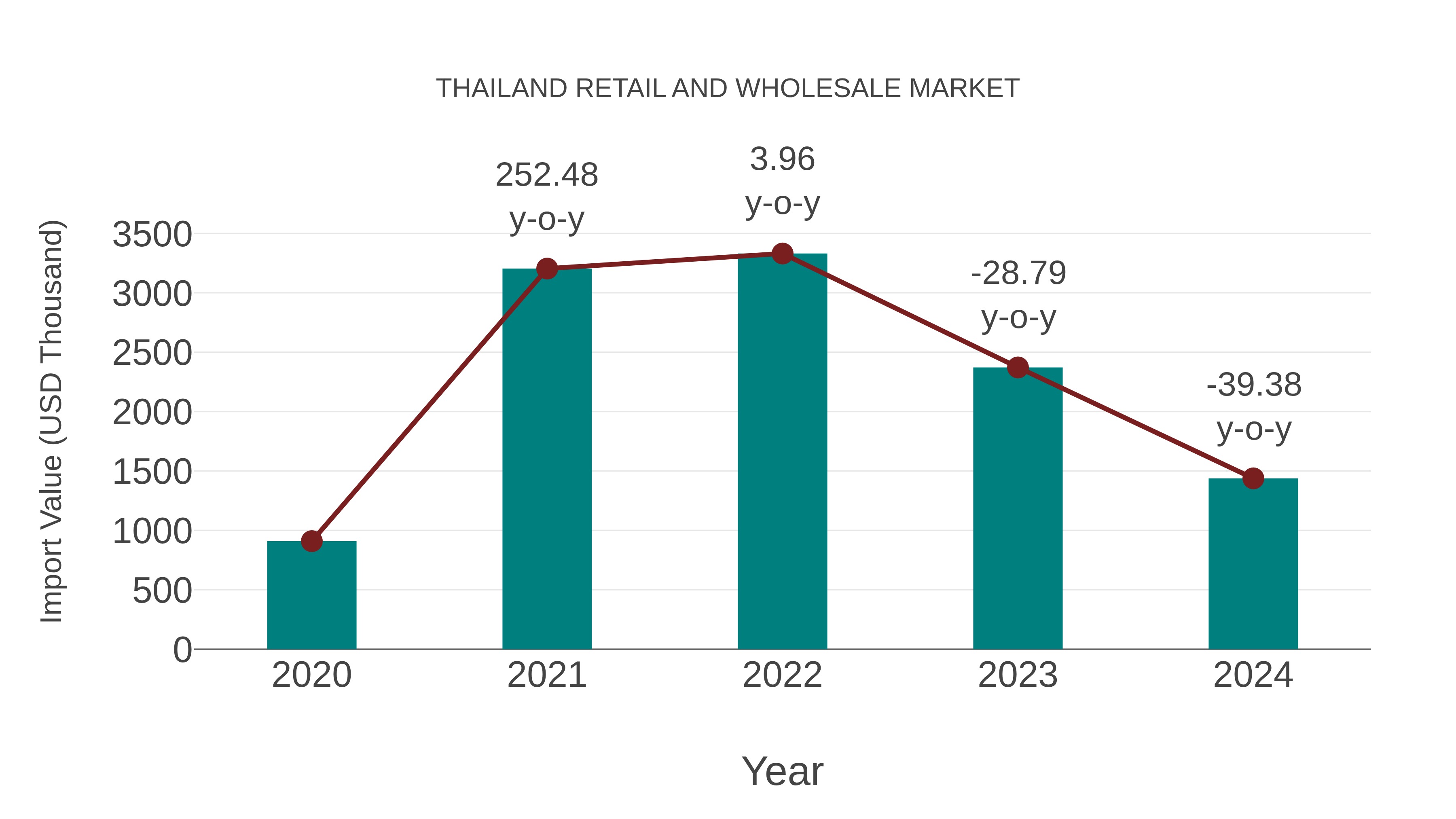
Thailand import trend in the retail and wholesale market experienced a notable decline from 2023 to 2024, with a negative growth rate of -39.38%. However, the compound annual growth rate (CAGR) for the period from 2020 to 2024 stood at 12.15%. This sharp decline in import momentum can be attributed to shifting demand patterns or changes in trade policies impacting market stability.
Thailand Retail and Wholesale Market Synopsis
Thailand retail and wholesale market is a dynamic and rapidly evolving sector. With a growing middle class and urbanization, consumer preferences have shifted towards modern retail formats, including shopping malls and online stores. Traditional markets, however, still hold significance, offering a wide variety of local products and cultural experiences. E-commerce has witnessed substantial growth, with both domestic and international players vying for market share. This competitive landscape has led to innovations in supply chain management, payment solutions, and customer experiences, making Thailand retail and wholesale market vibrant and highly adaptable.
Drivers of the Market
The retail and wholesale market in Thailand is driven by a combination of factors, including a steadily growing middle class, urbanization, and changing consumer preferences. Thailand expanding economy has increased consumer spending power, driving demand for a wide range of products and services. E-commerce and digital platforms have also played a pivotal role in the sector`s growth, offering convenience and access to a broader customer base. Government policies aimed at promoting trade and commerce further stimulate the retail and wholesale sector.
Challenges of the Market
The Thailand retail and wholesale market encounters several challenges, primarily driven by changing consumer behavior and competition from e-commerce. Traditional retailers must adapt to the digital age and invest in online presence and logistics to stay relevant. They also face the challenge of managing inventory efficiently to minimize waste and losses. Additionally, competition from international retailers and marketplaces can put pressure on local businesses. Moreover, fluctuating economic conditions and consumer purchasing power can impact demand. Lastly, the retail sector needs to address sustainability concerns, including reducing plastic usage and adopting eco-friendly practices.
COVID-19 Impact on the Market
The Thailand retail and wholesale market witnessed significant changes in consumer behavior during the COVID-19 pandemic. Physical retail stores faced challenges due to restrictions and reduced foot traffic, leading to a shift towards online shopping. E-commerce platforms and retailers offering home delivery services saw substantial growth, while traditional brick-and-mortar retailers adapted by enhancing their online presence.
Key Players in the Market
Retail and wholesale businesses in Thailand are diverse, with prominent players like CP All Public Company Limited and Central Retail Corporation Public Company Limited.
Key Highlights of the Report:
- Thailand Retail And Wholesale Market Outlook
- Market Size of Thailand Retail And Wholesale Market, 2025
- Forecast of Thailand Retail And Wholesale Market, 2032
- Historical Data and Forecast of Thailand Retail And Wholesale Revenues & Volume for the Period 2022-2032F
- Thailand Retail And Wholesale Market Trend Evolution
- Thailand Retail And Wholesale Market Drivers and Challenges
- Thailand Retail And Wholesale Price Trends
- Thailand Retail And Wholesale Porter's Five Forces
- Thailand Retail And Wholesale Industry Life Cycle
- Historical Data and Forecast of Thailand Retail And Wholesale Market Revenues & Volume By Type for the Period 2022-2032F
- Historical Data and Forecast of Thailand Retail And Wholesale Market Revenues & Volume By Retail for the Period 2022-2032F
- Historical Data and Forecast of Thailand Retail And Wholesale Market Revenues & Volume By Wholesale for the Period 2022-2032F
- Historical Data and Forecast of Thailand Retail And Wholesale Market Revenues & Volume By Ownership for the Period 2022-2032F
- Historical Data and Forecast of Thailand Retail And Wholesale Market Revenues & Volume By Retail Chain/Wholesale Chain for the Period 2022-2032F
- Historical Data and Forecast of Thailand Retail And Wholesale Market Revenues & Volume By Independent Retailer/Independent Wholesalers for the Period 2022-2032F
- Historical Data and Forecast of Thailand Retail And Wholesale Market Revenues & Volume By Price Range for the Period 2022-2032F
- Historical Data and Forecast of Thailand Retail And Wholesale Market Revenues & Volume By Premium for the Period 2022-2032F
- Historical Data and Forecast of Thailand Retail And Wholesale Market Revenues & Volume By Mid-Range for the Period 2022-2032F
- Historical Data and Forecast of Thailand Retail And Wholesale Market Revenues & Volume By Economy for the Period 2022-2032F
- Historical Data and Forecast of Thailand Retail And Wholesale Market Revenues & Volume By Distribution Channel for the Period 2022-2032F
- Historical Data and Forecast of Thailand Retail And Wholesale Market Revenues & Volume By Supermarkets/Hypermarkets for the Period 2022-2032F
- Historical Data and Forecast of Thailand Retail And Wholesale Market Revenues & Volume By Convenience Stores for the Period 2022-2032F
- Historical Data and Forecast of Thailand Retail And Wholesale Market Revenues & Volume By Department Stores for the Period 2022-2032F
- Historical Data and Forecast of Thailand Retail And Wholesale Market Revenues & Volume By Specialty Stores for the Period 2022-2032F
- Thailand Retail And Wholesale Import Export Trade Statistics
- Market Opportunity Assessment By Type
- Market Opportunity Assessment By Ownership
- Market Opportunity Assessment By Price Range
- Market Opportunity Assessment By Distribution Channel
- Thailand Retail And Wholesale Top Companies Market Share
- Thailand Retail And Wholesale Competitive Benchmarking By Technical and Operational Parameters
- Thailand Retail And Wholesale Company Profiles
- Thailand Retail And Wholesale Key Strategic Recommendations






































