Thailand Retail Industry Market Size, Share & Growth Rate
The Thailand Retail Industry Market was estimated at USD 312 Million in 2025 and is projected to reach USD 414 Million by 2032, growing at a CAGR of 4.1% from 2026 to 2032. This growth is driven by a burgeoning middle class with increasing disposable incomes, facilitating a shift towards premium products and services. Additionally, the rapid expansion of e-commerce and digital retail solutions is redefining consumer engagement, allowing retailers to reach a broader audience than ever before.
Thailand Retail Industry Market Year-wise Growth Rate and Key Drivers
This graph highlights how the Thailand Retail Industry Market has steadily grown over the years, supported by major growth factors.
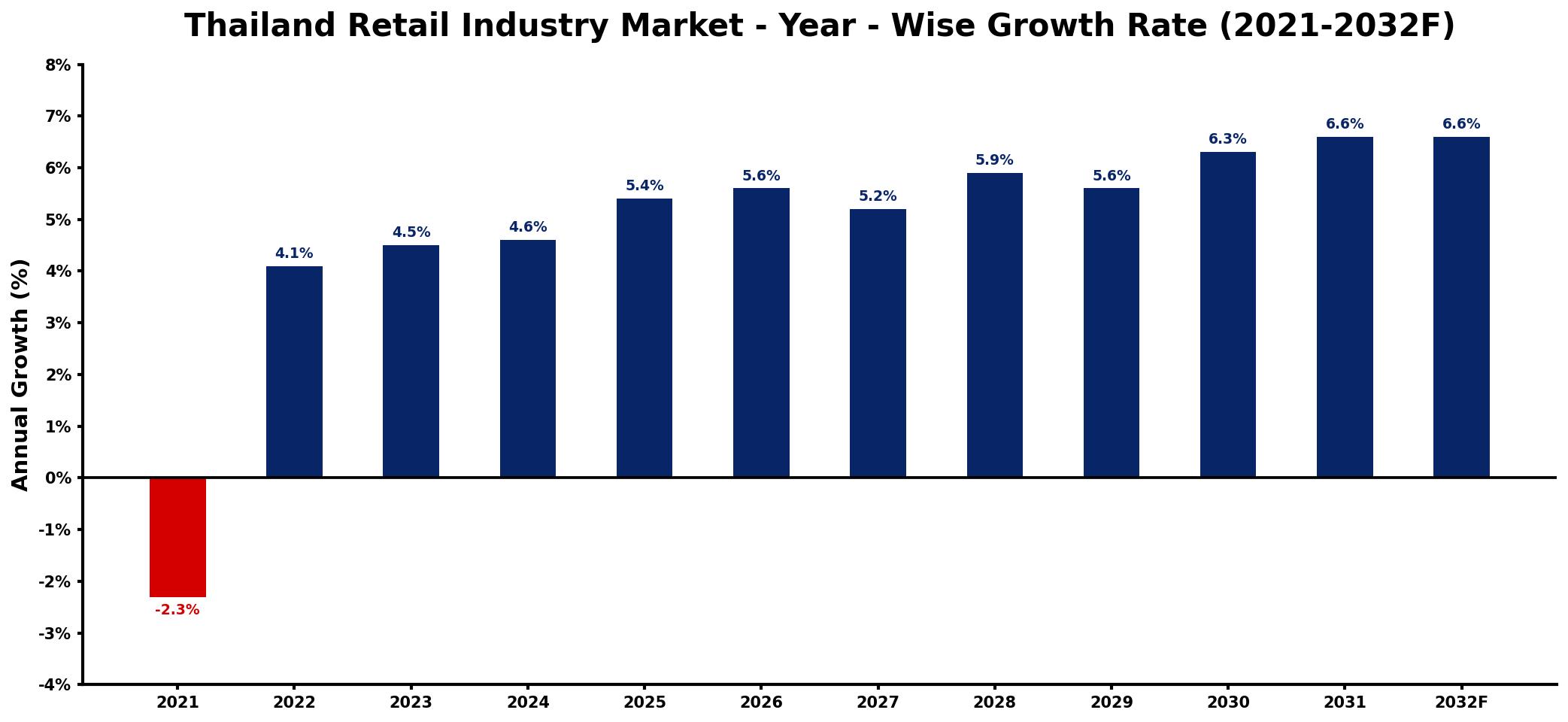
The table below presents the year‑wise growth rates along with the key drivers influencing the market
| Year | Growth Rate | Major Drivers |
| 2021 | -2.3% | decrease in consumer spending habits |
| 2022 | 4.1% | rise in disposable income levels |
| 2023 | 4.5% | increased digital shopping adoption |
| 2024 | 4.6% | growth in e-commerce platforms |
| 2025 | 5.4% | expansion of local brands presence |
| 2026 | 5.6% | investments in logistics infrastructure |
| 2027 | 5.2% | enhanced customer experience initiatives |
| 2028 | 5.9% | proliferation of mobile payment solutions |
| 2029 | 5.6% | strengthening of sustainability practices |
| 2030 | 6.3% | emphasis on health-conscious offerings |
| 2031 | 6.6% | diversification of product categories |
| 2032 | 6.6% | advancement in personalized marketing |
Note: Market size estimations and growth projections presented in this report are based on 6Wresearch's proprietary forecasting methodology, utilizing the latest available industry data, government publications, and primary research inputs.
Thailand Retail Industry Market Synopsis
Thailand's retail market is witnessing a notable shift towards digital platforms, with e-commerce steadily gaining market share over traditional retail formats. This transformation is characterized by increasing consumer demand for convenience, variety, and accessibility, compelling retailers to innovate their service delivery.
The sector is further bolstered by Thailand's reputation as a regional shopping hub, attracting tourists and local shoppers alike. Retailers are adapting to local preferences by incorporating both online and offline strategies, thus enhancing the overall shopping experience while navigating the complexities of a rapidly evolving market landscape.
Thailand Retail Industry Market Key Takeaways
- The retail industry is a crucial driver of Thailand's economic growth, supported by a rising middle class.
- Omnichannel retailing is becoming a necessity for traditional retailers to remain competitive.
- E-commerce growth is reshaping consumer behavior, leading to increased online spending.
- Government initiatives to boost domestic consumption are benefiting the retail sector.
- Retailers are increasingly leveraging technology to enhance customer experiences and streamline operations.
Evaluation of Restraints in Thailand Retail Industry Market
Despite its growth, the Thailand retail industry faces significant restraints. The surge in e-commerce has drastically changed shopping behaviors, leading traditional brick-and-mortar stores to contend with escalating competition and the need for significant investments in online infrastructures. Furthermore, the retail sector grapples with fluctuating consumer confidence due to broader economic uncertainties, influencing spending behaviors. Compliance with complex regulations, including foreign ownership restrictions, adds another layer of challenge for retailers striving to navigate the market effectively.
Thailand Retail Industry Market Trends
Several trends are shaping the Thailand retail landscape, notably the rise of personalized shopping experiences through data-driven marketing. Retailers are increasingly utilizing artificial intelligence to understand consumer preferences, thereby tailoring offerings and enhancing customer engagement. Additionally, sustainability is emerging as a key focus, with consumers gravitating towards brands that demonstrate environmental responsibility and ethical practices. The growing use of mobile payment systems also reflects a shift toward more seamless transaction methods, catering to the tech-savvy shopper.
Thailand Retail Industry Market Opportunities
The ongoing digital transformation presents significant growth opportunities within the Thailand retail market. Retailers that successfully harness emerging technologies—such as augmented reality and artificial intelligence—can elevate customer experiences and improve operational efficiencies. Furthermore, targeting the affluent segments of the growing middle class with premium product offerings can capitalize on the rising demand for quality and variety. Investments in logistics and supply chain enhancements will also be crucial to maintaining competitiveness in an increasingly omnichannel retail environment.
Government Initiatives in the Thailand Retail Industry Market
The Thai government is actively implementing initiatives aimed at fostering domestic consumption and supporting the retail sector. Policies to enhance tourism, such as simplified visa regulations for international travelers, bolster retail spending. Public investments in infrastructure improvements facilitate better logistics and distribution networks, crucial for retailers. Additionally, government support for digitalization efforts in retail helps businesses adapt to evolving consumer behaviors, thus strengthening the overall market framework.
Future Insights of the Thailand Retail Industry Market
Looking ahead to 2026-2032, the Thailand retail industry is poised for continued growth, driven by a combination of economic recovery and technological integration. As digital channels gain further traction, retailers will increasingly focus on building robust online presence while enhancing in-store experiences. The emphasis on sustainability and ethical consumption will shape product offerings and brand loyalty. Ultimately, the ability to adapt to shifting consumer preferences and leverage data analytics will determine the success of retail players in this dynamic market.
Thailand Retail Industry Market Latest Developments (2025 - 2026)
Recent developments in the Thailand retail industry indicate a marked shift towards digital solutions as companies seek to regain footing post-pandemic. A number of retailers are expanding their online platforms, investing in logistics, and enhancing customer service features to meet the demands of a diverse consumer base. Meanwhile, the integration of advanced technologies like AI and machine learning is becoming commonplace in inventory management and consumer analysis, further modernizing the retail landscape.
Thailand Retail Industry Market - Key Attractiveness of the Report
- 10 Years of Market Numbers
- Historical Data Starting from 2022 to 2025
- Base Year: 2025
- Forecast Data until 2032
- Key Performance Indicators Impacting the Market
- Major Upcoming Developments and Projects
Key Highlights of the Report:
- Thailand Retail Industry Market Outlook
- Market Size of Thailand Retail Industry Market, 2025
- Forecast of Thailand Retail Industry Market, 2032
- Historical Data and Forecast of Thailand Retail Industry Revenues & Volume for the Period 2022-2032F
- Thailand Retail Industry Market Trend Evolution
- Thailand Retail Industry Market Drivers and Challenges
- Thailand Retail Industry Price Trends
- Thailand Retail Industry Porter's Five Forces
- Thailand Retail Industry Industry Life Cycle
- Historical Data and Forecast of Thailand Retail Industry Market Revenues & Volume By Product for the Period 2022-2032F
- Historical Data and Forecast of Thailand Retail Industry Market Revenues & Volume By Food and Beverages for the Period 2022-2032F
- Historical Data and Forecast of Thailand Retail Industry Market Revenues & Volume By Personal and Household Care for the Period 2022-2032F
- Historical Data and Forecast of Thailand Retail Industry Market Revenues & Volume By Apparel, Footwear, and Accessories for the Period 2022-2032F
- Historical Data and Forecast of Thailand Retail Industry Market Revenues & Volume By Furniture, Toys, and Hobby for the Period 2022-2032F
- Historical Data and Forecast of Thailand Retail Industry Market Revenues & Volume By Electronic and Household Appliances for the Period 2022-2032F
- Historical Data and Forecast of Thailand Retail Industry Market Revenues & Volume By Other Products for the Period 2022-2032F
- Historical Data and Forecast of Thailand Retail Industry Market Revenues & Volume By Distribution Channel for the Period 2022-2032F
- Historical Data and Forecast of Thailand Retail Industry Market Revenues & Volume By Supermarkets/Hypermarkets for the Period 2022-2032F
- Historical Data and Forecast of Thailand Retail Industry Market Revenues & Volume By Convenience Stores for the Period 2022-2032F
- Historical Data and Forecast of Thailand Retail Industry Market Revenues & Volume By Department Stores for the Period 2022-2032F
- Historical Data and Forecast of Thailand Retail Industry Market Revenues & Volume By Specialty Stores for the Period 2022-2032F
- Historical Data and Forecast of Thailand Retail Industry Market Revenues & Volume By Online for the Period 2022-2032F
- Historical Data and Forecast of Thailand Retail Industry Market Revenues & Volume By Other Distribution Channels for the Period 2022-2032F
- Thailand Retail Industry Import Export Trade Statistics
- Market Opportunity Assessment By Product
- Market Opportunity Assessment By Distribution Channel
- Thailand Retail Industry Top Companies Market Share
- Thailand Retail Industry Competitive Benchmarking By Technical and Operational Parameters
- Thailand Retail Industry Company Profiles
- Thailand Retail Industry Key Strategic Recommendations






































