Thailand Sanitary Paper Market Summary
The thailand sanitary paper market was estimated at USD 81 Million in 2025 and is projected to reach USD 92 Million by 2032, growing at a CAGR of 3.1% from 2026 to 2032.
Thailand Sanitary Paper Market Year-wise Growth Rate and Key Drivers
This graph highlights how the Thailand Sanitary Paper Market has steadily grown over the past five years, supported by major growth factors.
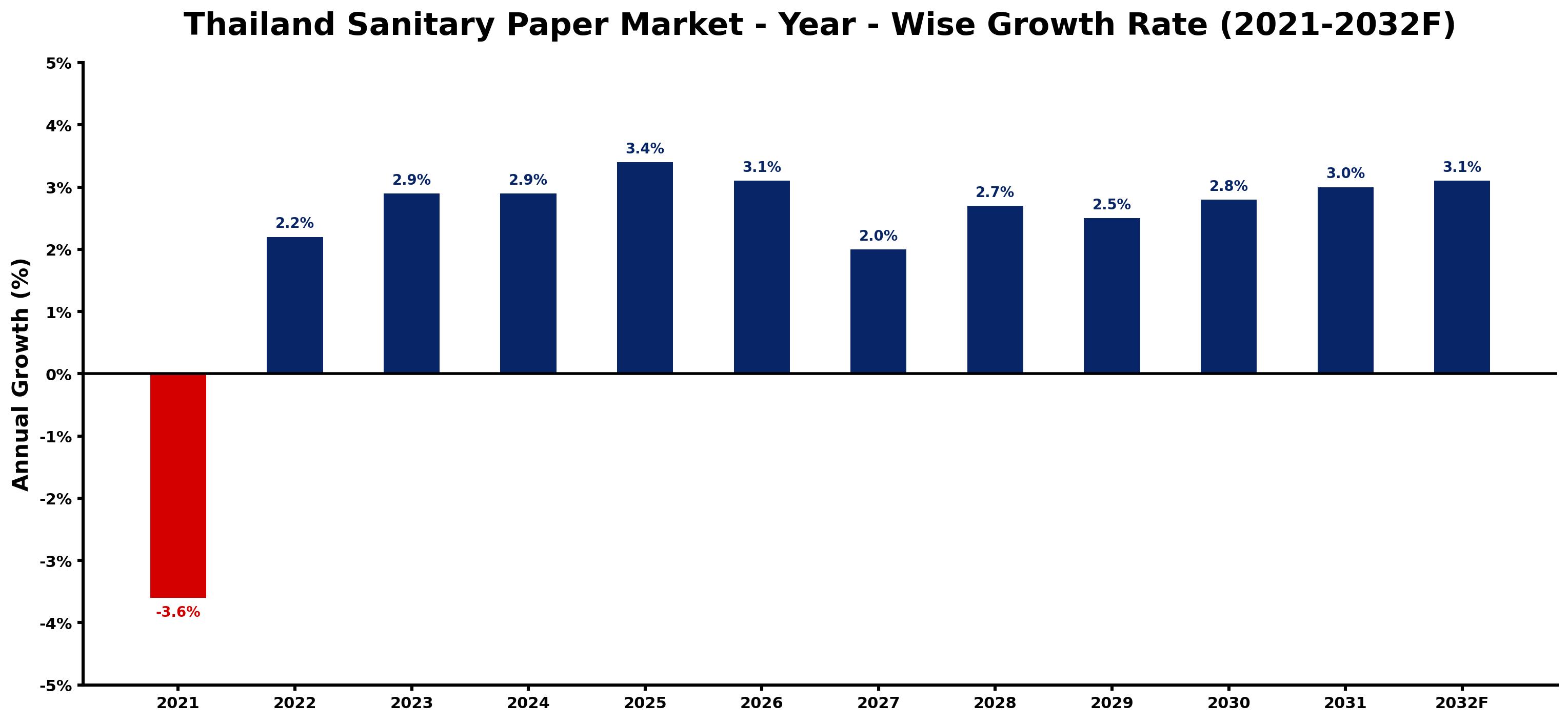
The table below presents the year wise growth rates along with the key drivers influencing the market
| Year | Growth Rate | Major Drivers |
| 2021 | -3.6% | Continuous supply chain disruptions due to the pandemic hindered product availability and dampened consumer purchases. |
| 2022 | 2.2% | Local manufacturers expanded distribution channels, enhancing accessibility across diverse retail outlets. |
| 2023 | 2.9% | Increased urbanization led to higher demand for sanitary products in metropolitan areas. |
| 2024 | 2.9% | Consumer awareness around eco-friendly products spurred interest in sustainable sanitary paper options. |
| 2025 | 3.4% | Innovative packaging solutions attracted a younger demographic seeking trendy, sustainable products. |
| 2026 | 3.1% | E-commerce platforms gained traction, making sanitary paper more accessible to rural consumers. |
| 2027 | 2.0% | Local brands emphasized affordability, challenging international players to compete effectively in pricing. |
| 2028 | 2.7% | Emerging trends in personal care encouraged product diversification within the sanitary paper segment. |
| 2029 | 2.5% | Investments in marketing campaigns focused on health benefits distinguished brands in a crowded market. |
| 2030 | 2.8% | Partnerships with local retailers enhanced market penetration in underrepresented regions across Thailand. |
| 2031 | 3.0% | Rising disposable incomes enabled consumers to prioritize premium sanitary paper products over basics. |
| 2032 | 3.1% | Technological advancements in production processes lowered costs, improving margins for manufacturers. |
Note - Market size estimations and growth projections presented in this report are based on 6Wresearch's advanced forecasting approach, validated with industry datasets as of June 2026.
Thailand Sanitary Paper Market Synopsis
The Thailand Sanitary Paper Market is projected to reach 3.1% and witness significant growth during the forecast period (2026-2032). This growth is largely fueled by heightened consumer awareness regarding personal hygiene, which spans urban and rural demographics, coupled with a rise in disposable incomes among the expanding middle class across the nation.
Thailand Sanitary Paper Market Growth Drivers
Several factors contribute to the growth trajectory of the Thailand Sanitary Paper Market. These include:
- Increased awareness of personal hygiene and cleanliness is driving consumers to invest in quality sanitary paper products, including toilet tissue and facial tissues.
- The rise in disposable income has enabled middle-class households to spend more on household essentials, significantly impacting the demand for sanitary paper items.
- The growth of the retail sector, particularly modern retail formats and e-commerce platforms, has improved product accessibility for consumers across various regions.
- Health consciousness among consumers has prompted a preference for high-quality sanitary paper products, including options such as ultra-soft and quilted varieties.
- Demand from hospitality sectors, including hotels and restaurants in major urban areas, is further propelling market growth, as these establishments seek premium sanitary paper products to enhance customer experience.
Thailand Sanitary Paper Market Challenges and Restraints
Despite the positive growth outlook, the Thailand Sanitary Paper Market faces several challenges:
- High raw material costs can lead to increased production expenses, potentially making products unaffordable for lower-income consumers and negatively impacting overall sales volume.
- Fluctuating currency exchange rates may adversely affect profit margins since many raw materials are imported, leading to unpredictability in cost structure.
- The lingering effects of the Covid-19 pandemic have introduced disruptions within the supply chain, temporarily hindering production rates and affecting sales revenue.
- Economic uncertainties influenced by global fluctuations can impact consumer spending, particularly on non-essential items, which includes certain sanitary paper products.
- The presence of counterfeit and low-quality products in the market can undermine consumer confidence and disrupt market dynamics.
Thailand Sanitary Paper Market Government Investment and Initiatives
The Thai government has taken proactive steps to support the sanitary paper market through various initiatives and policies aimed at enhancing public health and hygiene standards. These initiatives typically include:
- Public health campaigns focusing on personal hygiene education, which encourage increased consumption of sanitary paper products.
- Investment in infrastructure improvements within the retail sector to facilitate better distribution and availability of sanitary products.
- Grants and incentives for local manufacturers to promote the production of high-quality sanitary paper, thereby supporting domestic industries.
- Regulatory frameworks ensuring product quality standards, which aim to eliminate low-quality imports and support consumer safety.
- Collaboration with healthcare organizations to foster awareness around the importance of hygiene, thereby indirectly boosting market demand for sanitary paper products.
Thailand Sanitary Paper Market Latest Developments (May 2025 - June 2026)
Recent developments in the Thailand Sanitary Paper Market indicate a gradual recovery and adaptation to post-pandemic dynamics. Companies are increasingly focusing on innovation, including sustainable production methods and eco-friendly materials aimed at meeting consumer demand for environmentally conscious products.
There has also been an uptick in partnerships between manufacturers and e-commerce platforms, facilitating improved market penetration and access to sanitary paper products. These trends reflect a significant shift in consumer buying behavior, prioritizing quality and convenience. Additionally, companies are investing in marketing strategies to emphasize the health benefits associated with the use of quality sanitary products, thus aligning with the heightened health consciousness among consumers.
Thailand Sanitary Paper Market - Key Attractiveness of the Report
- 10 Years of Market Numbers
- Historical Data Starting from 2022 to 2025
- Base Year: 2025
- Forecast Data until 2032
- Key Performance Indicators Impacting the Market
- Major Upcoming Developments and Projects
Key Highlights of the Report:
- Thailand Sanitary Paper Market Outlook
- Market Size of Thailand Sanitary Paper Market, 2025
- Forecast of Thailand Sanitary Paper Market, 2032
- Historical Data and Forecast of Thailand Sanitary Paper Revenues & Volume for the Period 2022-2032F
- Thailand Sanitary Paper Market Trend Evolution
- Thailand Sanitary Paper Market Drivers and Challenges
- Thailand Sanitary Paper Price Trends
- Thailand Sanitary Paper Porter's Five Forces
- Thailand Sanitary Paper Industry Life Cycle
- Historical Data and Forecast of Thailand Sanitary Paper Market Revenues & Volume By Product Types for the Period 2022-2032F
- Historical Data and Forecast of Thailand Sanitary Paper Market Revenues & Volume By Tissues And Handkerchiefs for the Period 2022-2032F
- Historical Data and Forecast of Thailand Sanitary Paper Market Revenues & Volume By Table Napkins for the Period 2022-2032F
- Historical Data and Forecast of Thailand Sanitary Paper Market Revenues & Volume By Toilet Paper for the Period 2022-2032F
- Historical Data and Forecast of Thailand Sanitary Paper Market Revenues & Volume By Towels for the Period 2022-2032F
- Historical Data and Forecast of Thailand Sanitary Paper Market Revenues & Volume By Sanitary Napkins And Tampons for the Period 2022-2032F
- Historical Data and Forecast of Thailand Sanitary Paper Market Revenues & Volume By Disposable Diapers for the Period 2022-2032F
- Historical Data and Forecast of Thailand Sanitary Paper Market Revenues & Volume By Application? for the Period 2022-2032F
- Historical Data and Forecast of Thailand Sanitary Paper Market Revenues & Volume By Residential for the Period 2022-2032F
- Historical Data and Forecast of Thailand Sanitary Paper Market Revenues & Volume By Commercial for the Period 2022-2032F
- Thailand Sanitary Paper Import Export Trade Statistics
- Market Opportunity Assessment By Product Types
- Market Opportunity Assessment By Application?
- Thailand Sanitary Paper Top Companies Market Share
- Thailand Sanitary Paper Competitive Benchmarking By Technical and Operational Parameters
- Thailand Sanitary Paper Company Profiles
- Thailand Sanitary Paper Key Strategic Recommendations






































