Thailand Self-Driving Truck Market Size, Share & Growth Rate
The Thailand Self-Driving Truck Market was estimated at USD 89 Million in 2025 and is projected to reach USD 101 Million by 2032, growing at a CAGR of 1.8% from 2026 to 2032. This growth trajectory is primarily driven by the increasing demand for automation within the logistics sector, fueled by the rapid expansion of e-commerce in Thailand. Moreover, the government's supportive policies are creating a favorable environment for the development and deployment of self-driving technologies.
Thailand Self-Driving Truck Market Year-wise Growth Rate and Key Drivers
This graph highlights how the Thailand Self-Driving Truck Market has steadily grown over the years, supported by major growth factors.
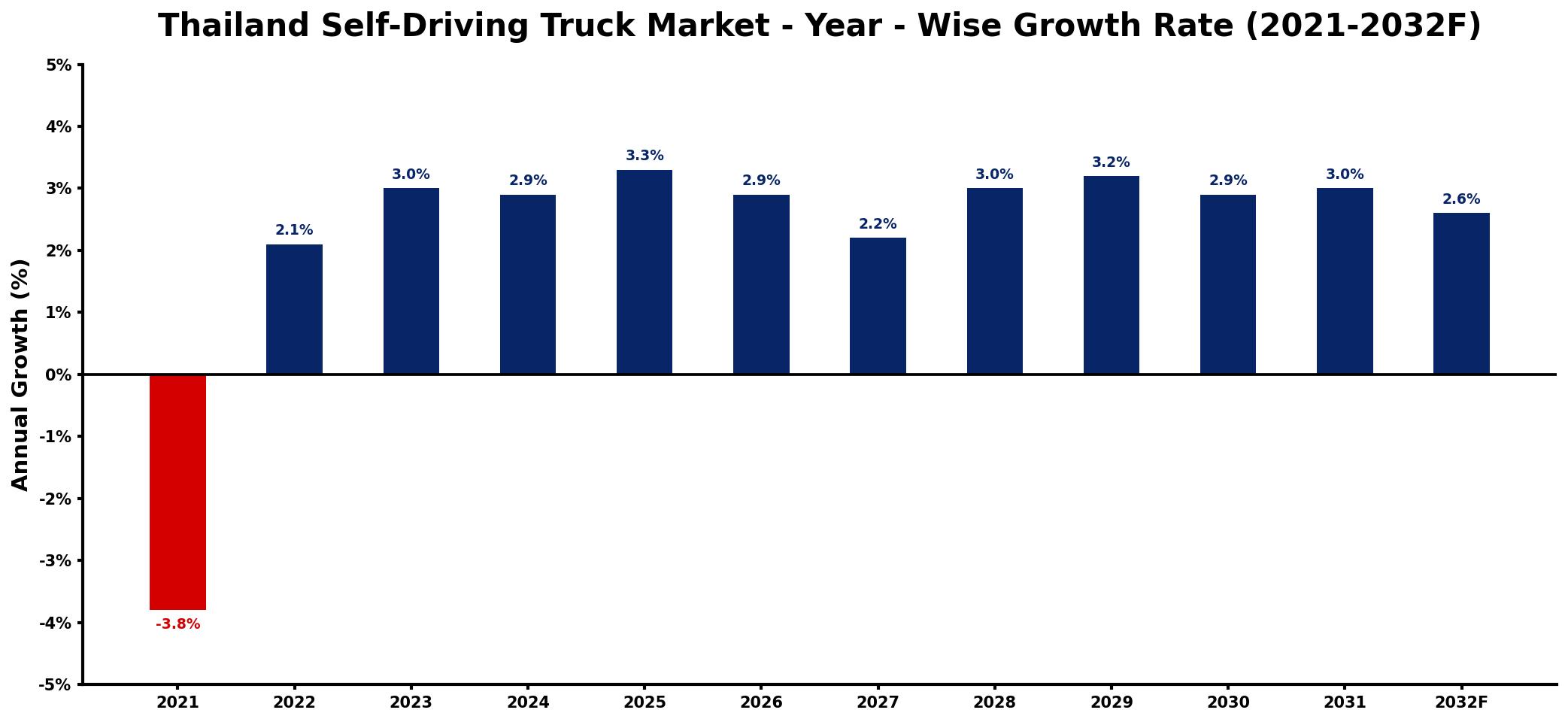
The table below presents the year‑wise growth rates along with the key drivers influencing the market
| Year | Growth Rate | Major Drivers |
| 2021 | -3.8% | decreased logistics demand in sector |
| 2022 | 2.1% | growing interest in automation solutions |
| 2023 | 3.0% | expansion of logistics infrastructure projects |
| 2024 | 2.9% | increased investments in technology |
| 2025 | 3.3% | rising demand for efficient transport |
| 2026 | 2.9% | enhanced regulatory support for automation |
| 2027 | 2.2% | broader acceptance of innovative solutions |
| 2028 | 3.0% | growing partnerships with tech companies |
| 2029 | 3.2% | increased focus on sustainability initiatives |
| 2030 | 2.9% | growing commercial sector adoption |
| 2031 | 3.0% | rising export shipment volumes |
| 2032 | 2.6% | improved raw material availability |
Note: Market size estimations and growth projections presented in this report are based on 6Wresearch's proprietary forecasting methodology, utilizing the latest available industry data, government publications, and primary research inputs.
Thailand Self-Driving Truck Market Synopsis
In recent years, the Thailand self-driving truck market has garnered significant attention, reflecting a growing inclination towards autonomous solutions in logistics. However, while the current momentum is promising, the path ahead is nuanced, with challenges around regulation and infrastructure needing careful navigation.
As the market continues to evolve, the focus will shift towards enhancing public acceptance and addressing safety concerns surrounding autonomous vehicles. The potential for self-driving trucks to optimize the Thai logistics sector remains high, offering a transformative impact on transportation efficiency.
Thailand Self-Driving Truck Market Key Takeaways
- The market is on an upward trajectory, expected to reach USD 101 Million by 2032.
- Key drivers include advancements in automation technology and a booming e-commerce sector.
- Public acceptance and regulatory developments are pivotal to the market's growth.
- Infrastructure improvements are essential to support the deployment of self-driving trucks.
- Government initiatives are fostering a conducive environment for innovation in autonomous vehicle technology.
Evaluation of Restraints in Thailand Self-Driving Truck Market
Despite the optimistic outlook, the Thailand self-driving truck market faces several restraints that could impede growth. Regulatory hurdles remain a significant concern, with the need for comprehensive safety standards and operational guidelines for autonomous vehicles. Additionally, public skepticism towards self-driving technology poses a barrier to widespread acceptance. The high costs associated with retrofitting existing fleets with autonomous systems also present financial challenges for logistics companies. Furthermore, the lack of requisite infrastructure, such as smart highways and reliable charging stations, limits the operational capabilities of self-driving trucks, thereby stalling their integration into the market.
Thailand Self-Driving Truck Market Trends
The Thailand self-driving truck market is witnessing several transformative trends that shape its future. The integration of advanced technologies such as artificial intelligence (AI) and machine learning is enhancing the operational efficiency of autonomous vehicles. Additionally, increasing investments in smart logistics and automation technology reflect a strategic shift towards embracing digital solutions. The growing emphasis on sustainability in transportation is also driving interest in self-driving trucks, as they promise reduced emissions and optimized fuel usage. With Thailand's logistics sector undergoing a significant evolution, the demand for innovative transportation solutions will likely continue to rise.
Thailand Self-Driving Truck Market Opportunities
Amid the challenges, there exist substantial growth and investment opportunities in the Thailand self-driving truck market. The burgeoning e-commerce sector necessitates faster and more efficient logistics solutions, which self-driving trucks are well-positioned to provide. Moreover, as government policies increasingly support the development of autonomous technologies, collaboration between public and private sectors could catalyze rapid advancements in this field. Additionally, investment in infrastructure that supports autonomous vehicles will create avenues for business development, as logistics firms seek to upgrade their fleets and capabilities.
Government Initiatives in the Thailand Self-Driving Truck Market
The Thai government has shown a proactive stance in promoting the development of autonomous vehicle technology. Initiatives aimed at establishing regulatory frameworks for self-driving vehicles are crucial in paving the way for market growth. Public spending on infrastructure improvements and research into smart transportation systems signifies a commitment to enhancing the logistics sector. Furthermore, programs designed to foster partnerships between private tech firms and government agencies are integral to advancing the capabilities of self-driving trucks in Thailand.
Future Insights of the Thailand Self-Driving Truck Market
Looking ahead to 2026-2032, the Thailand self-driving truck market is poised for significant evolution. As technology advances and public sentiment gradually shifts towards acceptance, the landscape for autonomous trucks will become increasingly favorable. Regulatory clarity and infrastructure readiness will be key to unlocking the full potential of this market. Continued growth in e-commerce and logistics demand will further accelerate the integration of self-driving trucks, positioning them as a transformative force within the supply chain dynamics of Thailand.
Thailand Self-Driving Truck Market Latest Developments (2025 - 2026)
Recent developments in the Thailand self-driving truck market have focused on refining technology and improving safety measures. Companies are actively engaging in pilot programs to test autonomous trucks in various logistics environments, gaining valuable data to inform future rollouts. Additionally, collaborations between technology developers and logistics providers are emerging, aimed at accelerating the deployment of self-driving solutions across Thailand's transportation networks. Public discussions regarding regulatory measures are also gaining traction, highlighting the increasing recognition of the need for a robust legal framework to support the market's growth.
Thailand Self-Driving Truck Market - Key Attractiveness of the Report
- 10 Years of Market Numbers
- Historical Data Starting from 2022 to 2025
- Base Year: 2025
- Forecast Data until 2032
- Key Performance Indicators Impacting the Market
- Major Upcoming Developments and Projects
Key Highlights of the Report:
- Thailand Self-Driving Truck Market Outlook
- Market Size of Thailand Self-Driving Truck Market, 2025
- Forecast of Thailand Self-Driving Truck Market, 2032
- Historical Data and Forecast of Thailand Self-Driving Truck Revenues & Volume for the Period 2022-2032F
- Thailand Self-Driving Truck Market Trend Evolution
- Thailand Self-Driving Truck Market Drivers and Challenges
- Thailand Self-Driving Truck Price Trends
- Thailand Self-Driving Truck Porter's Five Forces
- Thailand Self-Driving Truck Industry Life Cycle
- Historical Data and Forecast of Thailand Self-Driving Truck Market Revenues & Volume By Level Of Autonomy for the Period 2022-2032F
- Historical Data and Forecast of Thailand Self-Driving Truck Market Revenues & Volume By Level One for the Period 2022-2032F
- Historical Data and Forecast of Thailand Self-Driving Truck Market Revenues & Volume By Level Two for the Period 2022-2032F
- Historical Data and Forecast of Thailand Self-Driving Truck Market Revenues & Volume By Level Three for the Period 2022-2032F
- Historical Data and Forecast of Thailand Self-Driving Truck Market Revenues & Volume By Level Four for the Period 2022-2032F
- Historical Data and Forecast of Thailand Self-Driving Truck Market Revenues & Volume By Industry Verticals for the Period 2022-2032F
- Historical Data and Forecast of Thailand Self-Driving Truck Market Revenues & Volume By Logistics for the Period 2022-2032F
- Historical Data and Forecast of Thailand Self-Driving Truck Market Revenues & Volume By Construction & Manufacturing for the Period 2022-2032F
- Historical Data and Forecast of Thailand Self-Driving Truck Market Revenues & Volume By Mining for the Period 2022-2032F
- Historical Data and Forecast of Thailand Self-Driving Truck Market Revenues & Volume By Port for the Period 2022-2032F
- Thailand Self-Driving Truck Import Export Trade Statistics
- Market Opportunity Assessment By Level Of Autonomy
- Market Opportunity Assessment By Industry Verticals
- Thailand Self-Driving Truck Top Companies Market Share
- Thailand Self-Driving Truck Competitive Benchmarking By Technical and Operational Parameters
- Thailand Self-Driving Truck Company Profiles
- Thailand Self-Driving Truck Key Strategic Recommendations






































