Thailand Sheep Shearing Equipment Market Size, Share & Growth Rate
The Thailand Sheep Shearing Equipment Market was estimated at USD 125 Million in 2025 and is projected to reach USD 143 Million by 2032, growing at a CAGR of 1.9% from 2026 to 2032. The growth is primarily fueled by the increasing focus on improving wool quality and productivity among sheep farmers, as well as the rising demand for compliant shearing practices that prioritize animal welfare. Additionally, the global push for higher standards in wool products and increasing international exports are driving investment in advanced shearing technologies.
Thailand Sheep Shearing Equipment Market Year-wise Growth Rate and Key Drivers
This graph highlights how the Thailand Sheep Shearing Equipment Market has steadily grown over the years, supported by major growth factors.
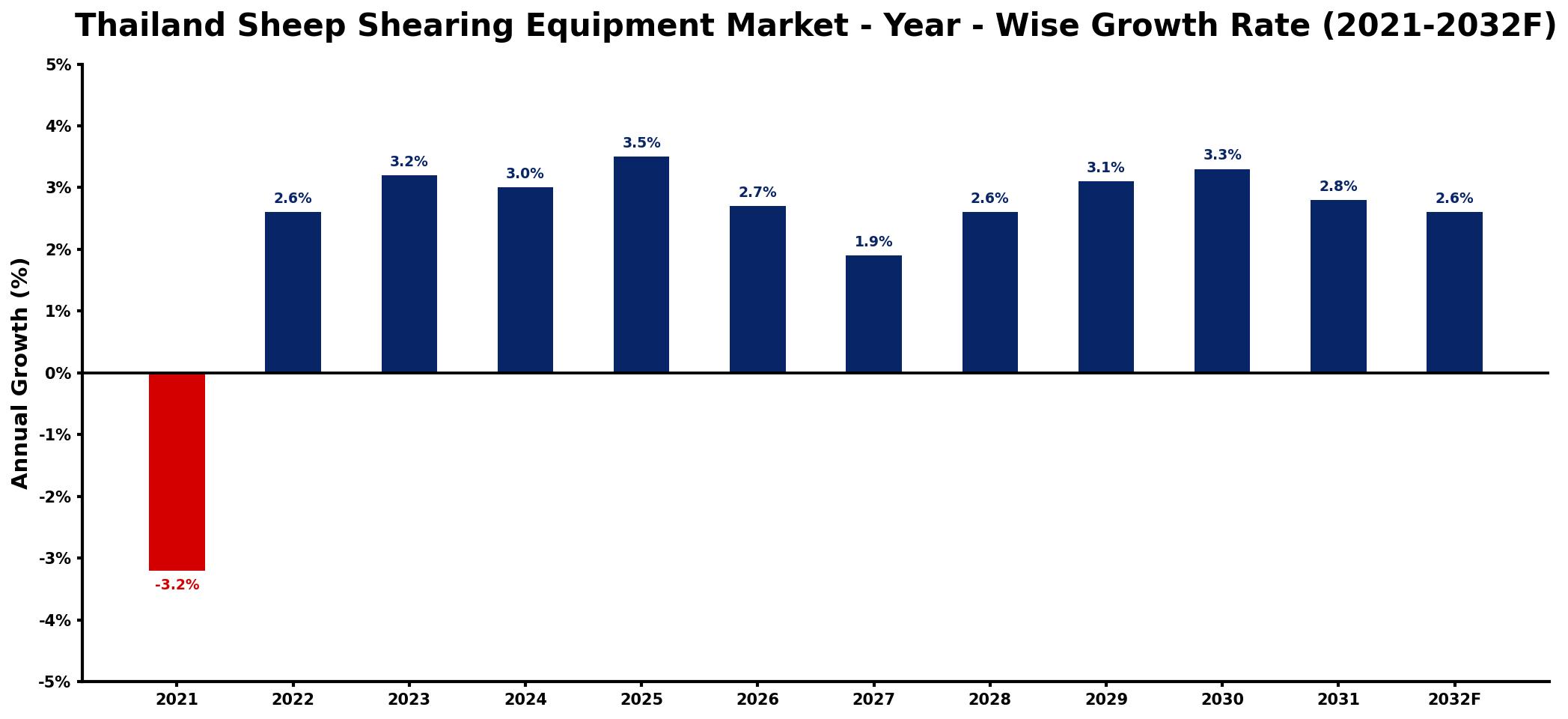
The table below presents the year‑wise growth rates along with the key drivers influencing the market
| Year | Growth Rate | Major Drivers |
| 2021 | -3.2% | decreased agricultural investment activities |
| 2022 | 2.6% | increased livestock farming initiatives |
| 2023 | 3.2% | growing demand for wool products |
| 2024 | 3.0% | expansion of rural farming practices |
| 2025 | 3.5% | rising popularity of organic wool |
| 2026 | 2.7% | enhanced technologies in farming |
| 2027 | 1.9% | growth in export opportunities |
| 2028 | 2.6% | increased awareness of sustainability |
| 2029 | 3.1% | stronger distribution network expansion |
| 2030 | 3.3% | advancements in breeding techniques |
| 2031 | 2.8% | rising interest in animal welfare |
| 2032 | 2.6% | growing support for rural economies |
Note: Market size estimations and growth projections presented in this report are based on 6Wresearch's proprietary forecasting methodology, utilizing the latest available industry data, government publications, and primary research inputs.
Thailand Sheep Shearing Equipment Market Synopsis
In Thailand, the importance of sheep shearing extends beyond mere wool production; it is essential for maintaining the health of sheep, which directly impacts the livestock sector. This rising awareness among farmers regarding the health and productivity of their flocks is creating a robust demand for efficient shearing equipment. With a wide array of tools such as electric and hand shears becoming available, farmers can enhance operational efficiency significantly.
Moreover, as Thailand's agricultural sector continues to modernize, there's a noticeable shift towards mechanized shearing methods. This transition is being supported by technological advancements that increase the speed and precision of shearing, meeting both local needs and international export standards. With Thai wool products gaining traction in overseas markets, the demand for high-quality shearing equipment is set to rise.
Thailand Sheep Shearing Equipment Market Key Takeaways
- The market is primarily driven by the growth of the agricultural sector and a focus on improved wool quality.
- Technological advancements are enhancing the efficiency and precision of sheep shearing processes.
- The demand for humane shearing equipment is crucial to align with global standards and practices.
- Small-scale farmers are gradually adopting modern shearing technology, albeit at a slower pace.
- The market shows resilience, with limited impact from external economic disruptions like COVID-19.
Evaluation of Restraints in Thailand Sheep Shearing Equipment Market
Despite the positive growth outlook, several restraints hinder the rapid adoption of modern sheep shearing equipment. A significant portion of traditional sheep farmers remains hesitant to transition from manual methods due to cost concerns and lack of awareness about the benefits of mechanized tools. Furthermore, the diverse range of sheep breeds in Thailand requires equipment that can adapt to different shearing needs, posing an additional challenge for manufacturers aiming to cater to the entire market spectrum.
Thailand Sheep Shearing Equipment Market Trends
Currently, the market is witnessing a notable shift towards the adoption of energy-efficient and lightweight shearing tools, which are designed for ease of use and greater mobility. Additionally, the rise of online platforms for purchasing agricultural equipment is broadening access for farmers, enabling them to acquire modern shearing tools more readily. This digital transformation is not only increasing market visibility but also promoting better knowledge sharing about the importance of humane shearing practices.
Thailand Sheep Shearing Equipment Market Opportunities
There are considerable opportunities for growth within the Thailand Sheep Shearing Equipment Market, particularly in enhancing education and outreach programs targeting small-scale farmers. By providing training on modern shearing techniques and their benefits, manufacturers can facilitate quicker adoption of advanced equipment. Furthermore, partnerships with local agricultural institutions can lead to co-development projects, expanding the market reach and improving product offerings tailored to local needs.
Government Initiatives in the Thailand Sheep Shearing Equipment Market
The Thai government has been actively supporting the agriculture and livestock sectors through various initiatives aimed at modernizing practices and enhancing productivity. This includes subsidies for acquiring modern farming equipment, including sheep shearing tools, and educational programs to inform farmers about sustainable livestock management practices. Such initiatives create a favorable environment for the growth of the sheep shearing equipment market.
Future Insights of the Thailand Sheep Shearing Equipment Market
Looking ahead to 2026-2032, the Thailand Sheep Shearing Equipment Market is expected to evolve rapidly as technological advancements continue to emerge. Increased demand for ethically sourced wool and high-quality livestock products will necessitate the adoption of innovative shearing solutions. As the market matures, expect to see a greater emphasis on sustainable practices and equipment that enhances both animal welfare and productivity.
Thailand Sheep Shearing Equipment Market Latest Developments (2025 - 2026)
In the past year, the Thailand sheep shearing equipment industry has seen a flurry of activity with companies launching new product lines that emphasize user-friendliness and efficiency. Additionally, ongoing collaborations between equipment manufacturers and agricultural bodies have led to workshops aimed at educating farmers about the advantages of modern shearing techniques. This proactive approach is positioning the market for sustained growth as it adapts to changing consumer demands.
Thailand Sheep Shearing Equipment Market - Key Attractiveness of the Report
- 10 Years of Market Numbers
- Historical Data Starting from 2022 to 2025
- Base Year: 2025
- Forecast Data until 2032
- Key Performance Indicators Impacting the Market
- Major Upcoming Developments and Projects
Key Highlights of the Report:
- Thailand Sheep Shearing Equipment Market Outlook
- Market Size of Thailand Sheep Shearing Equipment Market, 2025
- Forecast of Thailand Sheep Shearing Equipment Market, 2032
- Historical Data and Forecast of Thailand Sheep Shearing Equipment Revenues & Volume for the Period 2022-2032F
- Thailand Sheep Shearing Equipment Market Trend Evolution
- Thailand Sheep Shearing Equipment Market Drivers and Challenges
- Thailand Sheep Shearing Equipment Price Trends
- Thailand Sheep Shearing Equipment Porter's Five Forces
- Thailand Sheep Shearing Equipment Industry Life Cycle
- Historical Data and Forecast of Thailand Sheep Shearing Equipment Market Revenues & Volume By Type for the Period 2022-2032F
- Historical Data and Forecast of Thailand Sheep Shearing Equipment Market Revenues & Volume By Cordless for the Period 2022-2032F
- Historical Data and Forecast of Thailand Sheep Shearing Equipment Market Revenues & Volume By Wired for the Period 2022-2032F
- Historical Data and Forecast of Thailand Sheep Shearing Equipment Market Revenues & Volume By Applications for the Period 2022-2032F
- Historical Data and Forecast of Thailand Sheep Shearing Equipment Market Revenues & Volume By Individual for the Period 2022-2032F
- Historical Data and Forecast of Thailand Sheep Shearing Equipment Market Revenues & Volume By Commercial for the Period 2022-2032F
- Thailand Sheep Shearing Equipment Import Export Trade Statistics
- Market Opportunity Assessment By Type
- Market Opportunity Assessment By Applications
- Thailand Sheep Shearing Equipment Top Companies Market Share
- Thailand Sheep Shearing Equipment Competitive Benchmarking By Technical and Operational Parameters
- Thailand Sheep Shearing Equipment Company Profiles
- Thailand Sheep Shearing Equipment Key Strategic Recommendations






































