Thailand Smart Warehousing Market Size & Growth Rate (2026-2032)
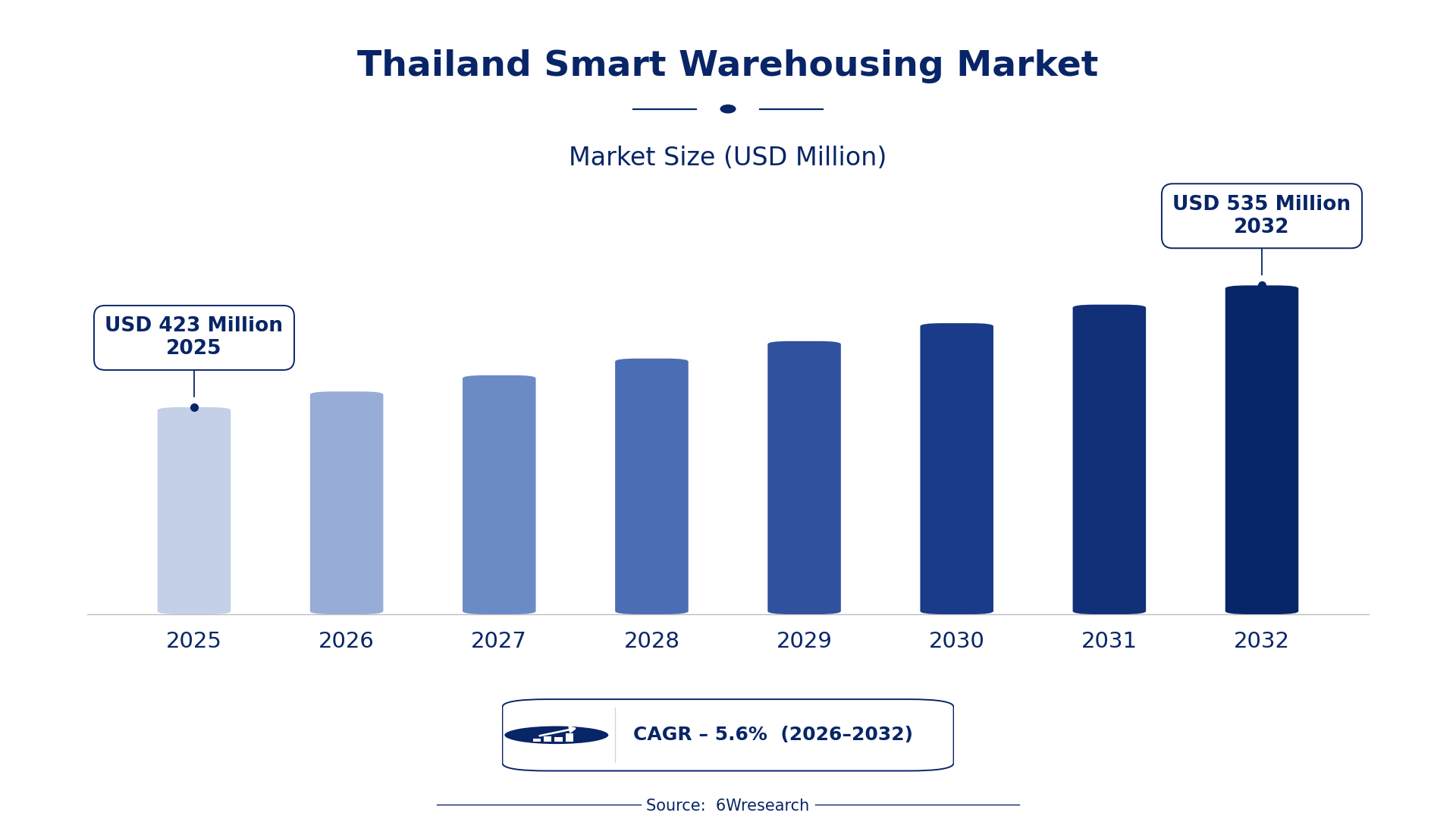
The Thailand Smart Warehousing Market was estimated at USD 423 Million in 2025 and is projected to reach USD 535 Million by 2032, growing at a CAGR of 5.6% from 2026 to 2032.
Thailand Smart Warehousing Market Synopsis
Thailand's Smart Warehousing market is undergoing a notable transformation, largely driven by advancements in automation and the Internet of Things (IoT). As e-commerce continues to thrive, businesses are increasingly recognizing the need for streamlined operations and enhanced inventory management to keep pace with consumer demand.
The integration of smart technologies is no longer a luxury but a necessity for logistics operators. Companies are investing heavily in robotics, real-time tracking systems, and data analytics to optimize order fulfillment processes. This shift is reshaping traditional warehousing paradigms and fostering a more efficient supply chain ecosystem in Thailand.
Thailand Smart Warehousing Market Year-wise Growth Rate and Key Drivers
This graph illustrates the annual growth rates of the Thailand Smart Warehousing Market from 2021 to 2032, highlighting a steady upward trajectory and projected expansion over the forecast period.
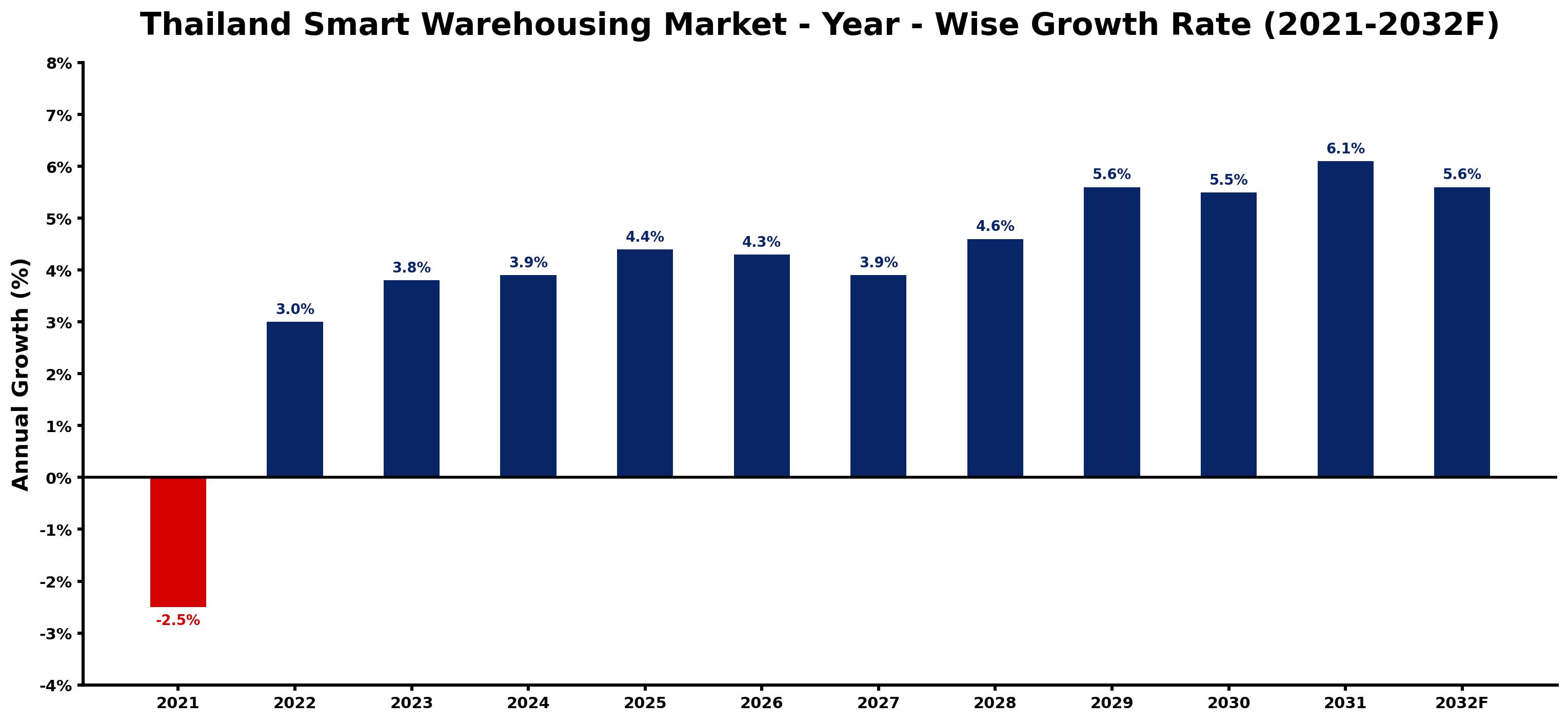
The table below presents the year‑wise growth rates along with the key drivers influencing the market
| Year | Growth Rate | Major Drivers |
| 2021 | -2.5% | High logistics costs due to Baht depreciation |
| 2022 | 3.0% | Government tax incentives for automated warehouse solutions |
| 2023 | 3.8% | Rise of e-commerce driving logistics efficiency demands |
| 2024 | 3.9% | Increased foreign investment in logistics technology infrastructure |
| 2025 | 4.4% | Supply chain disruptions accelerating automation adoption |
| 2026 | 4.3% | Local startups leveraging IoT for smart warehousing |
| 2027 | 3.9% | Thailand 4.0 initiative supporting digital transformation efforts |
| 2028 | 4.6% | Partnerships with international tech firms enhancing warehousing systems |
| 2029 | 5.6% | Growing urban population boosting logistics and warehousing needs |
| 2030 | 5.5% | COVID-19 recovery fueling demand for efficient operations |
| 2031 | 6.1% | Ample availability of skilled labor in tech-driven sectors |
| 2032 | 5.6% | Increased focus on sustainability in warehousing practices |
Note: Market size estimations and growth projections presented in this report are based on 6Wresearch's proprietary forecasting methodology, utilizing the latest available industry data, government publications, and primary research inputs.
Thailand Smart Warehousing Market Key Takeaways
Below are some of the specific key takeaways from the market, including:
- The Smart Warehousing market in Thailand is fueled by the rapid growth of the e-commerce sector.
- Technological integration is critical for improving operational efficiency and inventory accuracy.
- Automation and IoT solutions are becoming standard in modern warehouse management practices.
- Workforce training remains a significant challenge as companies transition to smart technologies.
- The ongoing impact of the COVID-19 pandemic has accelerated technology adoption in logistics.
Evaluation of Restraints in Thailand Smart Warehousing Market
Despite the promising growth trajectory, the Thailand Smart Warehousing market faces several constraints. Integrating advanced technologies into existing frameworks can be financially burdensome, requiring substantial upfront investments. on top of that, the transition from traditional to smart warehousing systems presents logistical hurdles that need careful management. Connectivity issues among various devices and systems further complicate the operational landscape, making it imperative for companies to develop comprehensive strategies. Finally, workforce adaptation to new technologies is an ongoing concern that can hinder the swift implementation of smart solutions.
Thailand Smart Warehousing Market Trends
Several trends are shaping the future of the Smart Warehousing market in Thailand. The rise of real-time data analytics is enabling businesses to make informed decisions quickly, enhancing inventory management. on top of that, as consumer expectations for rapid delivery grow, warehouse operators are adopting automation to speed up order processing. Environmental sustainability is also gaining traction, with more companies exploring energy-efficient technologies and practices. Collaborative robots, or cobots, are becoming increasingly prevalent, working alongside human employees to boost productivity while minimizing operational risks.
Thailand Smart Warehousing Market Opportunities
The evolving landscape presents several opportunities for growth within the Smart Warehousing market. Investment in smart logistics solutions is expected to surge as businesses recognize the long-term benefits of technological integration. Companies that specialize in developing IoT platforms and automation tools are well-positioned to capitalize on this trend. Additionally, partnerships between technology providers and logistics firms can lead to innovative solutions that enhance operational capabilities. As the demand for efficiency and accuracy rises, firms that can deliver tailored smart warehousing solutions will find substantial growth potential.
Government Initiatives in the Thailand Smart Warehousing Market
The Thai government is actively shaping the Smart Warehousing market through various initiatives aimed at enhancing logistics efficiency and promoting technological adoption. With a focus on improving supply chain resilience, public policy is increasingly prioritizing digital transformation and smart technologies. These measures are essential for keeping pace with the growing demands of both local and international markets.
- A recently completed initiative involved the launch of a national digital infrastructure upgrade program to enhance connectivity across logistics networks.
- Currently underway is a government-led effort to provide training programs for logistics personnel, aimed at equipping the workforce with necessary skills to manage new technologies.
- A planned public-private partnership is expected to support the deployment of automation technologies in warehousing by 2027.
- The government is also exploring incentives for businesses that invest in sustainable logistics practices, which could reshape operational norms in the coming years.
Future Insights of the Thailand Smart Warehousing Market
Looking ahead to 2026-2032, the Thailand Smart Warehousing market is set to witness substantial advancements driven by technology and changing consumer behaviors. The ongoing expansion of e-commerce will necessitate further investment in automation and smart technologies, pushing companies to innovate continuously. As businesses strive for operational excellence, the integration of AI and machine learning into warehousing solutions is likely to become commonplace, allowing for predictive analytics and smarter inventory management. This evolving market will require firms to remain agile and responsive to new trends, ensuring they meet the heightened expectations of the modern supply chain.
Thailand Smart Warehousing Market Latest Developments
In the past year, the Thailand Smart Warehousing market has seen a flurry of activity as companies adapt to emerging technologies and shifting consumer expectations. The focus on enhancing operational efficiency through automation and IoT integration has led to numerous strategic initiatives and partnerships.
- A major technology vendor launched a cutting-edge warehouse management system in Q1 2025 that incorporates AI-driven analytics.
- An ongoing initiative started in mid-2025 aims to implement real-time tracking solutions across several logistics hubs in Thailand.
- A regional operator is preparing for a rollout of automated sorting systems, expected to begin in early 2026, designed to enhance order fulfillment speed.
- By late 2025, a collaborative project between logistics firms and tech startups is anticipated to produce innovative inventory management solutions.
Thailand Smart Warehousing Market - Key Attractiveness of the Report
- 10 Years of Market Numbers
- Historical Data Starting from 2022 to 2025
- Base Year: 2025
- Forecast Data until 2032
- Key Performance Indicators Impacting the Market
- Major Upcoming Developments and Projects
Key Highlights of the Report:
- Thailand Smart Warehousing Market Outlook
- Market Size of Thailand Smart Warehousing Market, 2025
- Forecast of Thailand Smart Warehousing Market, 2032
- Historical Data and Forecast of Thailand Smart Warehousing Revenues & Volume for the Period 2022-2032F
- Thailand Smart Warehousing Market Trend Evolution
- Thailand Smart Warehousing Market Drivers and Challenges
- Thailand Smart Warehousing Price Trends
- Thailand Smart Warehousing Porter's Five Forces
- Thailand Smart Warehousing Industry Life Cycle
- Historical Data and Forecast of Thailand Smart Warehousing Market Revenues & Volume By Component for the Period 2022-2032F
- Historical Data and Forecast of Thailand Smart Warehousing Market Revenues & Volume By Hardware for the Period 2022-2032F
- Historical Data and Forecast of Thailand Smart Warehousing Market Revenues & Volume By Solutions for the Period 2022-2032F
- Historical Data and Forecast of Thailand Smart Warehousing Market Revenues & Volume By Services for the Period 2022-2032F
- Historical Data and Forecast of Thailand Smart Warehousing Market Revenues & Volume By Application for the Period 2022-2032F
- Historical Data and Forecast of Thailand Smart Warehousing Market Revenues & Volume By Transport Management for the Period 2022-2032F
- Historical Data and Forecast of Thailand Smart Warehousing Market Revenues & Volume By Inventory Management for the Period 2022-2032F
- Historical Data and Forecast of Thailand Smart Warehousing Market Revenues & Volume By Order Management for the Period 2022-2032F
- Historical Data and Forecast of Thailand Smart Warehousing Market Revenues & Volume By Yard Management for the Period 2022-2032F
- Historical Data and Forecast of Thailand Smart Warehousing Market Revenues & Volume By Shipping Management for the Period 2022-2032F
- Historical Data and Forecast of Thailand Smart Warehousing Market Revenues & Volume By Labor Management for the Period 2022-2032F
- Historical Data and Forecast of Thailand Smart Warehousing Market Revenues & Volume By Other Applications for the Period 2022-2032F
- Historical Data and Forecast of Thailand Smart Warehousing Market Revenues & Volume By Technology for the Period 2022-2032F
- Historical Data and Forecast of Thailand Smart Warehousing Market Revenues & Volume By IoT and Analytics for the Period 2022-2032F
- Historical Data and Forecast of Thailand Smart Warehousing Market Revenues & Volume By AI in Warehouse for the Period 2022-2032F
- Historical Data and Forecast of Thailand Smart Warehousing Market Revenues & Volume By Automated Guided Vehicles (AGV) for the Period 2022-2032F
- Historical Data and Forecast of Thailand Smart Warehousing Market Revenues & Volume By RFID for the Period 2022-2032F
- Historical Data and Forecast of Thailand Smart Warehousing Market Revenues & Volume By Blockchain in Warehouse for the Period 2022-2032F
- Historical Data and Forecast of Thailand Smart Warehousing Market Revenues & Volume By Other Technologies for the Period 2022-2032F
- Historical Data and Forecast of Thailand Smart Warehousing Market Revenues & Volume By Vertical for the Period 2022-2032F
- Historical Data and Forecast of Thailand Smart Warehousing Market Revenues & Volume By Transportation and Logistics for the Period 2022-2032F
- Historical Data and Forecast of Thailand Smart Warehousing Market Revenues & Volume By Retail and eCommerce for the Period 2022-2032F
- Historical Data and Forecast of Thailand Smart Warehousing Market Revenues & Volume By Manufacturing for the Period 2022-2032F
- Historical Data and Forecast of Thailand Smart Warehousing Market Revenues & Volume By Healthcare and Life Sciences for the Period 2022-2032F
- Historical Data and Forecast of Thailand Smart Warehousing Market Revenues & Volume By Energy and Utilities for the Period 2022-2032F
- Historical Data and Forecast of Thailand Smart Warehousing Market Revenues & Volume By Automotive for the Period 2022-2032F
- Historical Data and Forecast of Thailand Smart Warehousing Market Revenues & Volume By Food and Beverages for the Period 2022-2032F
- Historical Data and Forecast of Thailand Smart Warehousing Market Revenues & Volume By Other Verticals for the Period 2022-2032F
- Historical Data and Forecast of Thailand Smart Warehousing Market Revenues & Volume By Deployment Mode for the Period 2022-2032F
- Historical Data and Forecast of Thailand Smart Warehousing Market Revenues & Volume By Cloud for the Period 2022-2032F
- Historical Data and Forecast of Thailand Smart Warehousing Market Revenues & Volume By On-premises for the Period 2022-2032F
- Historical Data and Forecast of Thailand Smart Warehousing Market Revenues & Volume By Organization Size for the Period 2022-2032F
- Historical Data and Forecast of Thailand Smart Warehousing Market Revenues & Volume By Large enterprises for the Period 2022-2032F
- Historical Data and Forecast of Thailand Smart Warehousing Market Revenues & Volume By Small and medium-sized enterprises (SMEs) for the Period 2022-2032F
- Thailand Smart Warehousing Import Export Trade Statistics
- Market Opportunity Assessment By Component
- Market Opportunity Assessment By Application
- Market Opportunity Assessment By Technology
- Market Opportunity Assessment By Vertical
- Market Opportunity Assessment By Deployment Mode
- Market Opportunity Assessment By Organization Size
- Thailand Smart Warehousing Top Companies Market Share
- Thailand Smart Warehousing Competitive Benchmarking By Technical and Operational Parameters
- Thailand Smart Warehousing Company Profiles
- Thailand Smart Warehousing Key Strategic Recommendations






































