Thailand Sodium Aluminium Phosphate Market Size, Share & Growth Rate
The Thailand Sodium Aluminium Phosphate Market was estimated at USD 95 Million in 2025 and is projected to reach USD 109 Million by 2032, growing at a CAGR of 2.0% from 2026 to 2032. This modest growth trajectory is primarily driven by the increasing demand for sodium aluminium phosphate as a leavening agent in various food products, particularly baked goods. The food processing industry in Thailand is expanding, spurred by changing consumer preferences for convenience foods, which further boosts the market.
Thailand Sodium Aluminium Phosphate Market Year-wise Growth Rate and Key Drivers
This graph highlights how the Thailand Sodium Aluminium Phosphate Market has steadily grown over the years, supported by major growth factors.
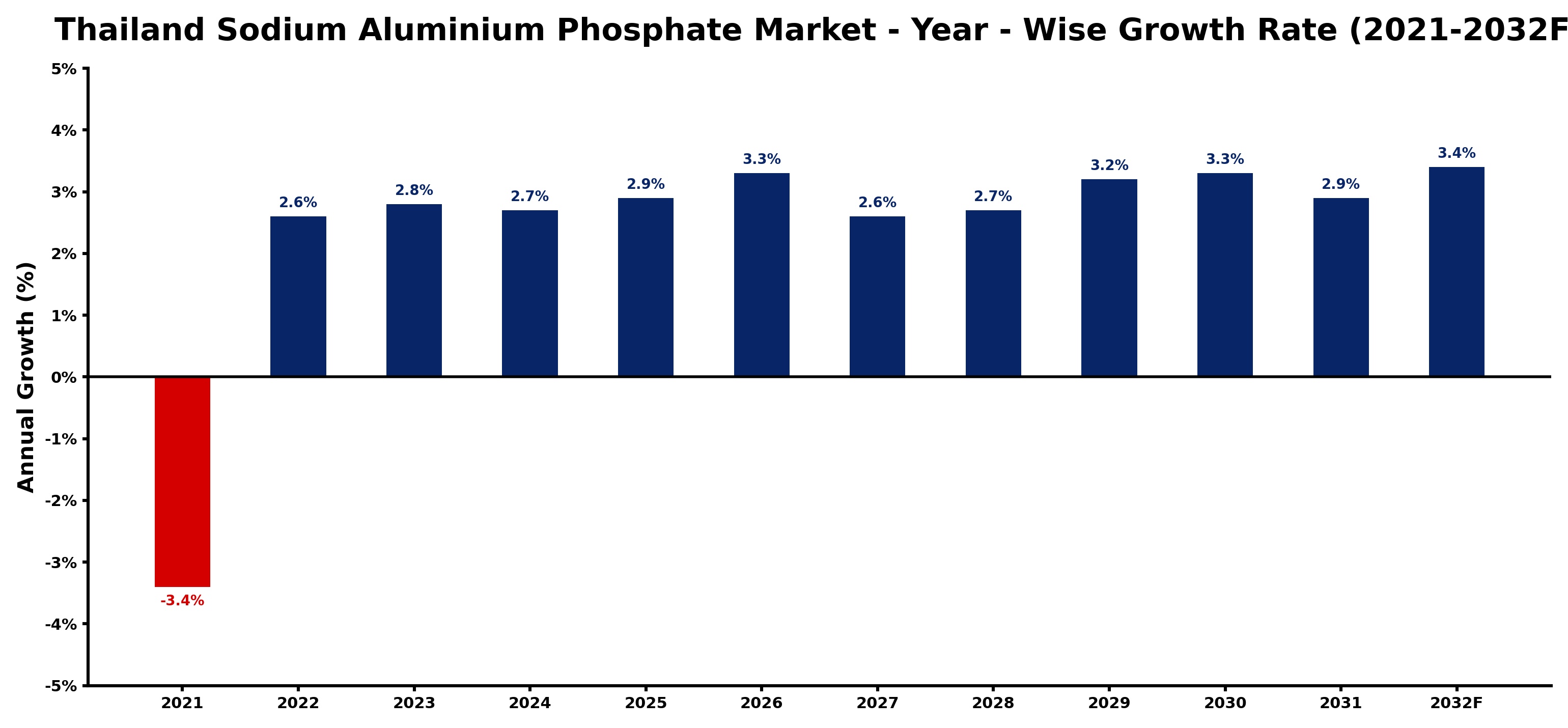
The table below presents the year‑wise growth rates along with the key drivers influencing the market
| Year | Growth Rate | Major Drivers |
| 2021 | -3.4% | Supply chain disruptions affected production |
| 2022 | 2.6% | Foodservice expansion drove growth |
| 2023 | 2.8% | Retail expansion increased availability |
| 2024 | 2.7% | Supermarket penetration improved access |
| 2025 | 2.9% | Premium pasta adoption gained traction |
| 2026 | 3.3% | Durum wheat imports stabilized supply |
| 2027 | 2.6% | Western cuisine adoption increased |
| 2028 | 2.7% | Health food interest surged upward |
| 2029 | 3.2% | Product diversification attracted consumers |
| 2030 | 3.3% | Grocery availability enhanced distribution |
| 2031 | 2.9% | Pasta brand expansion grew significantly |
| 2032 | 3.4% | Online grocery channels boosted sales |
Note - Market size estimations and growth projections presented in this report are based on 6Wresearch’s advanced forecasting approach, validated with industry datasets as of June 2026.
Thailand Sodium Aluminium Phosphate Market Synopsis
A significant force shaping the Thailand Sodium Aluminium Phosphate Market is the robust growth of the food processing sector. With rising health consciousness and a shift toward ready-to-eat meals, there is a consistent demand for food additives like sodium aluminium phosphate, which enhance the texture and quality of food products.
Additionally, the market's dynamics are influenced by fluctuating import and export trends, with imports making up about 44% of the total market share. Countries such as China, Malaysia, and Indonesia serve as major import sources, while India, Vietnam, and Japan lead the exports. This balance indicates a growing reliance on international trade for supply stability.
Thailand Sodium Aluminium Phosphate Market Key Takeaways
- The market is projected to grow steadily, driven by the food processing industry's expansion.
- Thailand hosts 91 establishments producing sodium aluminium phosphate with a combined capacity of 108 million tonnes per year.
- Imports constitute about 44% of the market, highlighting reliance on foreign suppliers for certain applications.
- Key applications of sodium aluminium phosphate are primarily in baking and processed foods, reflecting changing consumer habits.
- Strategic collaborations with food manufacturers are essential for sustaining growth and addressing market challenges.
Evaluation of Restraints in Thailand Sodium Aluminium Phosphate Market
Despite its growing presence, the Thailand Sodium Aluminium Phosphate Market faces some notable restraints. The relatively niche application scope, primarily in baking and food additives, limits the expansion potential compared to more versatile ingredients. Additionally, disruptions caused by the COVID-19 pandemic have highlighted vulnerabilities within the foodservice sector, which rely heavily on stable supply chains. As the market continues to recover, establishing resilience through diversification and strong partnerships will be critical to overcoming these challenges.
Thailand Sodium Aluminium Phosphate Market Trends
The Thailand Sodium Aluminium Phosphate Market is witnessing several emerging trends that shape demand and technology. There is a noticeable shift towards clean-label products, prompting food manufacturers to explore naturally sourced alternatives while ensuring quality and functionality. Additionally, innovation in production processes is being pursued to enhance the efficiency and quality of sodium aluminium phosphate, aligning with sustainability goals and reducing environmental impacts.
Thailand Sodium Aluminium Phosphate Market Opportunities
Genuine growth opportunities within the Thailand Sodium Aluminium Phosphate Market are found in expanding product applications and increasing production capabilities. The rising demand for gluten-free and low-calorie baked goods presents a chance for sodium aluminium phosphate to become a preferred ingredient in healthier product formulations. Moreover, investing in research and development can lead to new applications and improved formulations that cater to evolving consumer preferences.
Government Initiatives in the Thailand Sodium Aluminium Phosphate Market
The Thai government plays a pivotal role in the sodium aluminium phosphate market through various initiatives aimed at supporting the food processing sector. Policies promoting food safety and standards create a conducive environment for businesses involved in the production of food additives. Additionally, public spending on infrastructure and technology enhancements facilitates better supply chain management and boosts production capabilities, ultimately benefiting the market landscape.
Future Insights of the Thailand Sodium Aluminium Phosphate Market
Looking ahead to the period from 2026 to 2032, the Thailand Sodium Aluminium Phosphate Market is expected to continue its growth trajectory, albeit at a measured pace. Factors such as the increasing adoption of convenience foods, along with innovative product developments, will play a crucial role in maintaining demand. The market's resilience will largely depend on how effectively companies can adapt to consumer trends and address supply chain challenges, ensuring the steady availability of quality sodium aluminium phosphate.
Thailand Sodium Aluminium Phosphate Market Latest Developments (May 2025 - June 2026)
Recent developments in the Thailand Sodium Aluminium Phosphate Market reflect a concerted effort to enhance production methods and diversify applications. Innovations in manufacturing technologies have led to improved product quality and efficiency. Additionally, collaborations between food manufacturers and additive producers are becoming more common, driving the formulation of new and exciting food products that cater to the evolving demands of health-conscious consumers.
Thailand Sodium Aluminium Phosphate Market - Key Attractiveness of the Report
- 10 Years of Market Numbers
- Historical Data Starting from 2022 to 2025
- Base Year: 2025
- Forecast Data until 2032
- Key Performance Indicators Impacting the Market
- Major Upcoming Developments and Projects
Key Highlights of the Report:
- Thailand Sodium Aluminium Phosphate Market Outlook
- Market Size of Thailand Sodium Aluminium Phosphate Market, 2025
- Forecast of Thailand Sodium Aluminium Phosphate Market, 2032
- Historical Data and Forecast of Thailand Sodium Aluminium Phosphate Revenues & Volume for the Period 2022-2032F
- Thailand Sodium Aluminium Phosphate Market Trend Evolution
- Thailand Sodium Aluminium Phosphate Market Drivers and Challenges
- Thailand Sodium Aluminium Phosphate Price Trends
- Thailand Sodium Aluminium Phosphate Porter's Five Forces
- Thailand Sodium Aluminium Phosphate Industry Life Cycle
- Historical Data and Forecast of Thailand Sodium Aluminium Phosphate Market Revenues & Volume By Product Type for the Period 2022-2032F
- Historical Data and Forecast of Thailand Sodium Aluminium Phosphate Market Revenues & Volume By Acidic Sodium Aluminium Phosphate for the Period 2022-2032F
- Historical Data and Forecast of Thailand Sodium Aluminium Phosphate Market Revenues & Volume By Basic Sodium Aluminium Phosphate for the Period 2022-2032F
- Historical Data and Forecast of Thailand Sodium Aluminium Phosphate Market Revenues & Volume By End use for the Period 2022-2032F
- Historical Data and Forecast of Thailand Sodium Aluminium Phosphate Market Revenues & Volume By Bakery Products for the Period 2022-2032F
- Historical Data and Forecast of Thailand Sodium Aluminium Phosphate Market Revenues & Volume By Confectionery for the Period 2022-2032F
- Historical Data and Forecast of Thailand Sodium Aluminium Phosphate Market Revenues & Volume By Tortillas for the Period 2022-2032F
- Historical Data and Forecast of Thailand Sodium Aluminium Phosphate Market Revenues & Volume By Donut and Cake Mixes for the Period 2022-2032F
- Historical Data and Forecast of Thailand Sodium Aluminium Phosphate Market Revenues & Volume By Cheese for the Period 2022-2032F
- Historical Data and Forecast of Thailand Sodium Aluminium Phosphate Market Revenues & Volume By Function for the Period 2022-2032F
- Historical Data and Forecast of Thailand Sodium Aluminium Phosphate Market Revenues & Volume By Dough Strengtheners and Conditioners for the Period 2022-2032F
- Historical Data and Forecast of Thailand Sodium Aluminium Phosphate Market Revenues & Volume By Leavening Agent for the Period 2022-2032F
- Historical Data and Forecast of Thailand Sodium Aluminium Phosphate Market Revenues & Volume By pH Control Agent for the Period 2022-2032F
- Historical Data and Forecast of Thailand Sodium Aluminium Phosphate Market Revenues & Volume By Acidulant for the Period 2022-2032F
- Thailand Sodium Aluminium Phosphate Import Export Trade Statistics
- Market Opportunity Assessment By Product Type
- Market Opportunity Assessment By End use
- Market Opportunity Assessment By Function
- Thailand Sodium Aluminium Phosphate Top Companies Market Share
- Thailand Sodium Aluminium Phosphate Competitive Benchmarking By Technical and Operational Parameters
- Thailand Sodium Aluminium Phosphate Company Profiles
- Thailand Sodium Aluminium Phosphate Key Strategic Recommendations






































