Thailand Sodium Hydride Market Size, Share & Growth Rate
The Thailand Sodium Hydride Market was estimated at USD 218 Million in 2025 and is projected to reach USD 252 Million by 2032, growing at a CAGR of 2.1% from 2026 to 2032. This growth trajectory is primarily propelled by the increasing demand for sodium hydride in pharmaceutical manufacturing, where its role as a catalyst in essential organic synthesis reactions is critical. The expanding chemical industry in Thailand, alongside advancements in research and development, contributes significantly to this upward trend.
Thailand Sodium Hydride Market Year-wise Growth Rate and Key Drivers
This graph highlights how the Thailand Sodium Hydride Market has steadily grown over the years, supported by major growth factors.
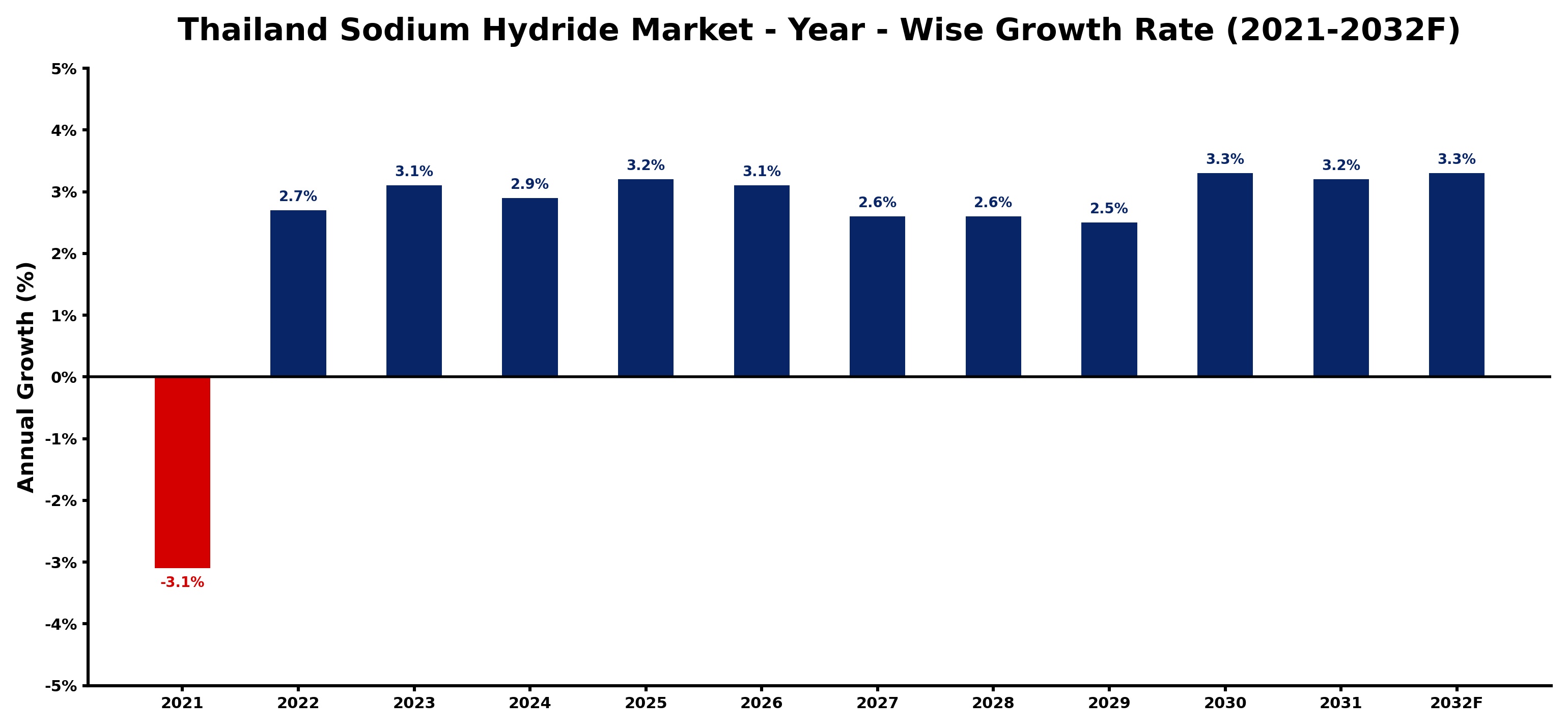
The table below presents the year‑wise growth rates along with the key drivers influencing the market
| Year | Growth Rate | Major Drivers |
| 2021 | -3.1% | Raw material prices limited production |
| 2022 | 2.7% | Chemical industry recovery stimulated demand |
| 2023 | 3.1% | Manufacturing sector expansion drove consumption |
| 2024 | 2.9% | Increased applications in pharmaceuticals emerged |
| 2025 | 3.2% | Technological advancements enhanced efficiency |
| 2026 | 3.1% | Growing demand in agriculture sector |
| 2027 | 2.6% | Rising interest in renewable energy |
| 2028 | 2.6% | Innovations in chemical processes increased |
| 2029 | 2.5% | Sustainability trends influenced purchasing decisions |
| 2030 | 3.3% | Global market integration enhanced exports |
| 2031 | 3.2% | Increased investment in R&D initiatives |
| 2032 | 3.3% | Partnerships with key industries expanded |
Note - Market size estimations and growth projections presented in this report are based on 6Wresearch’s advanced forecasting approach, validated with industry datasets as of June 2026.
Thailand Sodium Hydride Market Synopsis
Sodium hydride is integral to various organic synthesis processes within Thailand's robust chemical industry. Its application as a catalyst is critical for hydrolysis, condensation, and transesterification reactions, creating a consistent demand from sectors such as pharmaceuticals. The market's resilience is notable despite challenges posed by external factors, particularly the pandemic, which highlighted the need for a reliable supply chain.
With the pharmaceutical sector continuously innovating, the demand for sodium hydride remains strong. Companies in Thailand are responding to these needs by enhancing production capabilities and ensuring adherence to stringent safety standards, positioning themselves as dependable suppliers in a competitive landscape.
Thailand Sodium Hydride Market Key Takeaways
- The market is driven by the pharmaceutical sector's demand for efficient chemical reactions.
- Innovation and advancements in chemical synthesis are pivotal for market growth.
- Sodium hydride serves as a vital reagent in organic synthesis, emphasizing its importance in the industry.
- Companies are focusing on maintaining safety compliance while enhancing production capacity.
- Research and development activities are crucial to sustaining demand in the face of challenges.
Evaluation of Restraints in Thailand Sodium Hydride Market
Despite its critical role in the chemical and pharmaceutical sectors, the sodium hydride market in Thailand faces several constraints. Safety concerns related to the handling and production of sodium hydride necessitate stringent compliance measures that can slow down production processes. Furthermore, the COVID-19 pandemic exposed vulnerabilities within the supply chain, leading to disruptions that impacted both availability and pricing of sodium hydride. Moving forward, strategic planning and robust safety protocols will be essential for overcoming these challenges.
Thailand Sodium Hydride Market Trends
Emerging trends in the Thailand sodium hydride market reflect a growing emphasis on sustainability and green chemistry. Companies are exploring novel applications and environmentally friendly methods of synthesis to enhance productivity while minimizing waste. Additionally, digitalization and technological advancements are expected to improve efficiency in production processes and quality control, ultimately shaping the future landscape of sodium hydride usage.
Thailand Sodium Hydride Market Opportunities
As Thailand's pharmaceutical sector continues to evolve, new opportunities for sodium hydride are arising, particularly in the development of advanced therapeutic agents. The increasing investment in R&D and the push for innovative chemical processes provide a fertile ground for growth. Companies can capitalize on the demand for high-quality sodium hydride by refining their product offerings and expanding their market presence, catering to both domestic and international markets.
Government Initiatives in the Thailand Sodium Hydride Market
The Thai government has shown strong support for the chemical and pharmaceutical sectors through various policies and incentives aimed at promoting innovation and enhancing competitiveness. Initiatives focusing on research funding, infrastructure development, and regulatory support encourage growth in chemical synthesis, including the production of sodium hydride. These efforts create a conducive environment for businesses to thrive and adapt to emerging market demands.
Future Insights of the Thailand Sodium Hydride Market
Looking ahead to 2026-2032, the Thailand sodium hydride market is expected to experience steady growth driven by ongoing advancements in the pharmaceutical industry and continuous research in chemical applications. As companies focus on innovation and safety, there will likely be a rise in the use of sodium hydride in cutting-edge research, further solidifying its place in organic synthesis. Strategic partnerships and collaborations within the sector will be essential for unlocking new potential and expanding market reach.
Thailand Sodium Hydride Market Latest Developments (May 2025 - June 2026)
Recent developments in the Thailand sodium hydride market indicate a trend towards increased collaboration among industry players to enhance production efficiency and safety measures. This period has also seen a growing focus on sustainable practices, with companies investing in greener production methods. The ongoing emphasis on R&D is likely to foster innovations that cater to evolving market demands and improve the overall competitiveness of sodium hydride as a critical reagent.
Thailand Sodium Hydride Market - Key Attractiveness of the Report
- 10 Years of Market Numbers
- Historical Data Starting from 2022 to 2025
- Base Year: 2025
- Forecast Data until 2032
- Key Performance Indicators Impacting the Market
- Major Upcoming Developments and Projects
Key Highlights of the Report:
- Thailand Sodium Hydride Market Outlook
- Market Size of Thailand Sodium Hydride Market, 2025
- Forecast of Thailand Sodium Hydride Market, 2032
- Historical Data and Forecast of Thailand Sodium Hydride Revenues & Volume for the Period 2022-2032F
- Thailand Sodium Hydride Market Trend Evolution
- Thailand Sodium Hydride Market Drivers and Challenges
- Thailand Sodium Hydride Price Trends
- Thailand Sodium Hydride Porter's Five Forces
- Thailand Sodium Hydride Industry Life Cycle
- Historical Data and Forecast of Thailand Sodium Hydride Market Revenues & Volume By Product Range for the Period 2022-2032F
- Historical Data and Forecast of Thailand Sodium Hydride Market Revenues & Volume By Sodium Hydride 60% for the Period 2022-2032F
- Historical Data and Forecast of Thailand Sodium Hydride Market Revenues & Volume By Sodium Hydride 55% for the Period 2022-2032F
- Historical Data and Forecast of Thailand Sodium Hydride Market Revenues & Volume By Sodium Hydride 45% for the Period 2022-2032F
- Historical Data and Forecast of Thailand Sodium Hydride Market Revenues & Volume By Other for the Period 2022-2032F
- Historical Data and Forecast of Thailand Sodium Hydride Market Revenues & Volume By Application for the Period 2022-2032F
- Historical Data and Forecast of Thailand Sodium Hydride Market Revenues & Volume By Chemical Industry for the Period 2022-2032F
- Historical Data and Forecast of Thailand Sodium Hydride Market Revenues & Volume By Pharmaceutical Industry for the Period 2022-2032F
- Historical Data and Forecast of Thailand Sodium Hydride Market Revenues & Volume By Pesticide Industry for the Period 2022-2032F
- Thailand Sodium Hydride Import Export Trade Statistics
- Market Opportunity Assessment By Product Range
- Market Opportunity Assessment By Application
- Thailand Sodium Hydride Top Companies Market Share
- Thailand Sodium Hydride Competitive Benchmarking By Technical and Operational Parameters
- Thailand Sodium Hydride Company Profiles
- Thailand Sodium Hydride Key Strategic Recommendations






































