Thailand Solenoid Valve Market Size, Share & Growth Rate
The Thailand Solenoid Valve Market was estimated at USD 148 Million in 2025 and is projected to reach USD 170 Million by 2032, growing at a CAGR of 2.0% from 2026 to 2032. This upward trajectory is primarily driven by the robust growth of the manufacturing sector and the increasing automation in various industries. As companies continue to invest in advanced production technologies, the demand for solenoid valves to manage fluid control efficiently is set to rise.
Thailand Solenoid Valve Market Year-wise Growth Rate and Key Drivers
This graph highlights how the Thailand Solenoid Valve Market has steadily grown over the years, supported by major growth factors.
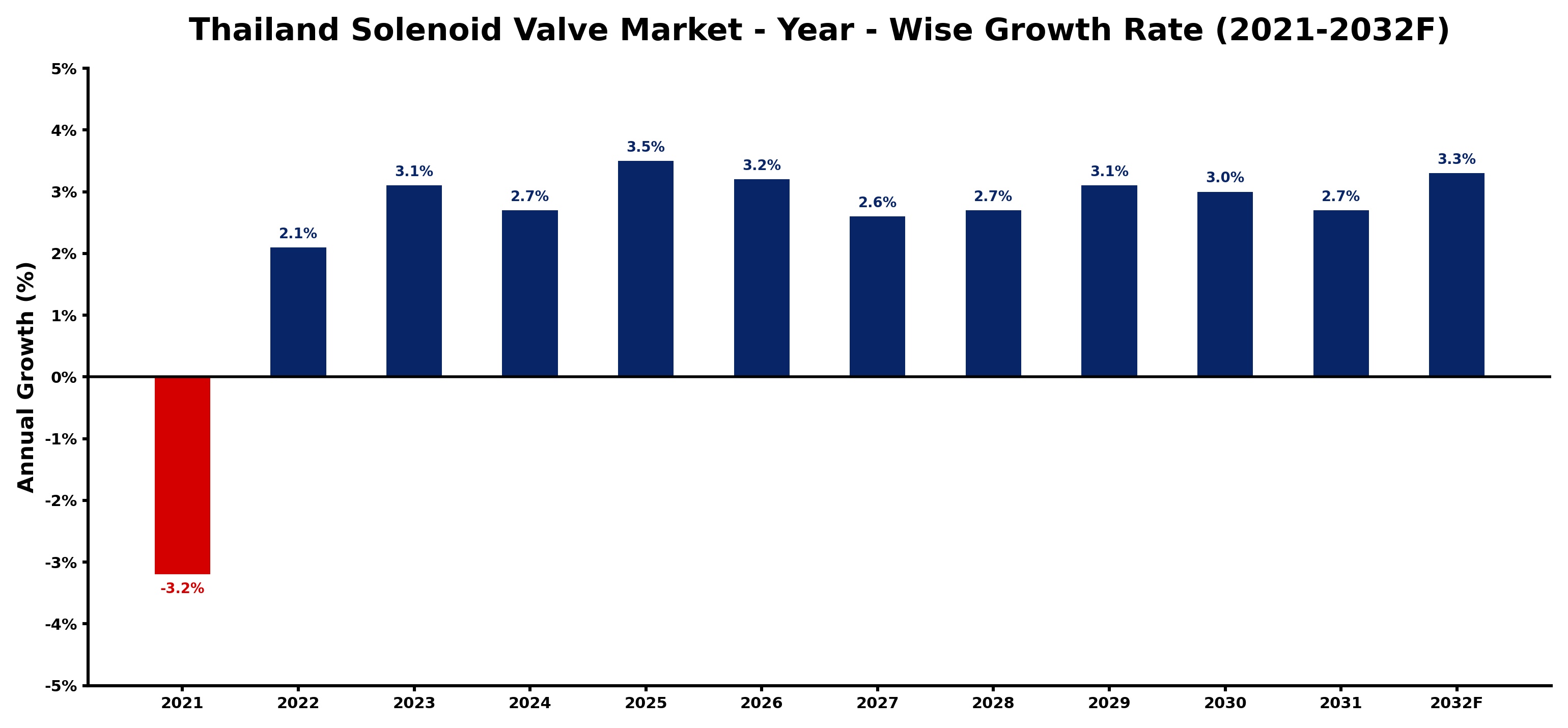
The table below presents the year‑wise growth rates along with the key drivers influencing the market
| Year | Growth Rate | Major Drivers |
| 2021 | -3.2% | Growing urbanization and commercial development |
| 2022 | 2.1% | Rapid growth in telecom and data center sectors |
| 2023 | 3.1% | Expansion of manufacturing activities |
| 2024 | 2.7% | Expansion of transportation and logistics networks |
| 2025 | 3.5% | Growing renewable energy integration projects |
| 2026 | 3.2% | Increasing industrial infrastructure investments |
| 2027 | 2.6% | Expansion of manufacturing activities |
| 2028 | 2.7% | Increasing smart city development projects |
| 2029 | 3.1% | Increasing smart city development projects |
| 2030 | 3.0% | Increasing industrial infrastructure investments |
| 2031 | 2.7% | Expansion of manufacturing activities |
| 2032 | 3.3% | Expansion of commercial construction activities |
Note - Market size estimations and growth projections presented in this report are based on 6Wresearch’s advanced forecasting approach, validated with industry datasets as of June 2026.
Thailand Solenoid Valve Market Synopsis
The strongest force shaping the Thailand Solenoid Valve Market is the rapid adoption of automation technologies across several industrial sectors. Industries such as manufacturing and water treatment are increasingly relying on solenoid valves to optimize processes and enhance efficiency.
In addition to automation, environmental concerns have propelled the use of solenoid valves in water management systems, as industries aim to adhere to strict regulations. With advancements in valve technology introducing smart features and better performance, the market is poised for continued growth.
Thailand Solenoid Valve Market Key Takeaways
- The market is driven by the need for automation in manufacturing and fluid control.
- Environmental regulations are increasing the use of solenoid valves in water treatment applications.
- Technological advancements are enhancing the functionality and performance of solenoid valves.
- Market growth is challenged by competition from alternative flow control solutions.
- Fluctuations in raw material prices can impact valve availability and pricing.
Evaluation of Restraints in Thailand Solenoid Valve Market
Despite its potential for growth, the Thailand Solenoid Valve Market faces significant restraints that could hinder its expansion. The prevalence of alternative flow control devices, such as manual valves and pneumatic actuators, poses competition, often influencing end-user preferences. Additionally, manufacturers must ensure that solenoid valves can withstand harsh industrial conditions, as reliability is a critical factor for customer satisfaction. Economic uncertainties and fluctuations in raw material costs further complicate the landscape, potentially affecting pricing and availability.
Thailand Solenoid Valve Market Trends
Several current and emerging trends are significantly shaping the Thailand Solenoid Valve Market. The integration of IoT technologies is increasingly prevalent, allowing for smarter, more efficient operation of solenoid valves. Industries are leaning towards automated solutions that can minimize human intervention, especially in environments requiring enhanced safety protocols. Furthermore, the development of energy-efficient solenoid valves is aligning with global sustainability trends, making them increasingly appealing for environmentally conscious businesses.
Thailand Solenoid Valve Market Opportunities
Opportunities for growth in the Thailand Solenoid Valve Market are abundant, particularly in sectors prioritizing automation and environmental sustainability. The water treatment industry presents a fertile ground for investment, driven by the need for efficient management of resources. Additionally, the rise in smart manufacturing and the application of Industry 4.0 principles create a demand for high-tech solenoid valves capable of integrated operations. As industries look to enhance their operational efficiency, the potential for new product development tailored to specific applications remains significant.
Government Initiatives in the Thailand Solenoid Valve Market
The Thai government has been proactive in promoting the industrial sector through various initiatives aimed at enhancing automation and efficiency. Public spending on infrastructure projects, particularly in water management and industrial automation, has created favorable conditions for the solenoid valve market. Furthermore, policies aimed at reducing environmental impact and improving resource management further support the adoption of advanced fluid control solutions, including solenoid valves.
Future Insights of the Thailand Solenoid Valve Market
Looking ahead to 2026-2032, the Thailand Solenoid Valve Market is likely to experience steady growth. The ongoing push towards automation in industries will continue to fuel demand for solenoid valves, while advancements in technology will expand their application range. As businesses increasingly prioritize efficiency and sustainability, the market will witness innovations that cater to these needs, ensuring that solenoid valves remain integral to industrial operations. The ability to adapt to changing regulations and consumer preferences will be crucial for stakeholders in navigating this evolving landscape.
Thailand Solenoid Valve Market Latest Developments (May 2025 - June 2026)
In the recent months, the Thailand Solenoid Valve Market has seen a shift towards more technologically integrated products, with many manufacturers focusing on enhancing their offerings through smart technologies. There has been increased emphasis on developing energy-efficient solutions that align with global sustainability goals. Additionally, partnerships and collaborations between technology firms and traditional valve manufacturers are on the rise, reflecting the industry's move towards innovative practices.
Thailand Solenoid Valve Market - Key Attractiveness of the Report
- 10 Years of Market Numbers
- Historical Data Starting from 2022 to 2025
- Base Year: 2025
- Forecast Data until 2032
- Key Performance Indicators Impacting the Market
- Major Upcoming Developments and Projects
Key Highlights of the Report:
- Thailand Solenoid Valve Market Outlook
- Market Size of Thailand Solenoid Valve Market, 2025
- Forecast of Thailand Solenoid Valve Market, 2032
- Historical Data and Forecast of Thailand Solenoid Valve Revenues & Volume for the Period 2022-2032F
- Thailand Solenoid Valve Market Trend Evolution
- Thailand Solenoid Valve Market Drivers and Challenges
- Thailand Solenoid Valve Price Trends
- Thailand Solenoid Valve Porter's Five Forces
- Thailand Solenoid Valve Industry Life Cycle
- Historical Data and Forecast of Thailand Solenoid Valve Market Revenues & Volume By Body Material for the Period 2022-2032F
- Historical Data and Forecast of Thailand Solenoid Valve Market Revenues & Volume By Stainless Steel for the Period 2022-2032F
- Historical Data and Forecast of Thailand Solenoid Valve Market Revenues & Volume By Brass for the Period 2022-2032F
- Historical Data and Forecast of Thailand Solenoid Valve Market Revenues & Volume By Aluminium for the Period 2022-2032F
- Historical Data and Forecast of Thailand Solenoid Valve Market Revenues & Volume By Plastic for the Period 2022-2032F
- Historical Data and Forecast of Thailand Solenoid Valve Market Revenues & Volume By Valve Design Type for the Period 2022-2032F
- Historical Data and Forecast of Thailand Solenoid Valve Market Revenues & Volume By 2-way for the Period 2022-2032F
- Historical Data and Forecast of Thailand Solenoid Valve Market Revenues & Volume By 3-way for the Period 2022-2032F
- Historical Data and Forecast of Thailand Solenoid Valve Market Revenues & Volume By 4-way for the Period 2022-2032F
- Historical Data and Forecast of Thailand Solenoid Valve Market Revenues & Volume By 5-way for the Period 2022-2032F
- Historical Data and Forecast of Thailand Solenoid Valve Market Revenues & Volume By Industry for the Period 2022-2032F
- Historical Data and Forecast of Thailand Solenoid Valve Market Revenues & Volume By Oil & Gas for the Period 2022-2032F
- Historical Data and Forecast of Thailand Solenoid Valve Market Revenues & Volume By Chemical & Petrochemical for the Period 2022-2032F
- Historical Data and Forecast of Thailand Solenoid Valve Market Revenues & Volume By Water & Wastewater for the Period 2022-2032F
- Historical Data and Forecast of Thailand Solenoid Valve Market Revenues & Volume By Food & Beverages for the Period 2022-2032F
- Historical Data and Forecast of Thailand Solenoid Valve Market Revenues & Volume By Power Generation for the Period 2022-2032F
- Historical Data and Forecast of Thailand Solenoid Valve Market Revenues & Volume By Pharmaceuticals for the Period 2022-2032F
- Historical Data and Forecast of Thailand Solenoid Valve Market Revenues & Volume By Automotive for the Period 2022-2032F
- Historical Data and Forecast of Thailand Solenoid Valve Market Revenues & Volume By Others for the Period 2022-2032F
- Thailand Solenoid Valve Import Export Trade Statistics
- Market Opportunity Assessment By Body Material
- Market Opportunity Assessment By Valve Design Type
- Market Opportunity Assessment By Industry
- Thailand Solenoid Valve Top Companies Market Share
- Thailand Solenoid Valve Competitive Benchmarking By Technical and Operational Parameters
- Thailand Solenoid Valve Company Profiles
- Thailand Solenoid Valve Key Strategic Recommendations






































