Thailand Sugar Centrifuge Market Size, Share & Growth Rate
The Thailand Sugar Centrifuge Market was estimated at USD 103 Million in 2025 and is projected to reach USD 118 Million by 2032, growing at a CAGR of 2.0% from 2026 to 2032. This growth trajectory is largely attributed to Thailand's robust sugar production and export capabilities, as well as an increasing domestic demand for high-quality sugar products. As sugar mills strive for greater operational efficiencies and product yields, the need for advanced centrifuge technology becomes even more critical.
Thailand Sugar Centrifuge Market Year-wise Growth Rate and Key Drivers
This graph highlights how the Thailand Sugar Centrifuge Market has steadily grown over the years, supported by major growth factors.
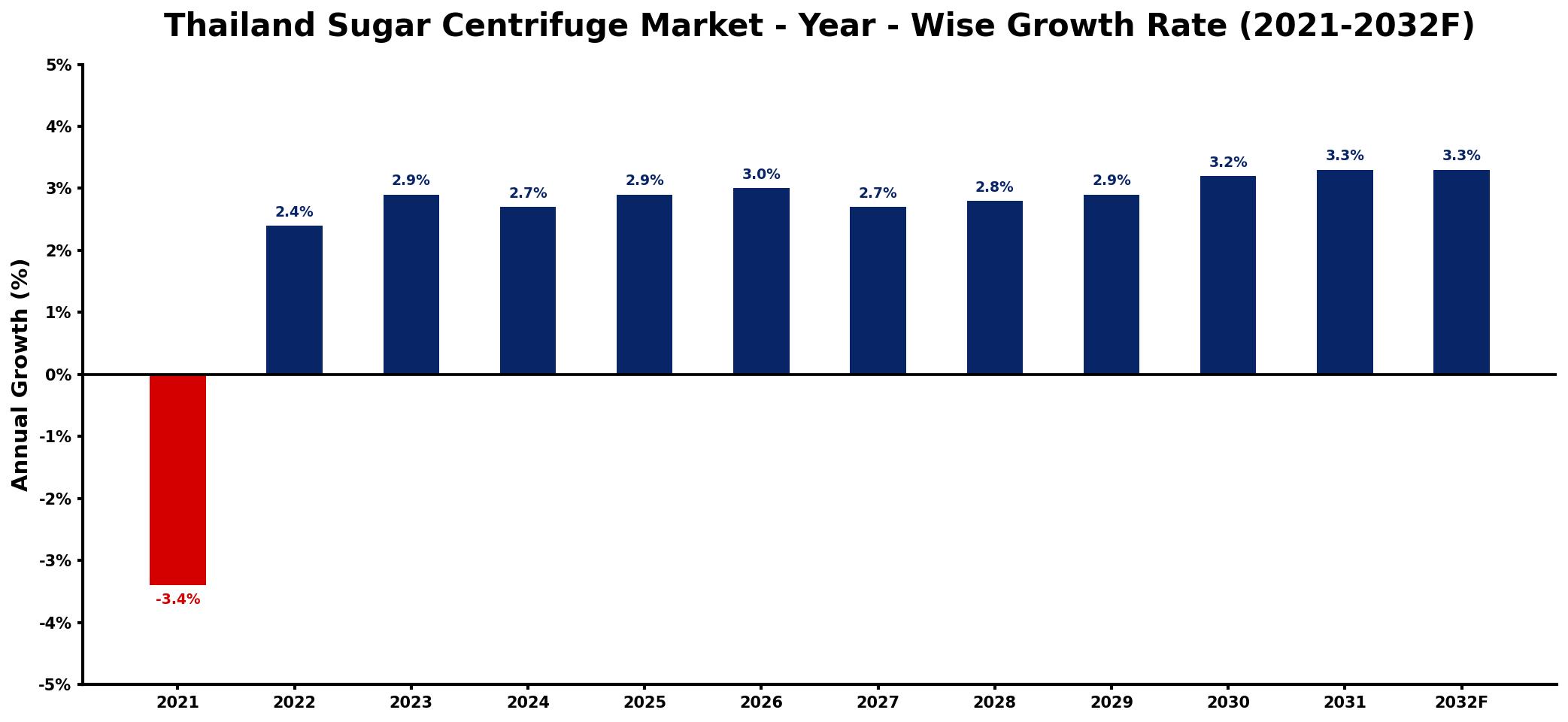
The table below presents the year‑wise growth rates along with the key drivers influencing the market
| Year | Growth Rate | Major Drivers |
| 2021 | -3.4% | decrease in agricultural investments |
| 2022 | 2.4% | rising demand for automation technology |
| 2023 | 2.9% | increased focus on food safety |
| 2024 | 2.7% | expansion of processing facilities |
| 2025 | 2.9% | growth in export markets |
| 2026 | 3.0% | advancements in energy efficiency |
| 2027 | 2.7% | enhanced regulatory compliance requirements |
| 2028 | 2.8% | increased production capacity investments |
| 2029 | 2.9% | growing consumer health awareness |
| 2030 | 3.2% | development of sustainable practices |
| 2031 | 3.3% | innovation in processing techniques |
| 2032 | 3.3% | strengthening of supply chain networks |
Note: Market size estimations and growth projections presented in this report are based on 6Wresearch's proprietary forecasting methodology, utilizing the latest available industry data, government publications, and primary research inputs.
Thailand Sugar Centrifuge Market Synopsis
In Thailand, sugar centrifuges are indispensable for achieving optimal sugar crystal separation from molasses. This function not only ensures higher product quality but also maximizes yield, making these machines central to operational success in sugar processing facilities. The growth of the market is closely tied to the expansion of sugar cane farming and the modernization of processing technologies in the country.
The market also reflects broader economic trends, with Thai sugar exports continuing to gain traction on the global stage. This international competitiveness drives local sugar producers to invest in state-of-the-art centrifuge systems that enhance processing efficiency and sustainability, reinforcing Thailands position among the top sugar exporters worldwide.
Thailand Sugar Centrifuge Market Key Takeaways
- The market is fueled by Thailands status as a leading sugar producer and exporter.
- Demand for advanced technology is paramount for optimizing production processes.
- Regulatory pressures emphasize sustainability and energy efficiency in operations.
- Manufacturers must focus on improving product quality to maintain competitive edge.
- COVID-19 has prompted shifts in operational strategies and automation investments.
Evaluation of Restraints in Thailand Sugar Centrifuge Market
Despite the favorable market conditions, several constraints persist that could hamper growth. High operational costs associated with maintaining and upgrading centrifuge technology pose significant challenges for sugar mills. The need for compliance with increasing environmental regulations can also strain budgets, particularly for smaller producers who may find it difficult to invest in the latest equipment. Additionally, the competitive threat from imported centrifuge systems can pressure local manufacturers to enhance product quality and customer service to retain market share.
Thailand Sugar Centrifuge Market Trends
Emerging trends in the Thailand Sugar Centrifuge Market include a shift towards automation and smart technology. With the advent of Industry 4.0, sugar producers are increasingly adopting automated centrifuge systems that integrate data analytics and IoT capabilities for real-time monitoring and performance optimization. Moreover, there is a growing emphasis on sustainable practices, leading to investments in energy-efficient and environmentally-friendly centrifuge solutions that minimize waste and enhance compliance with regulatory standards.
Thailand Sugar Centrifuge Market Opportunities
As Thailand continues to strengthen its position in the global sugar market, opportunities abound for innovation and investment in the sugar centrifuge segment. Companies that prioritize research and development to create next-generation centrifuge technology are well-positioned to capitalize on the rising demand for higher efficiency and better-quality sugar products. Additionally, the increasing interest in organic and specialty sugars opens new avenues for manufacturers willing to adapt their technologies to meet evolving consumer preferences.
Government Initiatives in the Thailand Sugar Centrifuge Market
The Thai government has been actively supporting the sugar industry through various initiatives aimed at enhancing productivity and sustainability. Policies focusing on agricultural innovation, subsidies for modern equipment, and research funding promote the adoption of advanced technologies in sugar processing. These efforts are aimed not only at boosting local production but also at ensuring compliance with international sustainability standards, thus benefiting the sugar centrifuge market.
Future Insights of the Thailand Sugar Centrifuge Market
Looking ahead to the period of 2026-2032, the Thailand Sugar Centrifuge Market is set to experience steady growth driven by the ongoing advancements in processing technologies and increasing export demands. The push for greater operational efficiencies and sustainability will further shape market dynamics, compelling sugar producers to upgrade their centrifuge equipment. As these trends unfold, the market is expected to adapt, integrating cutting-edge technologies while addressing regulatory pressures and environmental challenges.
Thailand Sugar Centrifuge Market Latest Developments (2025 - 2026)
Recent industry developments indicate a focus on automation and increased investment in sustainable practices. Manufacturers are increasingly introducing energy-efficient centrifuge models that comply with environmental regulations. Furthermore, collaborations between technology providers and sugar mills have been observed, aimed at enhancing operational efficiencies and reducing waste during the sugar extraction process. This trend reflects a broader commitment to modernization in the Thai sugar industry.
Thailand Sugar Centrifuge Market - Key Attractiveness of the Report
- 10 Years of Market Numbers
- Historical Data Starting from 2022 to 2025
- Base Year: 2025
- Forecast Data until 2032
- Key Performance Indicators Impacting the Market
- Major Upcoming Developments and Projects
Key Highlights of the Report:
- Thailand Sugar Centrifuge Market Outlook
- Market Size of Thailand Sugar Centrifuge Market, 2025
- Forecast of Thailand Sugar Centrifuge Market, 2032
- Historical Data and Forecast of Thailand Sugar Centrifuge Revenues & Volume for the Period 2022-2032F
- Thailand Sugar Centrifuge Market Trend Evolution
- Thailand Sugar Centrifuge Market Drivers and Challenges
- Thailand Sugar Centrifuge Price Trends
- Thailand Sugar Centrifuge Porter's Five Forces
- Thailand Sugar Centrifuge Industry Life Cycle
- Historical Data and Forecast of Thailand Sugar Centrifuge Market Revenues & Volume By Product for the Period 2022-2032F
- Historical Data and Forecast of Thailand Sugar Centrifuge Market Revenues & Volume By Batch Type Centrifugal Machines for the Period 2022-2032F
- Historical Data and Forecast of Thailand Sugar Centrifuge Market Revenues & Volume By Continuous Centrifugal Machines for the Period 2022-2032F
- Historical Data and Forecast of Thailand Sugar Centrifuge Market Revenues & Volume By End Users for the Period 2022-2032F
- Historical Data and Forecast of Thailand Sugar Centrifuge Market Revenues & Volume By Cane Processing for the Period 2022-2032F
- Historical Data and Forecast of Thailand Sugar Centrifuge Market Revenues & Volume By Beet Processing for the Period 2022-2032F
- Historical Data and Forecast of Thailand Sugar Centrifuge Market Revenues & Volume By Other Applications for the Period 2022-2032F
- Thailand Sugar Centrifuge Import Export Trade Statistics
- Market Opportunity Assessment By Product
- Market Opportunity Assessment By End Users
- Thailand Sugar Centrifuge Top Companies Market Share
- Thailand Sugar Centrifuge Competitive Benchmarking By Technical and Operational Parameters
- Thailand Sugar Centrifuge Company Profiles
- Thailand Sugar Centrifuge Key Strategic Recommendations






































