Thailand Sulphur Market Size, Share & Growth Rate
The Thailand Sulphur Market was estimated at USD 86 Million in 2025 and is projected to reach USD 99 Million by 2032, growing at a CAGR of 2.0% from 2026 to 2032. This upward trajectory is largely driven by the increasing demand from the construction sector, alongside the expanding automotive industry. Furthermore, innovative applications such as fireproofing agents and desulphurization processes are expected to bolster market opportunities for sulphur manufacturers in Thailand.
Thailand Sulphur Market Year-wise Growth Rate and Key Drivers
This graph highlights how the Thailand Sulphur Market has steadily grown over the years, supported by major growth factors.
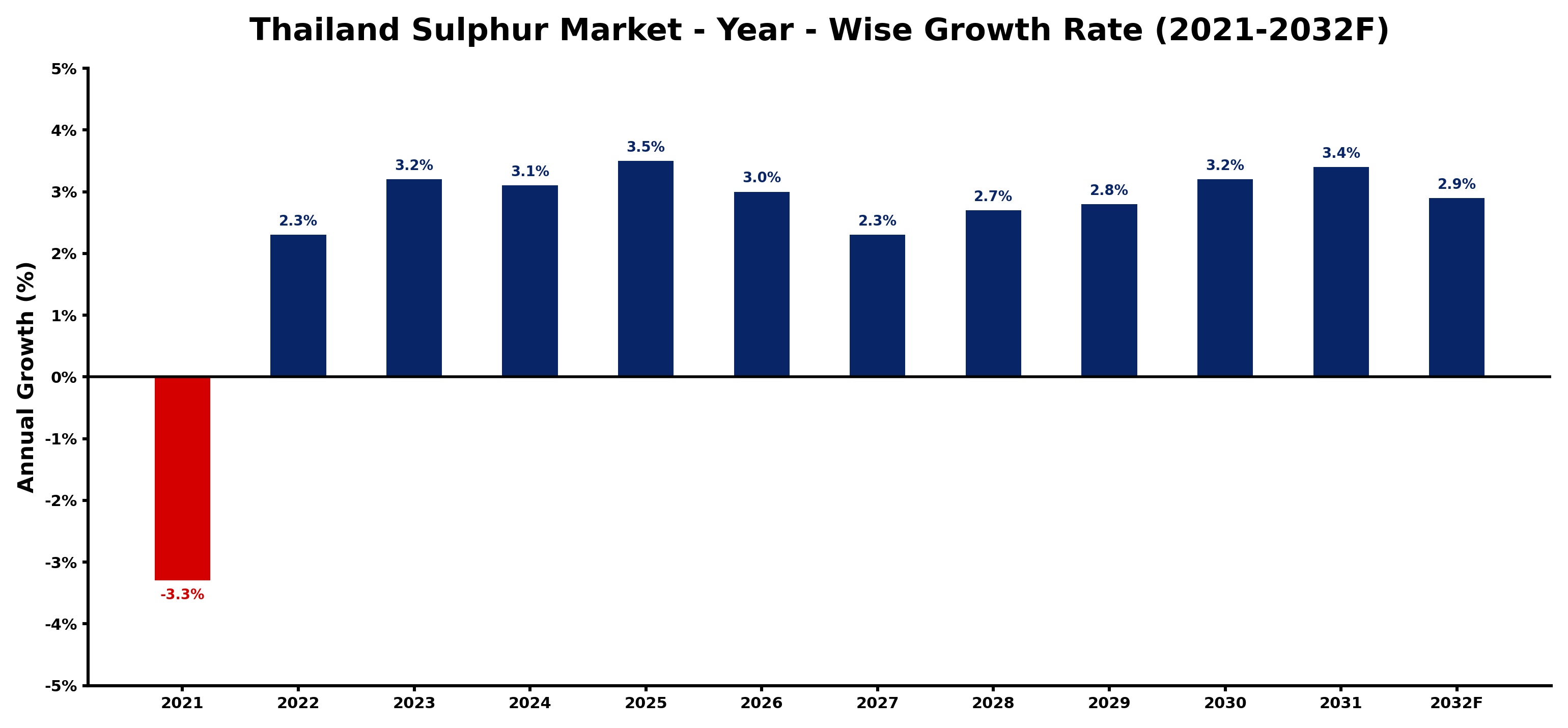
The table below presents the year‑wise growth rates along with the key drivers influencing the market
| Year | Growth Rate | Major Drivers |
| 2021 | -3.3% | Supply chain disruptions limited availability |
| 2022 | 2.3% | Industrial demand recovery stimulated growth |
| 2023 | 3.2% | Agricultural applications expanded significantly |
| 2024 | 3.1% | Chemical production increased market demand |
| 2025 | 3.5% | Construction sector growth drove consumption |
| 2026 | 3.0% | Fertilizer usage enhanced agricultural output |
| 2027 | 2.3% | Environmental regulations encouraged innovation |
| 2028 | 2.7% | Export opportunities opened new markets |
| 2029 | 2.8% | Technological advancements improved efficiency |
| 2030 | 3.2% | Sustainable practices gained market traction |
| 2031 | 3.4% | Partnerships enhanced distribution networks |
| 2032 | 2.9% | Consumer awareness drove product adoption |
Note - Market size estimations and growth projections presented in this report are based on 6Wresearch's advanced forecasting approach, validated with industry datasets as of June 2026.
Thailand Sulphur Market Synopsis
The sulphur market in Thailand is characterized by a steady growth trajectory, underpinned by the diverse applications of sulphur across various industries. Key sectors such as agriculture, chemicals, and pharmaceuticals consistently rely on sulphur as an essential raw material, ensuring sustained demand.
In recent years, the market has witnessed a paradigm shift towards sustainable practices, with companies exploring eco-friendly methods of sulphur extraction and utilization. The increasing focus on innovative applications is further energizing the market dynamics, indicating a robust outlook for the years ahead.
Thailand Sulphur Market Key Takeaways
- The sulphur market is driven by its pivotal role in agriculture, manufacturing, and chemical production.
- Innovative applications in fireproofing and desulphurization are emerging as significant growth areas.
- Market stability is challenged by the need for a consistent supply of elemental sulphur.
- The automotive industry's expansion is contributing to increased sulphur demand.
- Government policies are gradually adapting to promote sustainable practices within the industry.
Evaluation of Restraints in Thailand Sulphur Market
The Thailand sulphur market is not without its challenges. The most prominent restraint is the volatility in the supply of elemental sulphur, which is crucial for various industrial processes. Fluctuations in availability can lead to price instability, impacting both manufacturers and consumers. Additionally, while emerging applications hold promise, the adoption of new technologies often faces hurdles due to regulatory and infrastructural constraints, hindering rapid growth. The lasting effects of the COVID-19 pandemic have also created lingering uncertainties that influence production and consumption patterns across the market.
Thailand Sulphur Market Trends
Current trends in the Thailand sulphur market are heavily influenced by a shift towards sustainability. Companies are increasingly investing in technologies that not only enhance sulphur efficiency but also reduce environmental impact. Moreover, as the construction sector continues to grow, the adoption of sulphur in building materials, particularly as a fireproofing agent, is gaining momentum. The automotive industry's emphasis on cleaner production methods is also propelling the demand for sulphur in desulphurization processes.
Thailand Sulphur Market Opportunities
Significant growth opportunities lie within the agricultural sector, especially as farmers seek to improve soil quality and crop yields through advanced sulphur-based fertilizers. Furthermore, the rise of eco-friendly products opens avenues for sulphur in new applications, such as biodegradable materials. Manufacturers can also capitalize on strategic partnerships to enhance supply chain resilience and access innovative processing technologies that cater to evolving market demands.
Government Initiatives in the Thailand Sulphur Market
The Thai government is increasingly recognizing the importance of the sulphur market in supporting economic growth. Various initiatives aim to foster sustainable industrial practices and promote research into efficient sulphur extraction and application technologies. Public spending is being directed towards infrastructure improvements that facilitate better supply chain management and regulatory support for environmentally friendly sulphur applications. Such policies are instrumental in positioning the sulphur sector as a key player in Thailand's industrial landscape.
Future Insights of the Thailand Sulphur Market
Looking ahead to the period from 2026 to 2032, the Thailand sulphur market is poised for steady growth, underpinned by both domestic and international demand. As sectors like construction and automotive continue to expand, sulphur will play a critical role in meeting these industries' needs. The emphasis on innovative, sustainable practices will shape new applications and stimulate further research and development. Stakeholders who adapt to these trends and invest in sustainability will likely emerge as market leaders in this evolving landscape.
Thailand Sulphur Market Latest Developments (May 2025 - June 2026)
Recent developments in the Thailand sulphur market reflect a trend toward innovation and sustainability. Companies are increasingly collaborating on research projects aimed at enhancing the efficiency of sulphur processing. Additionally, there are ongoing efforts to integrate eco-friendly practices within the supply chain. This is leading to a diversification of sulphur applications beyond traditional uses, as stakeholders explore new opportunities in sectors like construction and agriculture.
Thailand Sulphur Market - Key Attractiveness of the Report
- 10 Years of Market Numbers
- Historical Data Starting from 2022 to 2025
- Base Year: 2025
- Forecast Data until 2032
- Key Performance Indicators Impacting the Market
- Major Upcoming Developments and Projects
Key Highlights of the Report:
- Thailand Sulphur Market Outlook
- Market Size of Thailand Sulphur Market, 2025
- Forecast of Thailand Sulphur Market, 2032
- Historical Data and Forecast of Thailand Sulphur Revenues & Volume for the Period 2022-2032F
- Thailand Sulphur Market Trend Evolution
- Thailand Sulphur Market Drivers and Challenges
- Thailand Sulphur Price Trends
- Thailand Sulphur Porter's Five Forces
- Thailand Sulphur Industry Life Cycle
- Historical Data and Forecast of Thailand Sulphur Market Revenues & Volume By Product Type for the Period 2022-2032F
- Historical Data and Forecast of Thailand Sulphur Market Revenues & Volume By Natural Gas for the Period 2022-2032F
- Historical Data and Forecast of Thailand Sulphur Market Revenues & Volume By Crude Oil for the Period 2022-2032F
- Historical Data and Forecast of Thailand Sulphur Market Revenues & Volume By Others for the Period 2022-2032F
- Historical Data and Forecast of Thailand Sulphur Market Revenues & Volume By End Users for the Period 2022-2032F
- Historical Data and Forecast of Thailand Sulphur Market Revenues & Volume By Sulfuric Acid (Fertilizers) for the Period 2022-2032F
- Historical Data and Forecast of Thailand Sulphur Market Revenues & Volume By Sulfuric Acid (Metal Manufacturing) for the Period 2022-2032F
- Historical Data and Forecast of Thailand Sulphur Market Revenues & Volume By Chemical Processing for the Period 2022-2032F
- Thailand Sulphur Import Export Trade Statistics
- Market Opportunity Assessment By Product Type
- Market Opportunity Assessment By End Users
- Thailand Sulphur Top Companies Market Share
- Thailand Sulphur Competitive Benchmarking By Technical and Operational Parameters
- Thailand Sulphur Company Profiles
- Thailand Sulphur Key Strategic Recommendations






































