Thailand Tailors Scissor Market Size, Share & Growth Rate
The Thailand Tailors Scissor Market was estimated at USD 380 Million in 2025 and is projected to reach USD 505 Million by 2032, growing at a CAGR of 4.1% from 2026 to 2032. This growth trajectory is primarily fueled by the resurgence of the fashion and textile industry, which has seen an uptick in demand for precision cutting tools. Furthermore, the rise of e-commerce and customization trends has driven tailors and manufacturers to seek high-quality scissors, reinforcing the importance of reliable tools in the competitive garment sector.
Thailand Tailors Scissor Market Year-wise Growth Rate and Key Drivers
This graph highlights how the Thailand Tailors Scissor Market has steadily grown over the years, supported by major growth factors.
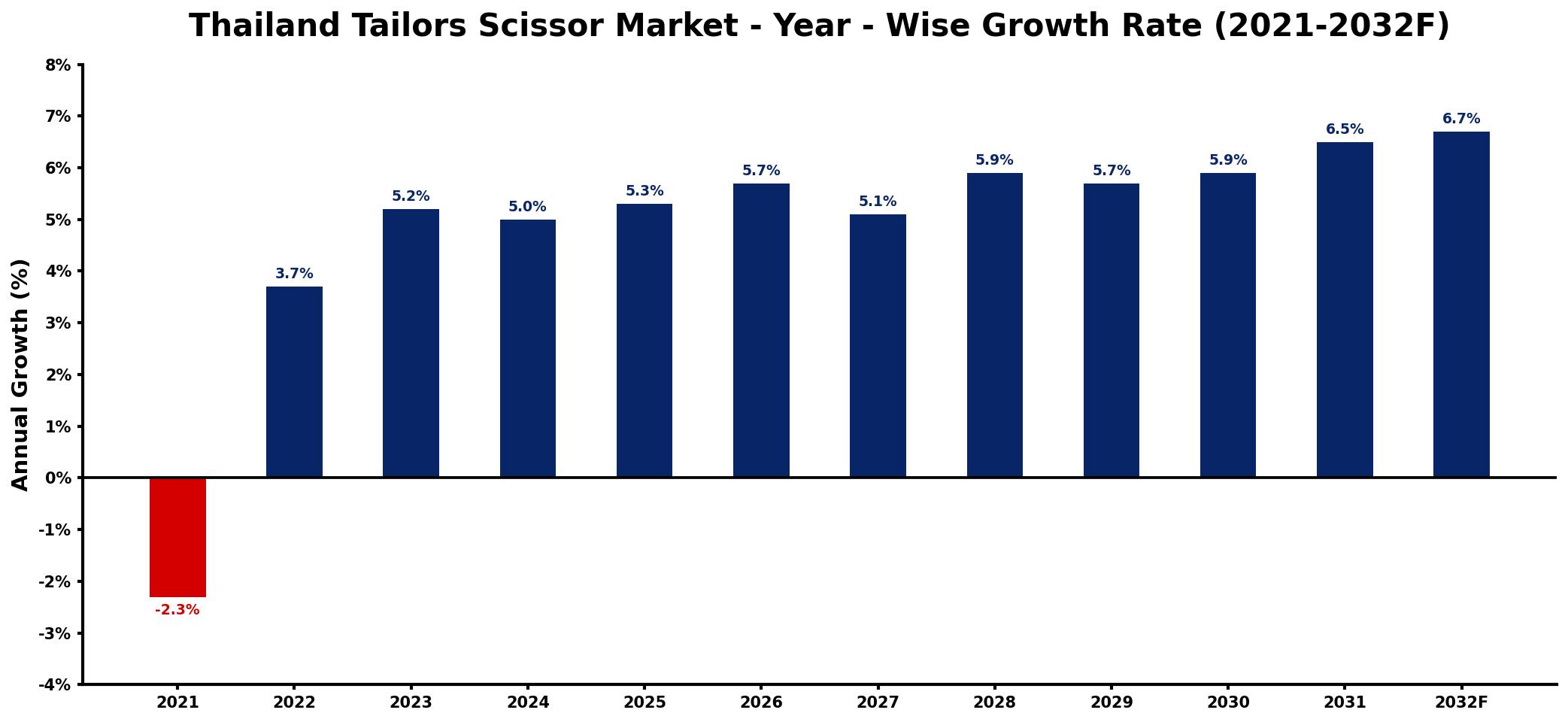
The table below presents the year‑wise growth rates along with the key drivers influencing the market
| Year | Growth Rate | Major Drivers |
| 2021 | -2.3% | decreased consumer spending on tools |
| 2022 | 3.7% | rising demand from fashion designers |
| 2023 | 5.2% | growth in textile manufacturing sector |
| 2024 | 5.0% | increased export opportunities emerging |
| 2025 | 5.3% | expansion of online retail platforms |
| 2026 | 5.7% | surge in home sewing activities |
| 2027 | 5.1% | growing interest in DIY projects |
| 2028 | 5.9% | enhanced product innovation strategies |
| 2029 | 5.7% | rising popularity of bespoke tailoring |
| 2030 | 5.9% | increased investments in manufacturing |
| 2031 | 6.5% | strengthening international trade flows |
| 2032 | 6.7% | growing awareness of quality tools |
Note: Market size estimations and growth projections presented in this report are based on 6Wresearch's proprietary forecasting methodology, utilizing the latest available industry data, government publications, and primary research inputs.
Thailand Tailors Scissor Market Synopsis
The Thailand Tailors Scissor Market is a vital component of the countrys robust garment and textile landscape, where precision is paramount. Local tailors and textile workers increasingly demand high-quality scissors with ergonomic designs and durable blades that cater to their intricate cutting needs.
With a growing emphasis on craftsmanship, the market is becoming highly competitive. As both local manufacturers and international brands vie for market share, buyers are prioritizing sharpness, ease of maintenance, and overall durability, contributing to a dynamic marketplace.
Thailand Tailors Scissor Market Key Takeaways
- The market is expected to grow significantly, reaching USD 505 Million by 2032.
- High-quality, ergonomic designs are driving customer preferences in the scissor segment.
- The influence of e-commerce is reshaping how tailors procure their essential tools.
- Competition is intensifying as both local and international brands expand their offerings.
- Increasing customization trends in fashion are creating new avenues for scissors demand.
Evaluation of Restraints in Thailand Tailors Scissor Market
While the Thailand Tailors Scissor Market is positioned for growth, it encounters several restraints that could limit its expansion. The shift toward automation in garment manufacturing may reduce the reliance on traditional tailor scissors as industries evolve. Additionally, the influx of imported scissors offers consumers competitive pricing and options, thereby challenging local manufacturers to enhance their value proposition. Adapting to these changes while maintaining a focus on quality and precision will be essential for future success.
Thailand Tailors Scissor Market Trends
Current trends indicate a strong move towards ergonomic designs that enhance user comfort, a critical factor for professionals who spend hours cutting fabric. Moreover, the integration of online platforms for purchasing scissors is gaining momentum, as tailors look for convenient and efficient ways to acquire the tools they need. Sustainability is also becoming increasingly important, prompting manufacturers to explore eco-friendly materials and production methods, thereby appealing to environmentally conscious consumers.
Thailand Tailors Scissor Market Opportunities
Emerging opportunities in the Thailand Tailors Scissor Market largely stem from the expansion of the garment sector and the rising interest in crafting and DIY activities. Tailors are on the lookout for innovative tools that can enhance their productivity and creativity. By diversifying product lines to include scissors suitable for crafting and home sewing, manufacturers can tap into new customer segments. Additionally, collaboration with fashion designers and educational institutions can provide avenues for brand building and community engagement.
Government Initiatives in the Thailand Tailors Scissor Market
The Thai government has recognized the significance of the textile and garment sector, often implementing initiatives aimed at boosting domestic production and exports. Programs designed to support local manufacturers through grants, subsidies, and skill development are increasingly common. These initiatives not only strengthen the market but also ensure that local tailors have access to the high-quality tools they need to compete globally.
Future Insights of the Thailand Tailors Scissor Market
Looking ahead to 2026-2032, the Thailand Tailors Scissor Market is anticipated to witness substantial advancements driven by technological innovation. The focus will likely shift towards developing scissors that incorporate smart technology for enhanced precision and user-friendliness. Furthermore, as fashion trends evolve, the market is expected to adapt, aligning product offerings with changing consumer preferences. This agility will be vital for manufacturers aiming to maintain relevance in a fast-paced environment.
Thailand Tailors Scissor Market Latest Developments (2025 - 2026)
In recent months, the Thailand Tailors Scissor Market has seen a wave of innovation as companies explore advanced materials and manufacturing techniques. There's a notable emphasis on ergonomic features, aligning with global health and safety trends. Additionally, partnerships with fashion schools and workshops have increased, enhancing the visibility of high-quality scissors among budding designers and tailors. These developments indicate a vibrant market poised for growth.
Thailand Tailors Scissor Market - Key Attractiveness of the Report
- 10 Years of Market Numbers
- Historical Data Starting from 2022 to 2025
- Base Year: 2025
- Forecast Data until 2032
- Key Performance Indicators Impacting the Market
- Major Upcoming Developments and Projects
Key Highlights of the Report:
- Thailand Tailors Scissor Market Outlook
- Market Size of Thailand Tailors Scissor Market, 2025
- Forecast of Thailand Tailors Scissor Market, 2032
- Historical Data and Forecast of Thailand Tailors Scissor Revenues & Volume for the Period 2022-2032F
- Thailand Tailors Scissor Market Trend Evolution
- Thailand Tailors Scissor Market Drivers and Challenges
- Thailand Tailors Scissor Price Trends
- Thailand Tailors Scissor Porter's Five Forces
- Thailand Tailors Scissor Industry Life Cycle
- Historical Data and Forecast of Thailand Tailors Scissor Market Revenues & Volume By Product for the Period 2022-2032F
- Historical Data and Forecast of Thailand Tailors Scissor Market Revenues & Volume By Standard Scissors for the Period 2022-2032F
- Historical Data and Forecast of Thailand Tailors Scissor Market Revenues & Volume By Customized Scissors for the Period 2022-2032F
- Historical Data and Forecast of Thailand Tailors Scissor Market Revenues & Volume By Applications for the Period 2022-2032F
- Historical Data and Forecast of Thailand Tailors Scissor Market Revenues & Volume By Household for the Period 2022-2032F
- Historical Data and Forecast of Thailand Tailors Scissor Market Revenues & Volume By Commercial for the Period 2022-2032F
- Thailand Tailors Scissor Import Export Trade Statistics
- Market Opportunity Assessment By Product
- Market Opportunity Assessment By Applications
- Thailand Tailors Scissor Top Companies Market Share
- Thailand Tailors Scissor Competitive Benchmarking By Technical and Operational Parameters
- Thailand Tailors Scissor Company Profiles
- Thailand Tailors Scissor Key Strategic Recommendations






































