Thailand Television Broadcasting Market Size, Share & Growth Rate
The Thailand Television Broadcasting Market was estimated at USD 452 Million in 2025 and is projected to reach USD 589 Million by 2032, growing at a CAGR of 3.9% from 2026 to 2032. This growth trajectory is fueled by the increasing penetration of digital broadcasting technologies and the burgeoning popularity of over-the-top (OTT) platforms that offer diverse content choices. Furthermore, the expanding middle-class population is enhancing advertising spending, ensuring the sustainability of traditional and digital broadcasting channels alike.
Thailand Television Broadcasting Market Year-wise Growth Rate and Key Drivers
This graph highlights how the Thailand Television Broadcasting Market has steadily grown over the years, supported by major growth factors.
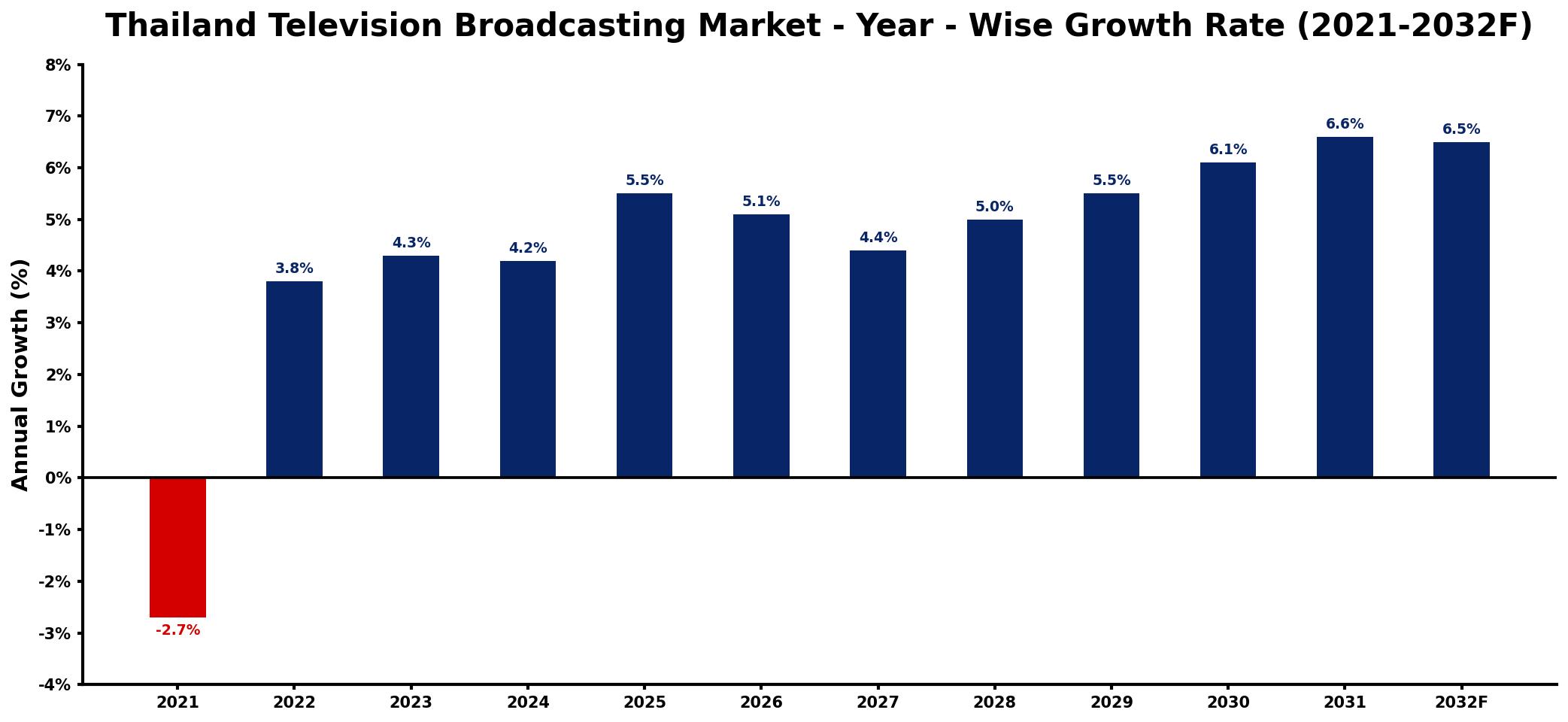
The table below presents the year‑wise growth rates along with the key drivers influencing the market
| Year | Growth Rate | Major Drivers |
| 2021 | -2.7% | decreased advertising revenue streams |
| 2022 | 3.8% | increased digital content consumption |
| 2023 | 4.3% | expansion of streaming platforms |
| 2024 | 4.2% | rise in local content production |
| 2025 | 5.5% | growing demand for premium content |
| 2026 | 5.1% | increased investments in technology |
| 2027 | 4.4% | enhanced viewer engagement strategies |
| 2028 | 5.0% | improved processing technologies adoption |
| 2029 | 5.5% | growing interest in interactive formats |
| 2030 | 6.1% | growing regional consumption patterns |
| 2031 | 6.6% | increased partnerships with influencers |
| 2032 | 6.5% | growth in cross-platform integration |
Note: Market size estimations and growth projections presented in this report are based on 6Wresearch's proprietary forecasting methodology, utilizing the latest available industry data, government publications, and primary research inputs.
Thailand Television Broadcasting Market Synopsis
Thailand's television broadcasting landscape is undergoing a notable transformation, driven by rapid digitalization and the rise of diverse content platforms. With both free-to-air and cable/satellite services flourishing, broadcasters are innovating to maintain audience engagement in an increasingly competitive environment.
The blend of traditional broadcasting with modern streaming services is reshaping how Thai consumers engage with television content. Cultural events and live sports continue to be pivotal in drawing audiences, reaffirming the importance of conventional broadcasts even as digital alternatives gain traction.
Thailand Television Broadcasting Market Key Takeaways
- The market is experiencing a shift towards digital broadcasting, enhancing signal quality and channel diversity.
- Rising disposable incomes among the middle class are driving increased advertising budgets and content consumption.
- OTT platforms are expanding the competitive landscape, offering viewers greater content variety.
- Live sports and cultural broadcasts remain vital for attracting traditional viewers.
- Investment in digital infrastructure is essential for broadcasters to stay competitive and relevant.
Evaluation of Restraints in Thailand Television Broadcasting Market
The Thailand Television Broadcasting Market faces specific constraints primarily linked to the evolution of viewer preferences. As consumers shift towards digital platforms, traditional broadcasters are compelled to adapt, often requiring significant investment in updated infrastructure and technology. Additionally, issues related to content piracy and intellectual property rights pose significant challenges, threatening the revenue streams that broadcasters depend on. These factors necessitate strategic adjustments and a proactive approach to remain competitive in a rapidly changing media landscape.
Thailand Television Broadcasting Market Trends
A significant trend influencing the Thailand Television Broadcasting Market is the convergence of traditional and digital media. Broadcasters are increasingly adopting hybrid models, blending linear television with on-demand services. This integration caters to evolving consumer habits, where flexibility and accessibility are paramount.
Another emerging trend is the use of data analytics and artificial intelligence to tailor content and advertising, enhancing viewer engagement. As broadcasters refine their offerings based on viewer preferences, the competition for audience loyalty intensifies.
Thailand Television Broadcasting Market Opportunities
The Thailand Television Broadcasting Market presents several growth opportunities, particularly in content creation and distribution. With the rising demand for localized content, there is a gap for innovative programming that resonates with diverse Thai audiences. Investment in original content production can significantly boost viewer engagement and advertiser interest.
Moreover, strategic partnerships between traditional broadcasters and digital platforms can enhance content reach and audience engagement. This synergy enables a more comprehensive content strategy, catering to varied viewer preferences across the spectrum.
Government Initiatives in the Thailand Television Broadcasting Market
The Thai government has been proactive in supporting the television broadcasting sector through various initiatives aimed at encouraging digital transition and content innovation. Policies promoting digital infrastructure development are pivotal, enabling broadcasters to enhance signal quality and channel offerings. Furthermore, public spending on cultural and educational programming seeks to enrich the media landscape and promote national values, benefiting both consumers and broadcasters.
Future Insights of the Thailand Television Broadcasting Market
Looking ahead to 2026-2032, the Thailand Television Broadcasting Market is poised for continued growth, driven by advancements in technology and changing consumer behaviors. The anticipated increase in digital adoption will likely lead to a more competitive environment, challenging traditional broadcasters to innovate and differentiate their offerings.
Moreover, as OTT services continue to flourish, the integration of traditional broadcasting with digital strategies will become essential for survival. With an evolving audience landscape, broadcasters who can effectively harness new technologies and audience insights will be well-positioned to thrive.
Thailand Television Broadcasting Market Latest Developments (2025 - 2026)
Recent developments in the Thailand Television Broadcasting Market showcase a shift towards enhanced viewer engagement strategies. Broadcasters are increasingly investing in advanced technologies, such as AI-driven analytics, to refine content delivery. Furthermore, collaborations between traditional networks and emerging digital platforms have gained momentum, enabling a broader distribution of content and fostering viewer loyalty.
Thailand Television Broadcasting Market - Key Attractiveness of the Report
- 10 Years of Market Numbers
- Historical Data Starting from 2022 to 2025
- Base Year: 2025
- Forecast Data until 2032
- Key Performance Indicators Impacting the Market
- Major Upcoming Developments and Projects
Key Highlights of the Report:
- Thailand Television Broadcasting Market Outlook
- Market Size of Thailand Television Broadcasting Market, 2025
- Forecast of Thailand Television Broadcasting Market, 2032
- Historical Data and Forecast of Thailand Television Broadcasting Revenues & Volume for the Period 2022-2032F
- Thailand Television Broadcasting Market Trend Evolution
- Thailand Television Broadcasting Market Drivers and Challenges
- Thailand Television Broadcasting Price Trends
- Thailand Television Broadcasting Porter's Five Forces
- Thailand Television Broadcasting Industry Life Cycle
- Historical Data and Forecast of Thailand Television Broadcasting Market Revenues & Volume By Type for the Period 2022-2032F
- Historical Data and Forecast of Thailand Television Broadcasting Market Revenues & Volume By Television Station for the Period 2022-2032F
- Historical Data and Forecast of Thailand Television Broadcasting Market Revenues & Volume By Television Network for the Period 2022-2032F
- Historical Data and Forecast of Thailand Television Broadcasting Market Revenues & Volume By Broadcaster Type for the Period 2022-2032F
- Historical Data and Forecast of Thailand Television Broadcasting Market Revenues & Volume By Public for the Period 2022-2032F
- Historical Data and Forecast of Thailand Television Broadcasting Market Revenues & Volume By Commercial for the Period 2022-2032F
- Historical Data and Forecast of Thailand Television Broadcasting Market Revenues & Volume By Revenue Source for the Period 2022-2032F
- Historical Data and Forecast of Thailand Television Broadcasting Market Revenues & Volume By Subscription-based for the Period 2022-2032F
- Historical Data and Forecast of Thailand Television Broadcasting Market Revenues & Volume By Advertisement-based for the Period 2022-2032F
- Thailand Television Broadcasting Import Export Trade Statistics
- Market Opportunity Assessment By Type
- Market Opportunity Assessment By Broadcaster Type
- Market Opportunity Assessment By Revenue Source
- Thailand Television Broadcasting Top Companies Market Share
- Thailand Television Broadcasting Competitive Benchmarking By Technical and Operational Parameters
- Thailand Television Broadcasting Company Profiles
- Thailand Television Broadcasting Key Strategic Recommendations






































