Thailand Tensile Testing Equipment Market Size, Share & Growth Rate
The Thailand Tensile Testing Equipment Market was estimated at USD 204 Million in 2025 and is projected to reach USD 236 Million by 2032, growing at a CAGR of 2.1% from 2026 to 2032. This growth is underpinned by the expanding manufacturing and construction sectors, as well as the heightened focus on research and development within industries such as automotive and aerospace. The increased emphasis on quality control standards further necessitates the widespread adoption of advanced tensile testing machinery across various applications.
Thailand Tensile Testing Equipment Market Year-wise Growth Rate and Key Drivers
This graph highlights how the Thailand Tensile Testing Equipment Market has steadily grown over the years, supported by major growth factors.
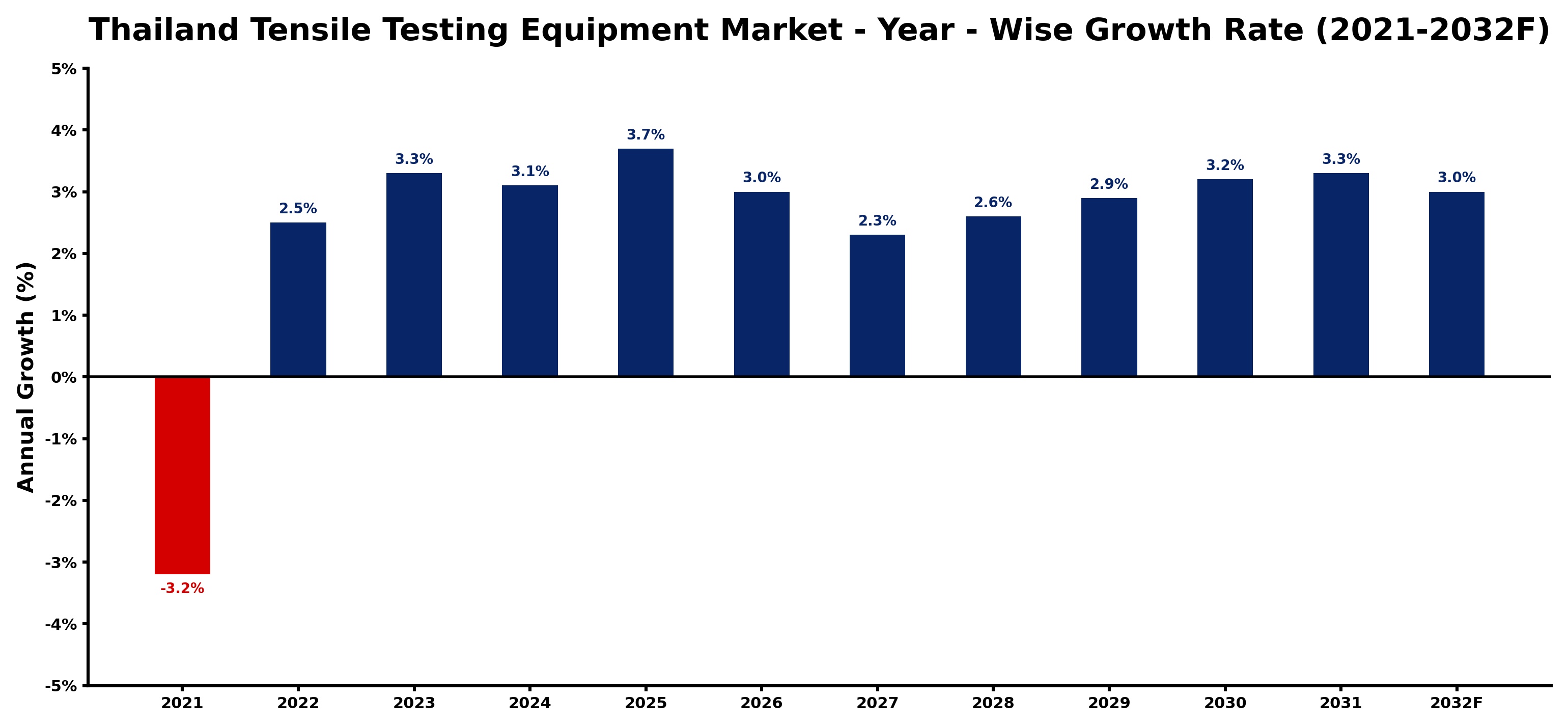
The table below presents the year‑wise growth rates along with the key drivers influencing the market
| Year | Growth Rate | Major Drivers |
| 2021 | -3.2% | Rapid growth in telecom and data center sectors |
| 2022 | 2.5% | Increasing industrial infrastructure investments |
| 2023 | 3.3% | Growing renewable energy integration projects |
| 2024 | 3.1% | Increasing industrial infrastructure investments |
| 2025 | 3.7% | Increasing industrial automation investments |
| 2026 | 3.0% | Rising electricity demand across industries |
| 2027 | 2.3% | Government infrastructure modernization initiatives |
| 2028 | 2.6% | Increasing smart city development projects |
| 2029 | 2.9% | Increasing smart city development projects |
| 2030 | 3.2% | Increasing industrial automation investments |
| 2031 | 3.3% | Expansion of commercial construction activities |
| 2032 | 3.0% | Expansion of manufacturing activities |
Note - Market size estimations and growth projections presented in this report are based on 6Wresearch’s advanced forecasting approach, validated with industry datasets as of June 2026.
Thailand Tensile Testing Equipment Market Synopsis
Recent momentum in the Thailand Tensile Testing Equipment market reflects a robust response to the growing demands of multiple sectors. As industries adapt to stringent quality standards and compliance measures, the need for precise testing equipment becomes ever more critical.
Looking ahead, the market is expected to navigate challenges such as competition from low-cost imports and the need for technological upgrades. Nonetheless, the ongoing investment in advanced testing solutions positions the Thailand market for sustained growth as manufacturers increasingly prioritize quality assurance.
Thailand Tensile Testing Equipment Market Key Takeaways
- The market is witnessing steady growth driven by the booming manufacturing sector.
- Compliance with international quality standards is a significant factor boosting equipment adoption.
- Research and development activities in various industries are propelling the demand for advanced testing solutions.
- Technological advancements present both opportunities and challenges for manufacturers in the market.
- Operational expertise in handling complex equipment remains a key barrier to widespread adoption.
Evaluation of Restraints in Thailand Tensile Testing Equipment Market
One notable restraint in the Thailand Tensile Testing Equipment market is the significant competition posed by low-cost imported testing machines. These imports can often undermine the sales of domestic manufacturers, creating a challenging landscape for local businesses to thrive. Additionally, as the technology underlying tensile testing evolves, manufacturers are pressed to continually invest in R&D to keep pace with customer expectations for sophisticated features. This demand for innovation, coupled with a shortage of skilled operators capable of managing advanced testing machinery, further complicates market dynamics.
Thailand Tensile Testing Equipment Market Trends
The market is currently observing a shift towards automation and digitalization within tensile testing equipment. Many manufacturers are integrating smart technologies and remote monitoring capabilities, thereby enhancing operational efficiency and accuracy. The increasing interest in sustainability is also influencing trends, with many organizations seeking eco-friendly testing solutions. Furthermore, a heightened focus on material performance in sectors like aerospace and automotive is encouraging innovative testing methodologies to better evaluate mechanical properties.
Thailand Tensile Testing Equipment Market Opportunities
There exists a significant growth opportunity in the development of highly specialized testing equipment tailored to niche applications within emerging sectors, such as renewable energy and advanced materials. The rise of smart manufacturing practices is also prompting investment in testing solutions that offer improved data analytics capabilities. Furthermore, as regulatory frameworks tighten around product quality and safety standards, there will be a corresponding uptick in the demand for comprehensive testing services across various industries.
Government Initiatives in the Thailand Tensile Testing Equipment Market
The Thai government is actively promoting policies aimed at boosting the manufacturing sector, which includes enhancing quality control measures. Various initiatives are in place to support technology adoption and innovation in industrial practices. Public spending directed towards infrastructure development also indirectly benefits the tensile testing equipment market, creating a ripple effect that encourages investment in advanced testing technologies to meet the demands of growing industries.
Future Insights of the Thailand Tensile Testing Equipment Market
From 2026 to 2032, the Thailand Tensile Testing Equipment market is likely to evolve in response to technological innovations and changing industry standards. The adoption of next-generation testing solutions, coupled with increasing demand from the automotive and aerospace sectors, is expected to be pivotal. Enhanced focus on compliance with global quality standards will further drive the need for advanced testing equipment. As manufacturers adapt to these evolving dynamics, the market is set for a trajectory of steady growth, with opportunities for players who are agile and willing to innovate.
Thailand Tensile Testing Equipment Market Latest Developments (May 2025 - June 2026)
Recent developments in the Thailand Tensile Testing Equipment market indicate a strong push towards integrating smart technologies and automation. Manufacturers are focusing on enhancing the digital capabilities of their testing solutions, which includes features for real-time data analysis and remote operation. Additionally, industry players are increasingly engaging in strategic partnerships to drive innovation and expand their product offerings, ensuring they remain competitive in a rapidly evolving landscape.
Thailand Tensile Testing Equipment Market - Key Attractiveness of the Report
- 10 Years of Market Numbers
- Historical Data Starting from 2022 to 2025
- Base Year: 2025
- Forecast Data until 2032
- Key Performance Indicators Impacting the Market
- Major Upcoming Developments and Projects
Key Highlights of the Report:
- Thailand Tensile Testing Equipment Market Outlook
- Market Size of Thailand Tensile Testing Equipment Market, 2025
- Forecast of Thailand Tensile Testing Equipment Market, 2032
- Historical Data and Forecast of Thailand Tensile Testing Equipment Revenues & Volume for the Period 2022-2032F
- Thailand Tensile Testing Equipment Market Trend Evolution
- Thailand Tensile Testing Equipment Market Drivers and Challenges
- Thailand Tensile Testing Equipment Price Trends
- Thailand Tensile Testing Equipment Porter's Five Forces
- Thailand Tensile Testing Equipment Industry Life Cycle
- Historical Data and Forecast of Thailand Tensile Testing Equipment Market Revenues & Volume By Equipment Type for the Period 2022-2032F
- Historical Data and Forecast of Thailand Tensile Testing Equipment Market Revenues & Volume By Universal Testing Machine for the Period 2022-2032F
- Historical Data and Forecast of Thailand Tensile Testing Equipment Market Revenues & Volume By Hydraulic for the Period 2022-2032F
- Historical Data and Forecast of Thailand Tensile Testing Equipment Market Revenues & Volume By Electromechanical for the Period 2022-2032F
- Historical Data and Forecast of Thailand Tensile Testing Equipment Market Revenues & Volume By Others for the Period 2022-2032F
- Historical Data and Forecast of Thailand Tensile Testing Equipment Market Revenues & Volume By End-User Industry for the Period 2022-2032F
- Historical Data and Forecast of Thailand Tensile Testing Equipment Market Revenues & Volume By Industrial Manufacturing for the Period 2022-2032F
- Historical Data and Forecast of Thailand Tensile Testing Equipment Market Revenues & Volume By Automotive for the Period 2022-2032F
- Historical Data and Forecast of Thailand Tensile Testing Equipment Market Revenues & Volume By Construction for the Period 2022-2032F
- Historical Data and Forecast of Thailand Tensile Testing Equipment Market Revenues & Volume By Others for the Period 2022-2032F
- Thailand Tensile Testing Equipment Import Export Trade Statistics
- Market Opportunity Assessment By Equipment Type
- Market Opportunity Assessment By End-User Industry
- Thailand Tensile Testing Equipment Top Companies Market Share
- Thailand Tensile Testing Equipment Competitive Benchmarking By Technical and Operational Parameters
- Thailand Tensile Testing Equipment Company Profiles
- Thailand Tensile Testing Equipment Key Strategic Recommendations






































