Topics Covered in Thailand Termite Bait Systems Market Report
Thailand Termite Bait Systems Market Report thoroughly covers the market by station type, termite type and application. Thailand Termite Bait Systems Market Outlook report provides an unbiased and detailed analysis of the ongoing Thailand Termite Bait Systems Market trends, opportunities/high growth areas, and market drivers. This would help stakeholders devise and align their market strategies according to the current and future market dynamics.
Thailand Termite Bait Systems Market Synopsis
The Thailand termite bait systems market experienced notable growth during 2021-2024, driven by various key factors. The increasing urbanization and rapid expansion of residential, commercial, and luxury developments, particularly in termite-prone regions such as Bangkok, significantly fueled the demand for effective termite control solutions. Additionally, government initiatives such as Soft Loan program stimulated the residential construction sector, which in turn drove the demand for termite control in both new and renovated homes. The expansion of Thailand's hospitality sector further amplified the demand for termite protection in high-value properties such as hotels and resorts. The Thai market also saw a growing emphasis on eco-friendly and sustainable pest control solutions due to the government's "Thailand 4.0" policy, which aims to modernize agriculture through the adoption of smart technologies.
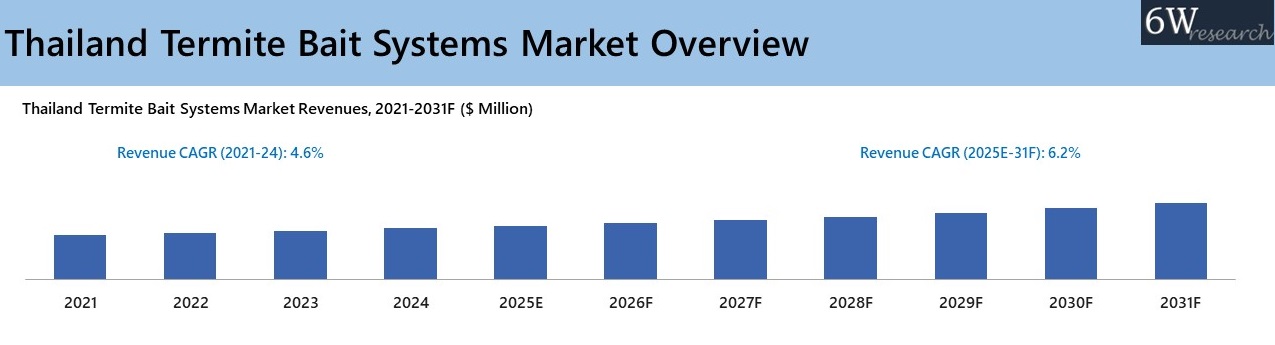
According to 6Wresearch, the Thailand Termite Bait Systems Market revenue is projected to grow at a CAGR of 6.2% from 2025 to 2031. The market growth would be driven by ongoing infrastructure projects, urbanization, and awareness about the economic impact of termite infestations and the growing adoption of green building standards. As urbanization continues to expand in both residential and commercial sectors, the need for reliable termite protection will intensify.
By January 2025, despite a slight 0.85% decline in the Manufacturing Production Index (MPI) due to global economic uncertainties, Thailand’s industrial sector remained resilient. Large-scale developments, including Porsche Sky Villas (2025-2028), Mandarin Oriental Residences (2025-2027), and high-profile hospitality projects such as InterContinental Bangkok Chinatown (2027), The Okura Prestige Sukhumvit Bangkok Hotel and Spa (2028), and Kimpton Pattaya (2028), have expected to further drive demand for termite bait systems.
The increasing awareness about the potential economic impact of termite infestations would also boost demand for effective, long-term protection solutions. The continued adoption of green building standards and eco-friendly practices in the construction industry would further drive the demand for non-toxic, sustainable termite bait systems. Thailand’s sustainable agricultural sector is also advancing with initiatives such as the Thai Rice: Strengthening Climate-Smart Rice Farming Project (2024–2028), which helps smallholder farmers adopt climate-smart technologies such as Farm-level Water Management (FWM), Laser Land Levelling (LLL), and Integrated Pest Management (IPM), reducing reliance on chemical pesticides.
Further, the Twenty-Year Strategy (2017–2036) by the Ministry of Agriculture and Cooperatives (MOAC) promotes eco-friendly pest control and sustainable resource management. As the market continues to evolve, stakeholders in the termite bait systems market could expect growing opportunities as demand shifts towards more efficient, eco-friendly, and advanced termite control technologies.
Market Segmentation By Station Type
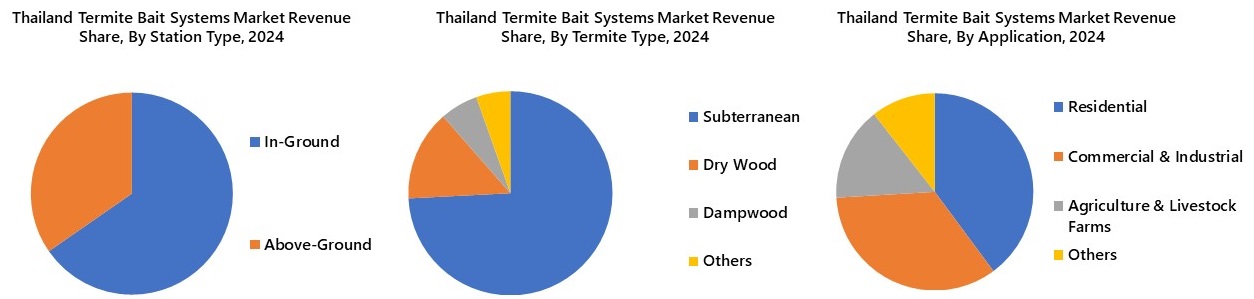
In-Ground segment is projected to have the largest revenue size by 2031 and the fastest growth during 2025-2031, driven by the increasing demand for permanent, long-term termite protection solutions in both residential and commercial developments, especially in high-value urban projects and large-scale infrastructure projects, due to their low maintenance requirements . The segment's ability to offer robust protection and durability in various soil conditions has expected to fuel its rapid adoption. Further, they are less visible, maintaining aesthetic value while protecting properties.
Market Segmentation By Termite Type
The subterranean termite segment is projected to have the largest revenue size by 2031 and the fastest growth during 2025-2031, as they are being the most destructive and widespread species and driving the highest demand for termite bait systems due to their ability to cause significant structural damage and their tendency to infest both residential and commercial properties. Thus, users tend to apply bait systems to remove these termites from source. Further, as urbanization and infrastructure projects increase, so does the risk of infestations, particularly in areas where these termites thrive.
The dry wood termite segment is expected to witness the second fastest growth by 2031. fueled by the increasing awareness of dry wood termites in regions with specific climate conditions, leading to higher demand for targeted treatment solutions.
Market Segmentation By Application
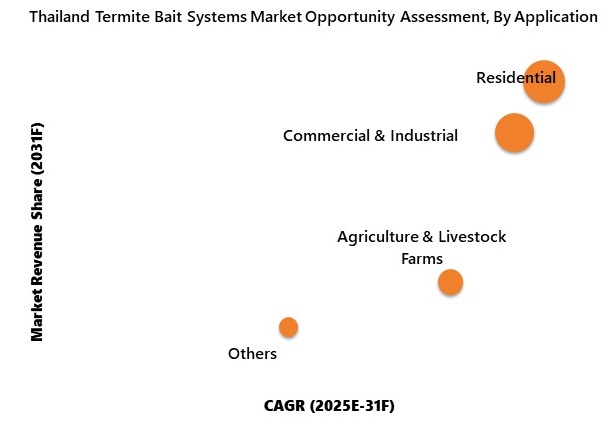
The residential segment has been projected to have the largest revenue size by 2031 and the fastest growth during 2025-2031, driven by the rapid expansion of urbanization and increasing homeownership rates. As more new homes are being constructed, especially in termite-prone regions, the demand for effective pest control solutions is rising. Additionally, the growing concern among homeowners about protecting property value and avoiding costly damage from termite infestations has expected to boost the adoption of advanced termite management systems. With a stronger emphasis on preventative measures and long-term protection, residential properties has expected to remain a major focus area for termite bait systems in the coming years.
The commercial and industrial segment has expected to have the second fastest growth size by 2031 driven by the increasing number of commercial properties and industrial facilities, particularly in urban areas and industrial zones, which are prone to termite infestations.
Key Attractiveness of the Report
- 10 Years Market Numbers.
- Historical Data Starting from 2021 to 2024
- Base Year: 2024
- Forecast Data until 2031
- Key Performance Indicators Impacting the Market.
- Major Upcoming Developments and Projects.
Key Highlights of the Report:
- Thailand Termite Bait Systems Market Overview
- Thailand Termite Bait Systems Market Outlook
- Thailand Termite Bait Systems Market Forecast
- Historical Data and Forecast of Thailand Termite Bait Systems Market Revenues for the Period 2021-2031F
- Historical Data and Forecast of Market Revenues, By Station Type, for the Period 2021-2031F
- Historical Data and Forecast of Market Revenues, By Termite Type, for the Period 2021-2031F
- Historical Data and Forecast of Market Revenues, By Application, for the Period 2021-2031F
- Thailand Termite Bait Systems Market Drivers and Restraints
- Industry Life Cycle
- Porter’s Five Force Analysis
- Thailand Termite Bait Systems Market Trends & Evolution
- Market Opportunity Assessment
- Thailand Termite Bait Systems Market Revenue Ranking, By Companies
- Competitive Benchmarking
- Company Profiles
- Key Strategic Recommendations
Market Scope and Segmentation
Thereportprovides a detailed analysis of the following market segments:
By Station Type
- In-Ground
- Above-Ground
By Termite Type
- Subterranean
- Dry-Wood
- Dampwood
- Others (Conehead and Formosan)
By Application
- Residential
- Commercial & Industrial
- Agriculture & Livestock Farms
- Others (Infrastructure & Public Spaces )






































