Thailand Thermoformed Plastic Products Market Size, Share & Growth Rate
The Thailand Thermoformed Plastic Products Market was estimated at USD 193 Million in 2025 and is projected to reach USD 221 Million by 2032, growing at a CAGR of 2.0% from 2026 to 2032. This growth trajectory is primarily driven by the booming packaging and automotive sectors, where the demand for efficient, cost-effective, and customizable solutions continues to rise. Additionally, the increasing emphasis on sustainability within packaging is further propelling market expansion, as companies look to align with consumer preferences for eco-friendly materials.
Thailand Thermoformed Plastic Products Market Year-wise Growth Rate and Key Drivers
This graph highlights how the Thailand Thermoformed Plastic Products Market has steadily grown over the years, supported by major growth factors.
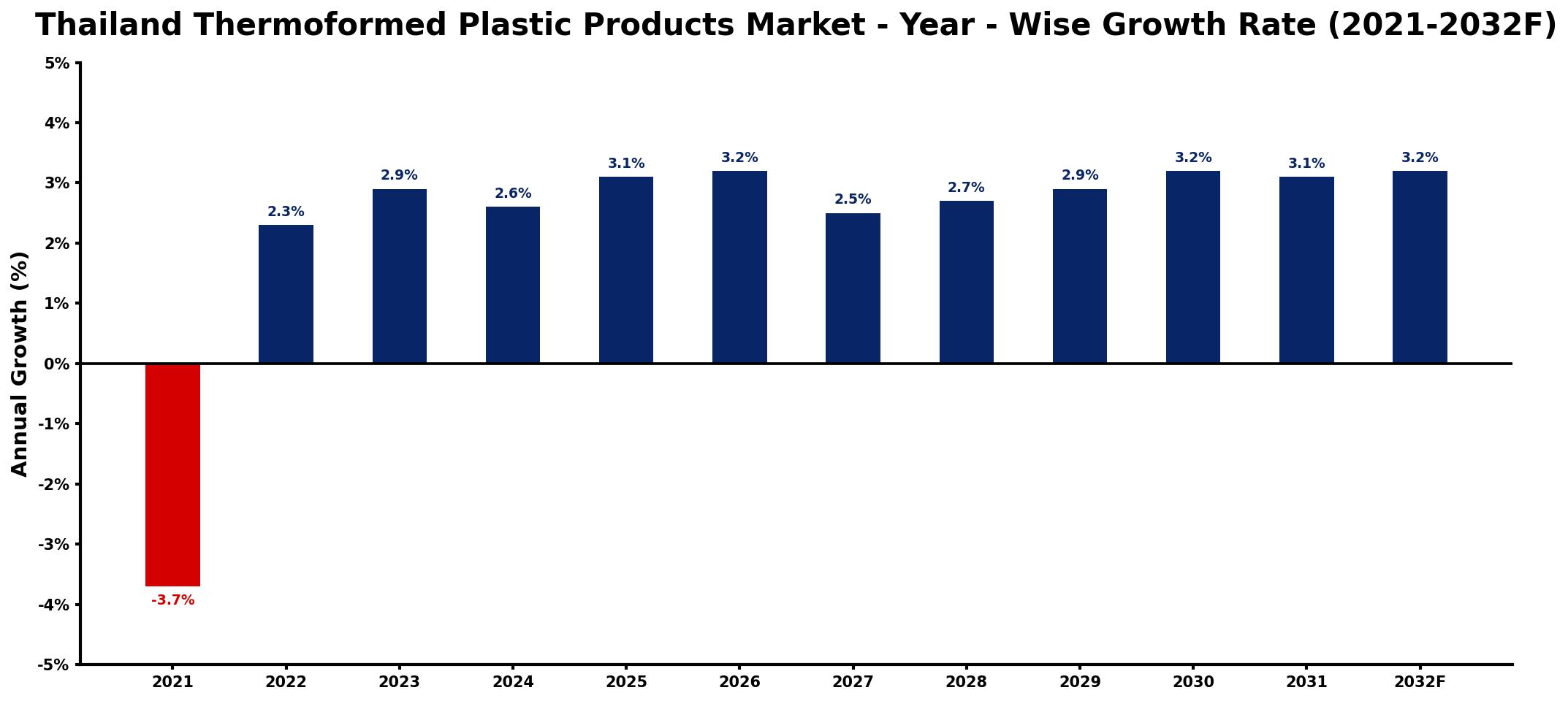
The table below presents the year‑wise growth rates along with the key drivers influencing the market
| Year | Growth Rate | Major Drivers |
| 2021 | -3.7% | decreased consumer spending on goods |
| 2022 | 2.3% | increased demand from packaging sector |
| 2023 | 2.9% | growth in food service industry |
| 2024 | 2.6% | expansion of retail distribution channels |
| 2025 | 3.1% | surge in e-commerce logistics needs |
| 2026 | 3.2% | rising investments in automation technologies |
| 2027 | 2.5% | increased domestic production output |
| 2028 | 2.7% | increased focus on recycling practices |
| 2029 | 2.9% | rising infrastructure development spending |
| 2030 | 3.2% | growing demand for custom solutions |
| 2031 | 3.1% | increased utilization in construction sector |
| 2032 | 3.2% | growing emerging market penetration |
Note: Market size estimations and growth projections presented in this report are based on 6Wresearch's proprietary forecasting methodology, utilizing the latest available industry data, government publications, and primary research inputs.
Thailand Thermoformed Plastic Products Market Synopsis
The most significant force shaping the Thailand thermoformed plastic products market today is the demand for innovative packaging solutions. Industries ranging from food to electronics are increasingly adopting thermoformed products due to their versatility and efficiency in meeting diverse packaging needs. This shift is underscored by a growing consumer focus on sustainable practices, which is motivating businesses to explore more environmentally friendly alternatives.
In parallel, the automotive industry continues to leverage thermoformed plastics for various applications, including lightweight components that enhance fuel efficiency. These dual drivers are creating a vibrant market landscape, where technological advancements in material science are enabling the production of more complex and efficient products to meet evolving customer demands.
Thailand Thermoformed Plastic Products Market Key Takeaways
- Robust growth is being fueled by the booming packaging and automotive sectors.
- Sustainable packaging solutions are becoming increasingly critical to market strategies.
- Technological advancements are paving the way for innovative and lightweight thermoformed products.
- Market players are actively addressing environmental concerns related to plastic waste.
- Thailand's strategic location enhances its attractiveness for both domestic and international investments.
Evaluation of Restraints in Thailand Thermoformed Plastic Products Market
The Thailand thermoformed plastic products market faces several constraints that could limit its growth. A primary concern is the sourcing of quality raw materials, which is essential for maintaining high production standards. Additionally, the industry grapples with increasing regulations and public scrutiny over plastic waste, necessitating a shift toward recyclable and sustainable materials. This transition, while beneficial in the long term, poses short-term challenges as manufacturers adapt their processes and product lines to comply with new standards.
Thailand Thermoformed Plastic Products Market Trends
A notable trend influencing the Thailand thermoformed plastic products market is the rising consumer preference for sustainable and biodegradable packaging options. As awareness of environmental issues grows, companies are compelled to innovate and provide eco-friendly solutions. Additionally, advancements in technology are enabling the production of complex designs with reduced material waste. The integration of smart technology into packaging is also emerging, with thermoformed products being used for high-tech applications in the automotive and electronics industries, thus expanding their utility.
Thailand Thermoformed Plastic Products Market Opportunities
There are substantial growth opportunities within the Thailand thermoformed plastic products market, particularly in the realm of sustainable packaging solutions. Companies investing in research and development can capitalize on the demand for alternative materials and eco-conscious designs. Furthermore, the automotive industry's shift towards lightweight and energy-efficient components presents a chance for producers to innovate within this sector. Collaboration with local governments and organizations to promote recycling initiatives can also create additional pathways for growth, fostering a more sustainable industry ecosystem.
Government Initiatives in the Thailand Thermoformed Plastic Products Market
The Thai government is actively promoting initiatives that support the development of sustainable practices in manufacturing, including thermoformed plastic production. This includes funding for research into innovative materials and processes that reduce environmental impact. Furthermore, public spending on infrastructure improvements is facilitating better logistics and supply chain efficiency for manufacturers. Programs aimed at encouraging recycling and reducing plastic waste are also on the rise, reflecting the government's commitment to fostering a sustainable economic environment.
Future Insights of the Thailand Thermoformed Plastic Products Market
Looking ahead to the period from 2026 to 2032, the Thailand thermoformed plastic products market is expected to experience steady growth propelled by increased industrial activity and heightened consumer demand for sustainable solutions. As technological advancements continue to evolve, producers will likely develop even more sophisticated thermoformed products that cater to niche markets, particularly in packaging and automotive sectors. The alignment with global sustainability trends will also strengthen the market's competitive position, attracting further investment and innovation.
Thailand Thermoformed Plastic Products Market Latest Developments (2025 - 2026)
In recent months, the Thailand thermoformed plastic products market has seen a notable shift towards sustainability, with several manufacturers announcing initiatives focused on reducing plastic waste and increasing the use of recycled materials. The emergence of new partnerships among industry players and research institutions is leading to advancements in biodegradable materials. Furthermore, some firms are diversifying their product lines to include smart packaging solutions, integrating technology to enhance user experience and functionality.
Thailand Thermoformed Plastic Products Market - Key Attractiveness of the Report
- 10 Years of Market Numbers
- Historical Data Starting from 2022 to 2025
- Base Year: 2025
- Forecast Data until 2032
- Key Performance Indicators Impacting the Market
- Major Upcoming Developments and Projects
Key Highlights of the Report:
- Thailand Thermoformed Plastic Products Market Outlook
- Market Size of Thailand Thermoformed Plastic Products Market, 2025
- Forecast of Thailand Thermoformed Plastic Products Market, 2032
- Historical Data and Forecast of Thailand Thermoformed Plastic Products Revenues & Volume for the Period 2022-2032F
- Thailand Thermoformed Plastic Products Market Trend Evolution
- Thailand Thermoformed Plastic Products Market Drivers and Challenges
- Thailand Thermoformed Plastic Products Price Trends
- Thailand Thermoformed Plastic Products Porter's Five Forces
- Thailand Thermoformed Plastic Products Industry Life Cycle
- Historical Data and Forecast of Thailand Thermoformed Plastic Products Market Revenues & Volume By Product for the Period 2022-2032F
- Historical Data and Forecast of Thailand Thermoformed Plastic Products Market Revenues & Volume By Polymethyl Methacrylate (PMMA) for the Period 2022-2032F
- Historical Data and Forecast of Thailand Thermoformed Plastic Products Market Revenues & Volume By Bio-degradable polymers for the Period 2022-2032F
- Historical Data and Forecast of Thailand Thermoformed Plastic Products Market Revenues & Volume By Polyethylene (PE) for the Period 2022-2032F
- Historical Data and Forecast of Thailand Thermoformed Plastic Products Market Revenues & Volume By Acrylonitrile Butadiene Styrene (ABS) for the Period 2022-2032F
- Historical Data and Forecast of Thailand Thermoformed Plastic Products Market Revenues & Volume By Poly Vinyl Chloride (PVC) for the Period 2022-2032F
- Historical Data and Forecast of Thailand Thermoformed Plastic Products Market Revenues & Volume By High Impact Polystyrene (HIPS) for the Period 2022-2032F
- Historical Data and Forecast of Thailand Thermoformed Plastic Products Market Revenues & Volume By Polystyrene (PS) for the Period 2022-2032F
- Historical Data and Forecast of Thailand Polymethyl Methacrylate (PMMA) Thermoformed Plastic Products Market Revenues & Volume By Polypropylene (PP) for the Period 2022-2032F
- Historical Data and Forecast of Thailand Thermoformed Plastic Products Market Revenues & Volume By Process for the Period 2022-2032F
- Historical Data and Forecast of Thailand Thermoformed Plastic Products Market Revenues & Volume By Plug Assist Forming for the Period 2022-2032F
- Historical Data and Forecast of Thailand Thermoformed Plastic Products Market Revenues & Volume By Thick Gauge Thermoforming for the Period 2022-2032F
- Historical Data and Forecast of Thailand Thermoformed Plastic Products Market Revenues & Volume By Thin Gauge Thermoforming for the Period 2022-2032F
- Historical Data and Forecast of Thailand Thermoformed Plastic Products Market Revenues & Volume By Vacuum Snapback for the Period 2022-2032F
- Historical Data and Forecast of Thailand Thermoformed Plastic Products Market Revenues & Volume By Application for the Period 2022-2032F
- Historical Data and Forecast of Thailand Thermoformed Plastic Products Market Revenues & Volume By Healthcare & Medical for the Period 2022-2032F
- Historical Data and Forecast of Thailand Thermoformed Plastic Products Market Revenues & Volume By Food Packaging for the Period 2022-2032F
- Historical Data and Forecast of Thailand Thermoformed Plastic Products Market Revenues & Volume By Electrical & Electronics for the Period 2022-2032F
- Historical Data and Forecast of Thailand Thermoformed Plastic Products Market Revenues & Volume By Automotive for the Period 2022-2032F
- Historical Data and Forecast of Thailand Thermoformed Plastic Products Market Revenues & Volume By Construction for the Period 2022-2032F
- Historical Data and Forecast of Thailand Thermoformed Plastic Products Market Revenues & Volume By Consumer Goods & Appliances for the Period 2022-2032F
- Thailand Thermoformed Plastic Products Import Export Trade Statistics
- Market Opportunity Assessment By Product
- Market Opportunity Assessment By Process
- Market Opportunity Assessment By Application
- Thailand Thermoformed Plastic Products Top Companies Market Share
- Thailand Thermoformed Plastic Products Competitive Benchmarking By Technical and Operational Parameters
- Thailand Thermoformed Plastic Products Company Profiles
- Thailand Thermoformed Plastic Products Key Strategic Recommendations






































