Thailand Tractor Market Size, Share & Growth Rate
The Thailand Tractor Market was estimated at USD 241 Million in 2025 and is projected to reach USD 276 Million by 2032, growing at a CAGR of 2.0% from 2026 to 2032. This growth is primarily driven by the ongoing modernization of the agriculture sector, where farmers are increasingly adopting mechanized solutions to enhance productivity and efficiency. Furthermore, the governments supportive policies and financial incentives are stimulating investments in mechanization, ensuring a robust demand for tractors over the forecast period.
Thailand Tractor Market Year-wise Growth Rate and Key Drivers
This graph highlights how the Thailand Tractor Market has steadily grown over the years, supported by major growth factors.
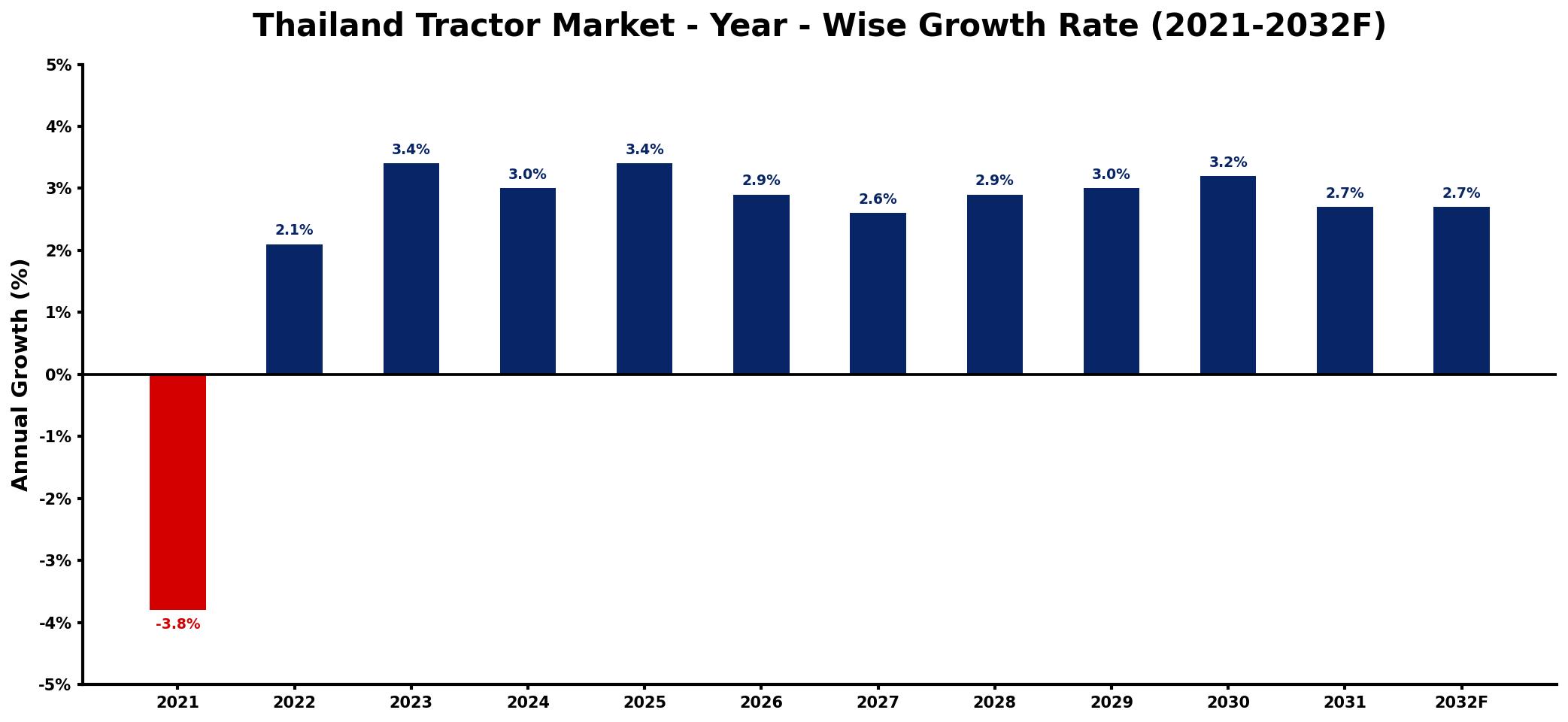
The table below presents the year‑wise growth rates along with the key drivers influencing the market
| Year | Growth Rate | Major Drivers |
| 2021 | -3.8% | decreased agricultural investment levels |
| 2022 | 2.1% | rising demand for modern machinery |
| 2023 | 3.4% | increased adoption of automation |
| 2024 | 3.0% | growing interest in sustainable practices |
| 2025 | 3.4% | expansion of rural infrastructure projects |
| 2026 | 2.9% | enhanced financing options for farmers |
| 2027 | 2.6% | growing popularity of precision farming |
| 2028 | 2.9% | increased focus on crop diversification |
| 2029 | 3.0% | rising exports of agricultural products |
| 2030 | 3.2% | growing awareness of efficiency benefits |
| 2031 | 2.7% | increased government support programs |
| 2032 | 2.7% | expanding market for rental services |
Note: Market size estimations and growth projections presented in this report are based on 6Wresearch's proprietary forecasting methodology, utilizing the latest available industry data, government publications, and primary research inputs.
Thailand Tractor Market Synopsis
In recent years, the Thailand tractor market has emerged as a cornerstone in both agricultural and construction sectors. With the pressing need for efficiency and productivity, tractors are no longer seen as optional equipment but rather as essential assets for modern farming and construction practices.
As mechanization becomes more prevalent, both local manufacturers and foreign entities are competing to provide advanced tractors tailored for Thailand's unique agricultural landscape. This is facilitated by government initiatives aimed at enhancing the sectors overall productivity, thereby reinforcing the market's growth trajectory.
Thailand Tractor Market Key Takeaways
- Increased mechanization in agriculture and construction is driving tractor sales in Thailand.
- Government subsidies and incentives are enhancing affordability and access for farmers.
- The need for diverse tractor models to suit varied terrains and crops remains a market characteristic.
- Commercial farming trends are further propelling the demand for efficient farming equipment.
- Addressing maintenance and servicing gaps in rural areas is crucial for sustainable market growth.
Evaluation of Restraints in Thailand Tractor Market
While the Thailand tractor market holds considerable potential, several constraints hinder its expansive growth. The high initial purchase costs associated with tractors often deter small-scale farmers, making it difficult for them to transition from traditional methods to mechanization. Additionally, Thailand's diverse agricultural landscape requires a broad array of tractor types, complicating the establishment of standardized solutions. The disparity in maintenance services across rural areas can lead to underutilization of advanced machinery, ultimately limiting market penetration and the overall effectiveness of mechanization efforts.
Thailand Tractor Market Trends
The tractor market in Thailand is witnessing several key trends that are reshaping its landscape. A significant shift towards precision agriculture techniques is emerging, as farmers seek to optimize resource usage and enhance crop yields. Additionally, technology integration, such as GPS and IoT-enabled tractors, is becoming more prevalent, offering improved operational efficiency. As sustainability gains importance, manufacturers are increasingly focusing on eco-friendly tractor designs that align with contemporary environmental standards.
Thailand Tractor Market Opportunities
Genuine growth opportunities in the Thailand tractor market lie in expanding support for smallholder farmers through accessible financing options and enhanced service networks. Moreover, there is a strong potential for growth in electric and hybrid tractor offerings, catering to the rising demand for sustainable farming solutions. Investing in research and development for innovative tractor technologies could further open new avenues for market players, particularly as agricultural practices evolve.
Government Initiatives in the Thailand Tractor Market
The Thai government has implemented various initiatives aimed at modernizing agriculture, which directly influence the tractor market. Financial support programs, including subsidies and low-interest loans for purchasing agricultural equipment, enhance access for farmers. Additionally, training programs on advanced agricultural techniques and mechanization are being introduced to better equip farmers for the modern landscape. These initiatives not only promote the adoption of tractors but also bolster the overall agricultural productivity of the country.
Future Insights of the Thailand Tractor Market
Looking ahead to 2026-2032, the Thailand tractor market is poised for gradual yet steady growth. As government initiatives continue to support agricultural modernization, and as technology in farming equipment evolves, demand for advanced tractors is likely to increase. A focus on sustainability and efficiency will shape new product development strategies. Furthermore, the integration of digital tools in farming practices is expected to enhance operational efficiencies, potentially reshaping the market landscape.
Thailand Tractor Market Latest Developments (2025 - 2026)
Recent developments in the Thailand tractor market have highlighted a growing emphasis on technological advancements. Manufacturers are increasingly introducing tractors equipped with precision agriculture tools and smart technology features aimed at improving performance. Additionally, ongoing collaborations between the government and agricultural stakeholders focus on enhancing the accessibility of modern equipment for farmers, thus supporting the mechanization trend in the region.
Thailand Tractor Market - Key Attractiveness of the Report
- 10 Years of Market Numbers
- Historical Data Starting from 2022 to 2025
- Base Year: 2025
- Forecast Data until 2032
- Key Performance Indicators Impacting the Market
- Major Upcoming Developments and Projects
Key Highlights of the Report:
- Thailand Tractor Market Outlook
- Market Size of Thailand Tractor Market, 2025
- Forecast of Thailand Tractor Market, 2032
- Historical Data and Forecast of Thailand Tractor Revenues & Volume for the Period 2022-2032F
- Thailand Tractor Market Trend Evolution
- Thailand Tractor Market Drivers and Challenges
- Thailand Tractor Price Trends
- Thailand Tractor Porter's Five Forces
- Thailand Tractor Industry Life Cycle
- Historical Data and Forecast of Thailand Tractor Market Revenues & Volume By Power Output for the Period 2022-2032F
- Historical Data and Forecast of Thailand Tractor Market Revenues & Volume By Less Than 30 HP for the Period 2022-2032F
- Historical Data and Forecast of Thailand Tractor Market Revenues & Volume By 30-50 HP for the Period 2022-2032F
- Historical Data and Forecast of Thailand Tractor Market Revenues & Volume By 51-100 HP for the Period 2022-2032F
- Historical Data and Forecast of Thailand Tractor Market Revenues & Volume By More Than 100 HP for the Period 2022-2032F
- Historical Data and Forecast of Thailand Tractor Market Revenues & Volume By Drive Type for the Period 2022-2032F
- Historical Data and Forecast of Thailand Tractor Market Revenues & Volume By 2 Wheel Drive for the Period 2022-2032F
- Historical Data and Forecast of Thailand Tractor Market Revenues & Volume By 4 Wheel Drive for the Period 2022-2032F
- Historical Data and Forecast of Thailand Tractor Market Revenues & Volume By Application for the Period 2022-2032F
- Historical Data and Forecast of Thailand Tractor Market Revenues & Volume By Agriculture for the Period 2022-2032F
- Thailand Tractor Import Export Trade Statistics
- Market Opportunity Assessment By Power Output
- Market Opportunity Assessment By Drive Type
- Market Opportunity Assessment By Application
- Thailand Tractor Top Companies Market Share
- Thailand Tractor Competitive Benchmarking By Technical and Operational Parameters
- Thailand Tractor Company Profiles
- Thailand Tractor Key Strategic Recommendations






































