Thailand Trolley Market Size, Share & Growth Rate
The Thailand Trolley Market was estimated at USD 200 Million in 2025 and is projected to reach USD 230 Million by 2032, growing at a CAGR of 2.0% from 2026 to 2032. This growth trajectory is primarily driven by the expanding logistics and e-commerce sectors, which increasingly rely on trolleys for efficient material handling. As the tourism industry rebounds post-pandemic, the hospitality sector is also contributing to rising demand, ensuring a robust market outlook.
Thailand Trolley Market Year-wise Growth Rate and Key Drivers
This graph highlights how the Thailand Trolley Market has steadily grown over the years, supported by major growth factors.
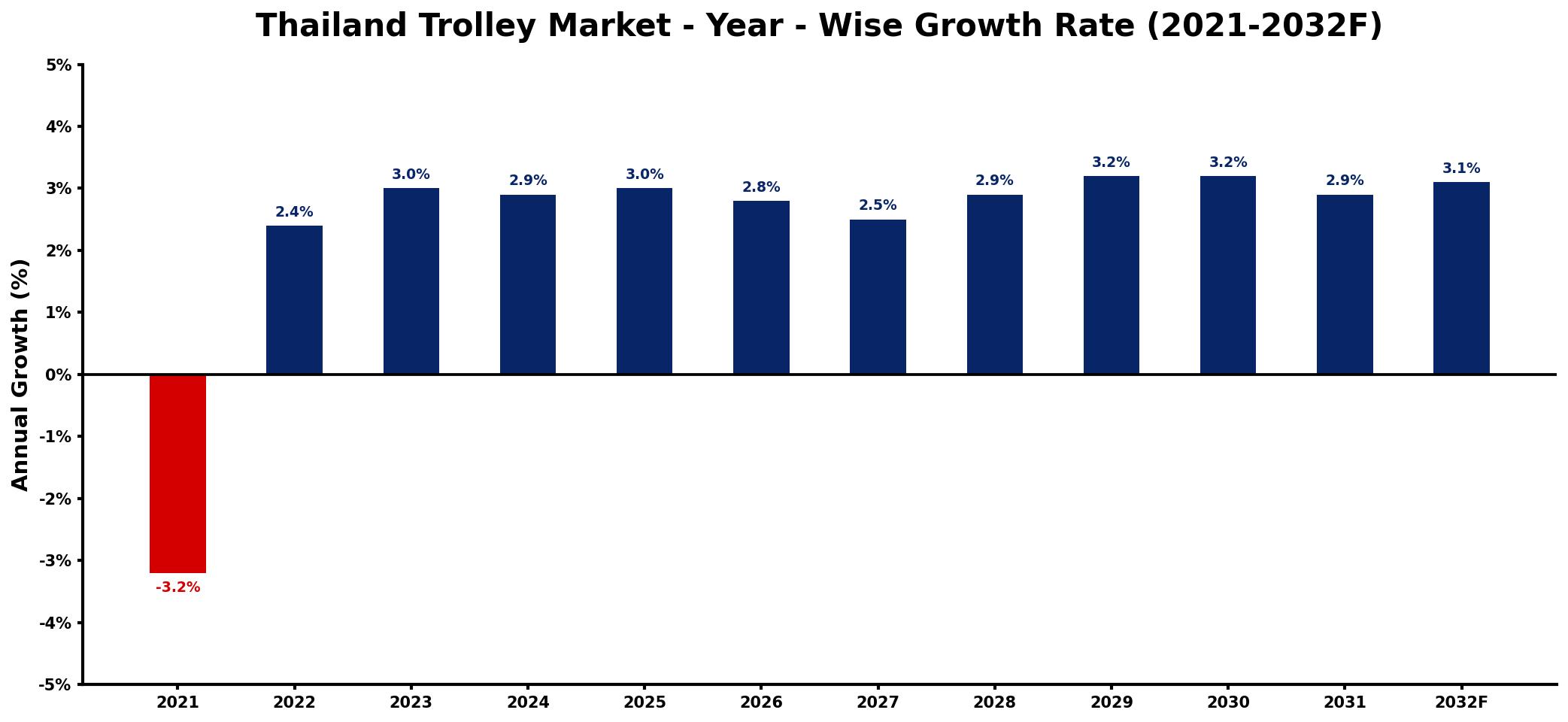
The table below presents the year‑wise growth rates along with the key drivers influencing the market
| Year | Growth Rate | Major Drivers |
| 2021 | -3.2% | decrease in consumer spending habits |
| 2022 | 2.4% | increase in e-commerce logistics demand |
| 2023 | 3.0% | growth in retail sector investments |
| 2024 | 2.9% | expansion of urban infrastructure projects |
| 2025 | 3.0% | rising demand for sustainable solutions |
| 2026 | 2.8% | enhanced distribution network efficiency |
| 2027 | 2.5% | growing popularity of online shopping |
| 2028 | 2.9% | rising procurement volume requirements |
| 2029 | 3.2% | rising end-use demand growth |
| 2030 | 3.2% | rising adoption of automation technologies |
| 2031 | 2.9% | increased domestic production output |
| 2032 | 3.1% | increased investment in logistics innovations |
Note: Market size estimations and growth projections presented in this report are based on 6Wresearch's proprietary forecasting methodology, utilizing the latest available industry data, government publications, and primary research inputs.
Thailand Trolley Market Synopsis
Currently, the most significant force shaping the Thailand Trolley Market is the surge in e-commerce, which has heightened the need for effective logistics solutions. Retailers and warehouses are increasingly adopting trolleys to streamline operations, reflecting a broader industry trend towards enhanced efficiency.
Additionally, the tourism sector's resurgence is playing a pivotal role in market dynamics. With more travelers seeking services in airports and hotels, the demand for trolleys has seen a noticeable uptick, further solidifying the market's growth potential. Various industries are recognizing that efficient material handling is crucial to operational success.
Thailand Trolley Market Key Takeaways
- The market is set to grow steadily, reflecting rising demand from e-commerce and tourism.
- Innovative designs and electric trolley solutions are influencing purchasing decisions across sectors.
- Logistics and warehousing are primary growth drivers, necessitating improved material handling solutions.
- Customization is becoming increasingly important as sectors seek tailored trolley solutions.
- Safety and hygiene considerations post-COVID-19 are reshaping product demand and features.
Evaluation of Restraints in Thailand Trolley Market
Despite the upward trajectory, the Thailand Trolley Market faces notable restraints. Competition from alternative material handling solutions can stifle growth, especially as businesses weigh the cost-effectiveness of different options. Furthermore, varying economic conditions can influence demand across the manufacturing and logistics sectors, as downturns may lead to reduced investments in material handling equipment. Additionally, the need for customized trolley solutions across diverse industries can complicate supply chains and increase operational costs for manufacturers.
Thailand Trolley Market Trends
Current trends indicate a significant shift towards electric and automated trolley solutions that promote efficiency and sustainability. Ergonomic designs are becoming increasingly popular, emphasizing user comfort while minimizing injury risks in manual handling. Moreover, the integration of smart technology in trolleys is emerging, offering features like tracking systems and touchless operations, which align with heightened hygiene standards in various environments.
Thailand Trolley Market Opportunities
The Thailand Trolley Market presents substantial growth and investment opportunities, particularly in the development of electric and automated trolley solutions. Companies that innovate by incorporating smart technologies can capture a significant share of the market. Furthermore, as industries look for customized solutions to enhance operational efficiency, manufacturers that can offer tailored products stand to benefit. Lastly, with the continued expansion of the logistics and tourism sectors, there are promising avenues for growth across these domains.
Government Initiatives in the Thailand Trolley Market
The Thai government has been actively promoting policies aimed at boosting the logistics and manufacturing sectors, which indirectly supports the trolley market. Public spending initiatives focused on infrastructure improvements and e-commerce facilitation are creating a favorable environment for material handling solutions. Additionally, government incentives for businesses adopting green technologies may further encourage the development of electric trolley systems, aligning with global sustainability trends.
Future Insights of the Thailand Trolley Market
Looking ahead to 2026-2032, the Thailand Trolley Market is anticipated to maintain a stable growth trajectory, underpinned by sustained demand from logistics, warehousing, and tourism. The integration of advanced technologies such as automation and IoT will likely redefine material handling processes, creating more efficient operations. As businesses continue to prioritize safety, hygiene, and operational efficiency, the demand for trolleys that meet these evolving standards will be crucial in shaping market dynamics.
Thailand Trolley Market Latest Developments (2025 - 2026)
Recent developments in the Thailand Trolley Market indicate a growing focus on sustainability and smart technology integration. Manufacturers are increasingly exploring eco-friendly materials and designs, driven by consumer demand for greener solutions. Additionally, emerging trends in automation are leading to the introduction of smart trolleys that enhance operational efficiency in various sectors. Adaptation to post-pandemic market realities continues to drive product innovations aimed at improving safety and hygiene, reflecting the changing needs of consumers and industries alike.
Thailand Trolley Market - Key Attractiveness of the Report
- 10 Years of Market Numbers
- Historical Data Starting from 2022 to 2025
- Base Year: 2025
- Forecast Data until 2032
- Key Performance Indicators Impacting the Market
- Major Upcoming Developments and Projects
Key Highlights of the Report:
- Thailand Trolley Market Outlook
- Market Size of Thailand Trolley Market, 2025
- Forecast of Thailand Trolley Market, 2032
- Historical Data and Forecast of Thailand Trolley Revenues & Volume for the Period 2022-2032F
- Thailand Trolley Market Trend Evolution
- Thailand Trolley Market Drivers and Challenges
- Thailand Trolley Price Trends
- Thailand Trolley Porter's Five Forces
- Thailand Trolley Industry Life Cycle
- Historical Data and Forecast of Thailand Trolley Market Revenues & Volume By Product for the Period 2022-2032F
- Historical Data and Forecast of Thailand Trolley Market Revenues & Volume By Manual for the Period 2022-2032F
- Historical Data and Forecast of Thailand Trolley Market Revenues & Volume By Electric for the Period 2022-2032F
- Historical Data and Forecast of Thailand Trolley Market Revenues & Volume By Application for the Period 2022-2032F
- Historical Data and Forecast of Thailand Trolley Market Revenues & Volume By Commercial for the Period 2022-2032F
- Historical Data and Forecast of Thailand Trolley Market Revenues & Volume By Non-commercial for the Period 2022-2032F
- Historical Data and Forecast of Thailand Trolley Market Revenues & Volume By Distribution for the Period 2022-2032F
- Historical Data and Forecast of Thailand Trolley Market Revenues & Volume By Offline for the Period 2022-2032F
- Historical Data and Forecast of Thailand Trolley Market Revenues & Volume By Online for the Period 2022-2032F
- Thailand Trolley Import Export Trade Statistics
- Market Opportunity Assessment By Product
- Market Opportunity Assessment By Application
- Market Opportunity Assessment By Distribution
- Thailand Trolley Top Companies Market Share
- Thailand Trolley Competitive Benchmarking By Technical and Operational Parameters
- Thailand Trolley Company Profiles
- Thailand Trolley Key Strategic Recommendations






































