Thailand Vegetable and Fruit Processing Machinery Market Size, Share & Growth Rate
The Thailand Vegetable and Fruit Processing Machinery Market was estimated at USD 223 Million in 2025 and is projected to reach USD 255 Million by 2032, growing at a CAGR of 1.9% from 2026 to 2032. This growth trajectory is propelled by an increasing demand for processed food products, driven in part by urbanization and a shift toward convenience in food consumption. Coupled with government initiatives aimed at enhancing the agricultural sector, the market reflects a robust potential for expansion in both domestic and export markets.
Thailand Vegetable and Fruit Processing Machinery Market Year-wise Growth Rate and Key Drivers
This graph highlights how the Thailand Vegetable and Fruit Processing Machinery Market has steadily grown over the years, supported by major growth factors.
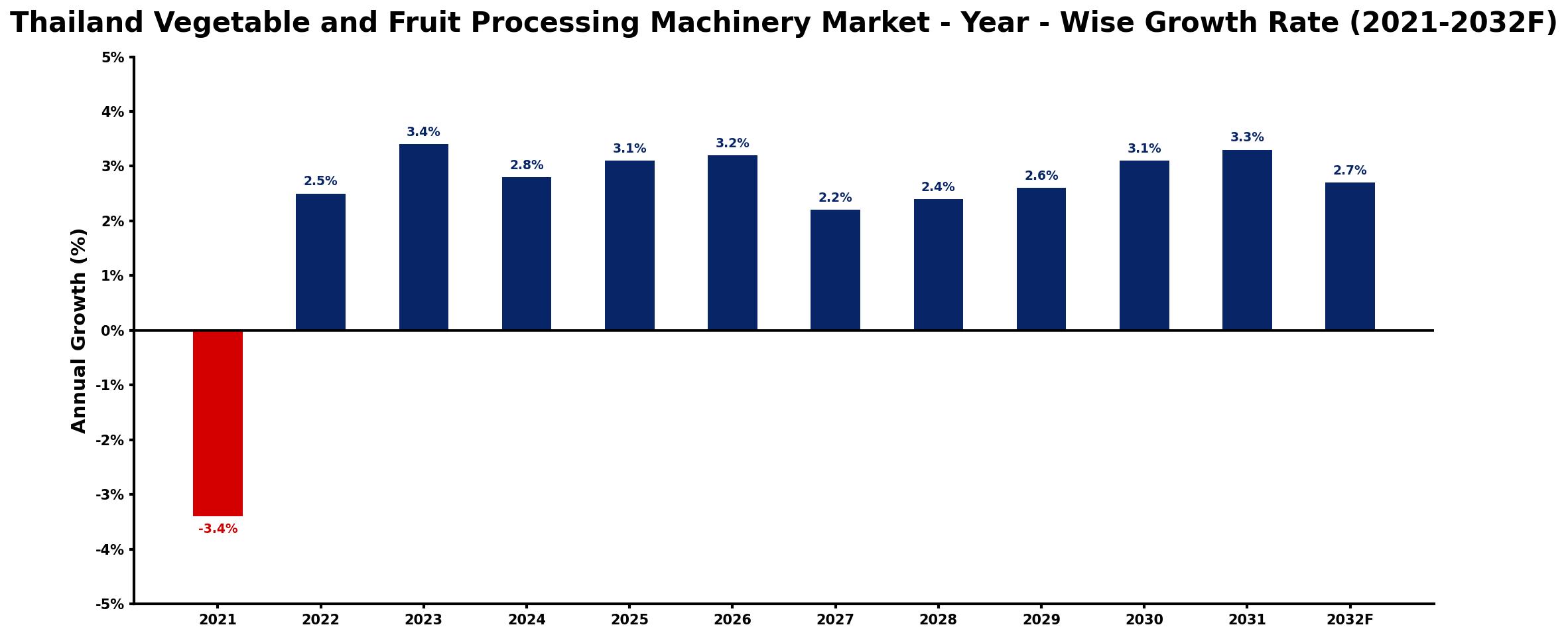
The table below presents the year‑wise growth rates along with the key drivers influencing the market
| Year | Growth Rate | Major Drivers |
| 2021 | -3.4% | reduced domestic production levels |
| 2022 | 2.5% | growing commercial sector adoption |
| 2023 | 3.4% | Technological advancements attract investments |
| 2024 | 2.8% | Increased export opportunities drive growth |
| 2025 | 3.1% | Growing urban population enhances consumption |
| 2026 | 3.2% | Sustainability trends promote eco-friendly solutions |
| 2027 | 2.2% | Government incentives support industry expansion |
| 2028 | 2.4% | E-commerce growth enhances distribution channels |
| 2029 | 2.6% | Rising disposable income fuels purchases |
| 2030 | 3.1% | Innovation in automation drives efficiency |
| 2031 | 3.3% | Collaborations foster new market entrants |
| 2032 | 2.7% | increased overall sector activity |
Note: Market size estimations and growth projections presented in this report are based on 6Wresearch's proprietary forecasting methodology, utilizing the latest available industry data, government publications, and primary research inputs.
Thailand Vegetable and Fruit Processing Machinery Market Synopsis
Thailand's unique agricultural landscape, characterized by a rich variety of tropical fruits and vegetables, sets a solid foundation for the vegetable and fruit processing machinery market. As the country continues to elevate its food safety standards and meet stringent export criteria, the importance of advanced processing equipment cannot be overstated.
The sector is experiencing a surge in demand, not only for traditional processing methods but also for innovative technologies that enhance operational efficiency. As consumers increasingly seek convenient, high-quality processed products, investment in machinery that can cater to these needs is paramount.
Thailand Vegetable and Fruit Processing Machinery Market Key Takeaways
- The market is witnessing consistent growth due to the rising popularity of processed food products.
- Urbanization and changing consumer lifestyles are driving demand for convenience in food options.
- Government support for the agricultural sector is a significant factor in market expansion.
- Food safety and hygiene considerations are leading to increased investments in advanced processing technologies.
- COVID-19 highlighted the importance of adaptability and innovation in food processing machinery.
Evaluation of Restraints in Thailand Vegetable and Fruit Processing Machinery Market
Despite its promising outlook, the Thailand Vegetable and Fruit Processing Machinery Market grapples with several constraints that hinder its growth. One significant challenge is the need to maintain stringent food safety standards, which require ongoing investments in compliance and technology. Moreover, post-harvest losses remain a critical concern, exacerbated by inefficiencies in the supply chain and processing capabilities. Adapting to rapidly changing consumer preferences for healthier, more sustainable products also requires machinery manufacturers to innovate continuously, often at a high cost.
Thailand Vegetable and Fruit Processing Machinery Market Trends
The Thailand Vegetable and Fruit Processing Machinery Market is witnessing several key trends that are shaping its future. Automation is at the forefront, with manufacturers increasingly integrating smart technology into processing equipment to improve efficiency and reduce labor costs. Additionally, there is a growing emphasis on sustainability, pushing companies to adopt eco-friendly practices and invest in machinery that minimizes waste. Furthermore, consumer preference is shifting towards healthier options, influencing the type of machinery in demand for producing organic and minimally processed products.
Thailand Vegetable and Fruit Processing Machinery Market Opportunities
Opportunities within the Thailand Vegetable and Fruit Processing Machinery Market are abundant, particularly in the realm of technological advancements. Companies that focus on R&D to develop innovative solutions tailored for local agricultural needs will find lucrative avenues for growth. Moreover, as global demand for Thai processed fruits and vegetables rises, enhancing export capabilities through state-of-the-art processing technology presents a significant opportunity. Collaborations between machinery manufacturers and local agricultural producers can also lead to bespoke solutions that effectively address specific market needs.
Government Initiatives in the Thailand Vegetable and Fruit Processing Machinery Market
The Thai government has implemented various initiatives to bolster the agricultural sector, significantly impacting the vegetable and fruit processing machinery market. Programs aimed at enhancing food safety standards are being rolled out, alongside incentives for farmers and processors to adopt modern technologies. Public spending on agricultural infrastructure is also on the rise, supporting the need for advanced processing equipment to meet both local and international market demands.
Future Insights of the Thailand Vegetable and Fruit Processing Machinery Market
Looking ahead to 2026-2032, the Thailand Vegetable and Fruit Processing Machinery Market is poised for significant transformation. As consumer preferences continue to evolve, the demand for more sophisticated processing solutions will accelerate. Advancements in automation and smart technologies will dominate the landscape, allowing for greater precision and efficiency in food production. Furthermore, a growing focus on sustainability will drive innovations in eco-friendly machinery, making it imperative for manufacturers to adapt swiftly to remain competitive.
Thailand Vegetable and Fruit Processing Machinery Market Latest Developments (2025 - 2026)
Recent developments in the Thailand Vegetable and Fruit Processing Machinery Market indicate a shift towards more automated and efficient processing solutions. Companies are increasingly adopting advanced technologies to enhance food safety and production speed. Additionally, partnerships between machinery producers and local agricultural entities are emerging to create tailored solutions that address specific market challenges. Overall, the market is trending towards more innovative approaches that focus on sustainability and consumer satisfaction.
Thailand Vegetable and Fruit Processing Machinery Market - Key Attractiveness of the Report
- 10 Years of Market Numbers
- Historical Data Starting from 2022 to 2025
- Base Year: 2025
- Forecast Data until 2032
- Key Performance Indicators Impacting the Market
- Major Upcoming Developments and Projects
Key Highlights of the Report:
- Thailand Vegetable and Fruit Processing Machinery Market Outlook
- Market Size of Thailand Vegetable and Fruit Processing Machinery Market, 2025
- Forecast of Thailand Vegetable and Fruit Processing Machinery Market, 2032
- Historical Data and Forecast of Thailand Vegetable and Fruit Processing Machinery Revenues & Volume for the Period 2022-2032F
- Thailand Vegetable and Fruit Processing Machinery Market Trend Evolution
- Thailand Vegetable and Fruit Processing Machinery Market Drivers and Challenges
- Thailand Vegetable and Fruit Processing Machinery Price Trends
- Thailand Vegetable and Fruit Processing Machinery Porter's Five Forces
- Thailand Vegetable and Fruit Processing Machinery Industry Life Cycle
- Historical Data and Forecast of Thailand Vegetable and Fruit Processing Machinery Market Revenues & Volume By Product Type for the Period 2022-2032F
- Historical Data and Forecast of Thailand Vegetable and Fruit Processing Machinery Market Revenues & Volume By Fresh for the Period 2022-2032F
- Historical Data and Forecast of Thailand Vegetable and Fruit Processing Machinery Market Revenues & Volume By Fresh-cut for the Period 2022-2032F
- Historical Data and Forecast of Thailand Vegetable and Fruit Processing Machinery Market Revenues & Volume By Canned for the Period 2022-2032F
- Historical Data and Forecast of Thailand Vegetable and Fruit Processing Machinery Market Revenues & Volume By Frozen for the Period 2022-2032F
- Historical Data and Forecast of Thailand Vegetable and Fruit Processing Machinery Market Revenues & Volume By Dried & Dehydrated for the Period 2022-2032F
- Historical Data and Forecast of Thailand Vegetable and Fruit Processing Machinery Market Revenues & Volume By Convenience for the Period 2022-2032F
- Historical Data and Forecast of Thailand Vegetable and Fruit Processing Machinery Market Revenues & Volume By Equipment Type for the Period 2022-2032F
- Historical Data and Forecast of Thailand Vegetable and Fruit Processing Machinery Market Revenues & Volume By Pre-processing for the Period 2022-2032F
- Historical Data and Forecast of Thailand Vegetable and Fruit Processing Machinery Market Revenues & Volume By Peeling/inspection/slicing for the Period 2022-2032F
- Historical Data and Forecast of Thailand Vegetable and Fruit Processing Machinery Market Revenues & Volume By Washing & Dewatering for the Period 2022-2032F
- Historical Data and Forecast of Thailand Vegetable and Fruit Processing Machinery Market Revenues & Volume By Fillers for the Period 2022-2032F
- Historical Data and Forecast of Thailand Vegetable and Fruit Processing Machinery Market Revenues & Volume By Packaging & Handling for the Period 2022-2032F
- Historical Data and Forecast of Thailand Vegetable and Fruit Processing Machinery Market Revenues & Volume By Seasoning Systems for the Period 2022-2032F
- Historical Data and Forecast of Thailand Vegetable and Fruit Processing Machinery Market Revenues & Volume By Others for the Period 2022-2032F
- Historical Data and Forecast of Thailand Vegetable and Fruit Processing Machinery Market Revenues & Volume By Operation for the Period 2022-2032F
- Historical Data and Forecast of Thailand Vegetable and Fruit Processing Machinery Market Revenues & Volume By Automatic for the Period 2022-2032F
- Historical Data and Forecast of Thailand Vegetable and Fruit Processing Machinery Market Revenues & Volume By Semi-automatic for the Period 2022-2032F
- Historical Data and Forecast of Thailand Vegetable and Fruit Processing Machinery Market Revenues & Volume By Processing System for the Period 2022-2032F
- Historical Data and Forecast of Thailand Vegetable and Fruit Processing Machinery Market Revenues & Volume By Small Scale for the Period 2022-2032F
- Historical Data and Forecast of Thailand Vegetable and Fruit Processing Machinery Market Revenues & Volume By Intermediate Scale for the Period 2022-2032F
- Thailand Vegetable and Fruit Processing Machinery Import Export Trade Statistics
- Market Opportunity Assessment By Product Type
- Market Opportunity Assessment By Equipment Type
- Market Opportunity Assessment By Operation
- Market Opportunity Assessment By Processing System
- Thailand Vegetable and Fruit Processing Machinery Top Companies Market Share
- Thailand Vegetable and Fruit Processing Machinery Competitive Benchmarking By Technical and Operational Parameters
- Thailand Vegetable and Fruit Processing Machinery Company Profiles
- Thailand Vegetable and Fruit Processing Machinery Key Strategic Recommendations






































