Thailand Vegetable Sorting Machines Market Size, Share & Growth Rate
The Thailand Vegetable Sorting Machines Market was estimated at USD 126 Million in 2025 and is projected to reach USD 145 Million by 2032, growing at a CAGR of 2.0% from 2026 to 2032. This growth trajectory is primarily fueled by an escalating demand for high-quality agricultural products and the necessity for efficient sorting mechanisms. As stakeholders in the agriculture sector strive for excellence in both domestic and export markets, the integration of advanced sorting technology becomes paramount for maintaining standards.
Thailand Vegetable Sorting Machines Market Year-wise Growth Rate and Key Drivers
This graph highlights how the Thailand Vegetable Sorting Machines Market has steadily grown over the years, supported by major growth factors.
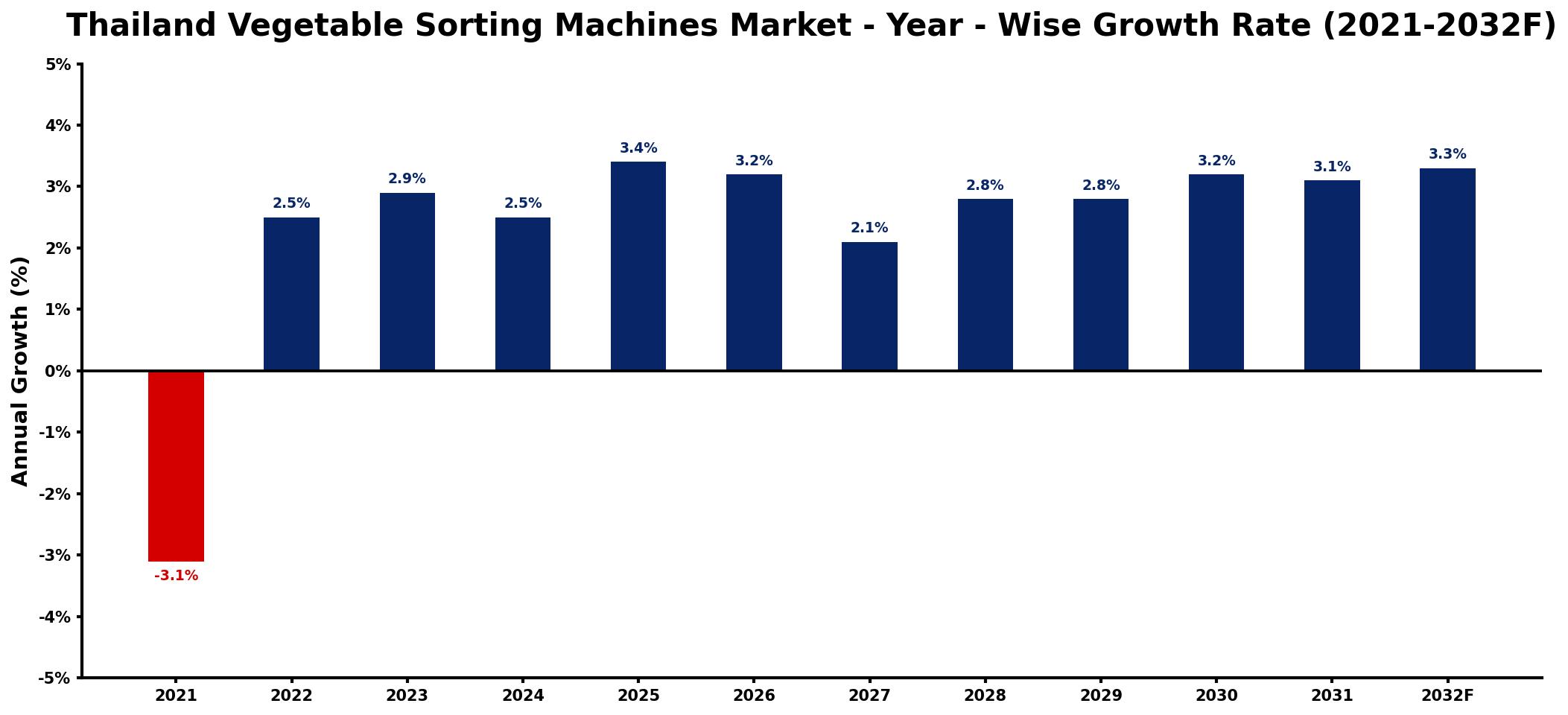
The table below presents the year‑wise growth rates along with the key drivers influencing the market
| Year | Growth Rate | Major Drivers |
| 2021 | -3.1% | Decreased agricultural investment trends |
| 2022 | 2.5% | Rising demand for automation technology |
| 2023 | 2.9% | Increased focus on food safety |
| 2024 | 2.5% | Expansion of export markets |
| 2025 | 3.4% | Growing adoption of sustainable practices |
| 2026 | 3.2% | Technological advancements in agriculture |
| 2027 | 2.1% | Rising labor cost pressures |
| 2028 | 2.8% | Increased government support initiatives |
| 2029 | 2.8% | Emerging agritech startups innovation |
| 2030 | 3.2% | Heightened awareness of quality standards |
| 2031 | 3.1% | Boost in organic farming practices |
| 2032 | 3.3% | Strengthened supply chain efficiency |
Note: Market size estimations and growth projections presented in this report are based on 6Wresearch's proprietary forecasting methodology, utilizing the latest available industry data, government publications, and primary research inputs.
Thailand Vegetable Sorting Machines Market Synopsis
The current market is heavily influenced by the increasing focus on quality control across agricultural practices. With heightened awareness among consumers regarding food quality and safety, the demand for reliable sorting machines has surged. These machines leverage state-of-the-art technologies such as computer vision and machine learning to ensure that only the finest produce reaches consumers.
Moreover, governmental initiatives aimed at modernizing the agricultural sector have also contributed significantly to market growth. Efforts to minimize post-harvest losses are becoming more pronounced, thus catalyzing investment in sorting technologies that promise improved efficiency and effectiveness in the sorting process.
Thailand Vegetable Sorting Machines Market Key Takeaways
- The market is driven by advancements in sorting technology, specifically targeting quality and efficiency.
- Government initiatives are propelling the modernization of agricultural practices in Thailand.
- There is a growing consumer expectation for high-quality produce, impacting sorting machine adoption rates.
- Technological innovations are evolving to address the challenges of crop diversity and quality control.
- The pandemic has accelerated interest in automation solutions, particularly in the food safety domain.
Evaluation of Restraints in Thailand Vegetable Sorting Machines Market
Despite the markets promising growth trajectory, several restraints pose challenges to its expansion. The diversity of crops grown in Thailand requires sorting machines to be versatile enough to handle various vegetable types without compromising accuracy. Furthermore, maintaining consistent quality control amidst these variations demands sophisticated technology, which may not always be accessible to smaller producers. Additionally, the initial investment required for such advanced machines can deter small and medium-sized enterprises from adopting these solutions, potentially stalling market growth in certain segments.
Thailand Vegetable Sorting Machines Market Trends
A notable trend within this market is the increasing integration of artificial intelligence and machine learning into sorting technology. These innovations enhance the ability to sort vegetables not just by size and weight, but also by subtle quality indicators such as color and surface defects. Furthermore, sustainability is becoming a vital consideration; as environmental awareness rises, producers are seeking sorting solutions that minimize waste and promote eco-friendly practices.
Thailand Vegetable Sorting Machines Market Opportunities
The future holds substantial growth opportunities within the Thailand Vegetable Sorting Machines Market. The ongoing modernization initiatives in agriculture are leading to heightened investments in automated solutions. Additionally, as export markets continue to expand, there will be an increasing demand for sorting machines that can cater to stringent international quality standards. Moreover, with the rapid development of smart agriculture technologies, there exists potential for integrating sorting machines with Internet of Things (IoT) capabilities, further optimizing the supply chain.
Government Initiatives in the Thailand Vegetable Sorting Machines Market
The Thai government has been actively promoting modernization within the agricultural sector through various initiatives and funding programs. These efforts aim to reduce post-harvest losses and improve overall quality standards. The government's support for technology adoption, alongside training programs for farmers and agricultural workers, is creating an environment conducive to the uptake of advanced sorting solutions. Such policies not only enhance the efficiency of production but also contribute to higher quality outputs in the market.
Future Insights of the Thailand Vegetable Sorting Machines Market
Looking ahead, the Thailand Vegetable Sorting Machines Market is poised for a period of steady growth driven by technological advancements and regulatory support. By 2026-2032, the integration of AI and IoT technologies in sorting processes will likely become more commonplace, allowing for enhanced precision and automation. As stakeholders continue to prioritize quality and safety, the market will see increased investments and innovations aimed at meeting both local and global demand.
Thailand Vegetable Sorting Machines Market Latest Developments (2025 - 2026)
Recent developments in the market indicate a significant shift towards automation and technological innovation. Manufacturers are focusing on enhancing machine capabilities to address the diverse needs of vegetable sorting effectively. Additionally, collaborations between technology providers and agricultural producers are emerging as a strategy to streamline the implementation of sorting solutions. As such, the emphasis on food safety and quality control continues to drive the evolution of sorting machines in Thailand.
Thailand Vegetable Sorting Machines Market - Key Attractiveness of the Report
- 10 Years of Market Numbers
- Historical Data Starting from 2022 to 2025
- Base Year: 2025
- Forecast Data until 2032
- Key Performance Indicators Impacting the Market
- Major Upcoming Developments and Projects
Key Highlights of the Report:
- Thailand Vegetable Sorting Machines Market Outlook
- Market Size of Thailand Vegetable Sorting Machines Market, 2025
- Forecast of Thailand Vegetable Sorting Machines Market, 2032
- Historical Data and Forecast of Thailand Vegetable Sorting Machines Revenues & Volume for the Period 2022-2032F
- Thailand Vegetable Sorting Machines Market Trend Evolution
- Thailand Vegetable Sorting Machines Market Drivers and Challenges
- Thailand Vegetable Sorting Machines Price Trends
- Thailand Vegetable Sorting Machines Porter's Five Forces
- Thailand Vegetable Sorting Machines Industry Life Cycle
- Historical Data and Forecast of Thailand Vegetable Sorting Machines Market Revenues & Volume By Types for the Period 2022-2032F
- Historical Data and Forecast of Thailand Vegetable Sorting Machines Market Revenues & Volume By Size Sorter Machine for the Period 2022-2032F
- Historical Data and Forecast of Thailand Vegetable Sorting Machines Market Revenues & Volume By Weight Sorting Machine for the Period 2022-2032F
- Historical Data and Forecast of Thailand Vegetable Sorting Machines Market Revenues & Volume By Appearance Quality Sorting Machine for the Period 2022-2032F
- Historical Data and Forecast of Thailand Vegetable Sorting Machines Market Revenues & Volume By Internal Quality Sorting Machine for the Period 2022-2032F
- Historical Data and Forecast of Thailand Vegetable Sorting Machines Market Revenues & Volume By Applications for the Period 2022-2032F
- Historical Data and Forecast of Thailand Vegetable Sorting Machines Market Revenues & Volume By Fresh Vegetables for the Period 2022-2032F
- Historical Data and Forecast of Thailand Vegetable Sorting Machines Market Revenues & Volume By Frozen Vegetables for the Period 2022-2032F
- Historical Data and Forecast of Thailand Vegetable Sorting Machines Market Revenues & Volume By Dehydrated Vegetables for the Period 2022-2032F
- Thailand Vegetable Sorting Machines Import Export Trade Statistics
- Market Opportunity Assessment By Types
- Market Opportunity Assessment By Applications
- Thailand Vegetable Sorting Machines Top Companies Market Share
- Thailand Vegetable Sorting Machines Competitive Benchmarking By Technical and Operational Parameters
- Thailand Vegetable Sorting Machines Company Profiles
- Thailand Vegetable Sorting Machines Key Strategic Recommendations






































