Thailand Virtual Private Server Market Size & Growth Rate (2026-2032)
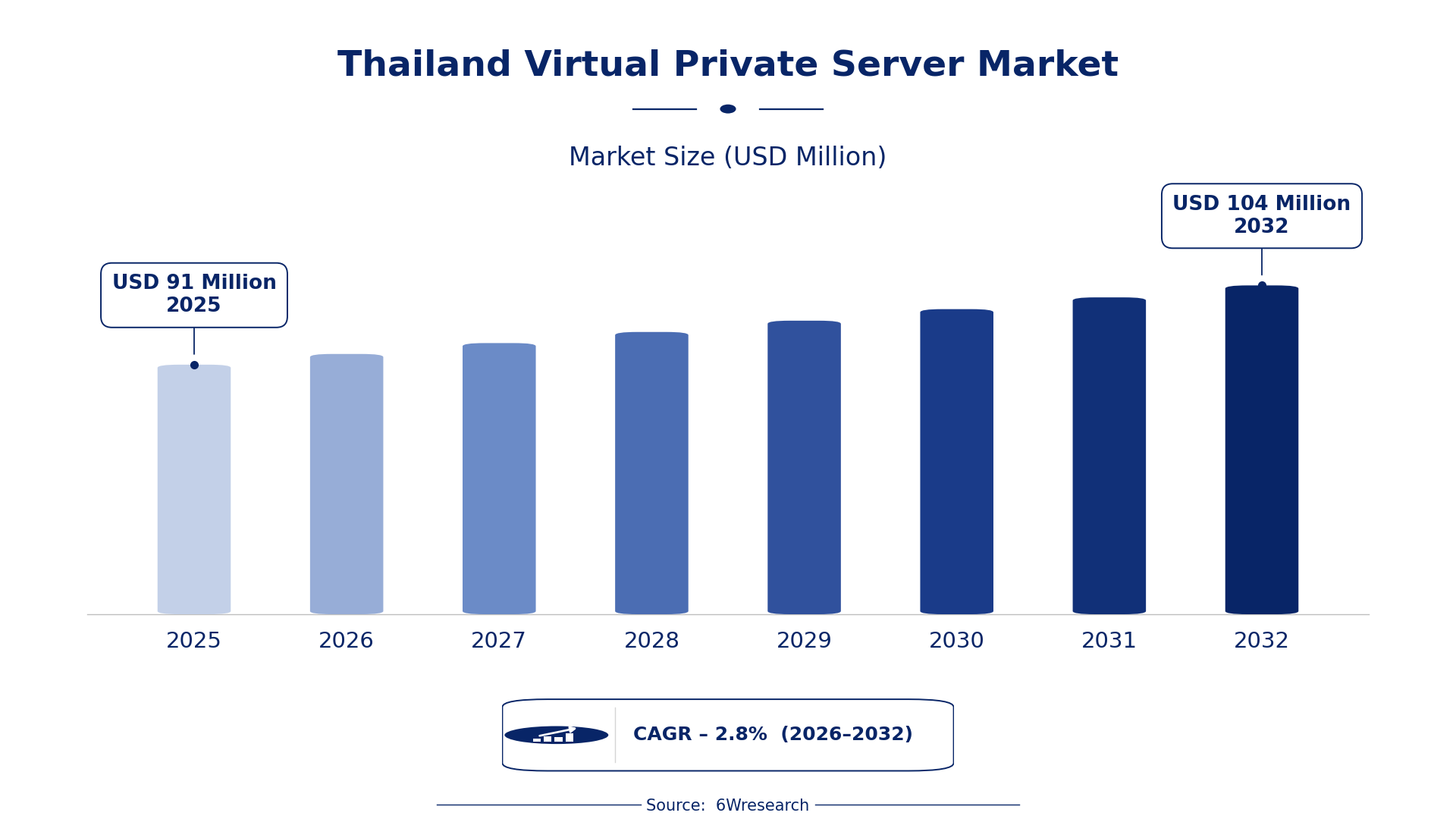
The Thailand Virtual Private Server Market was estimated at USD 91 Million in 2025 and is projected to reach USD 104 Million by 2032, growing at a CAGR of 2.8% from 2026 to 2032.
Thailand Virtual Private Server Market Synopsis
The demand for Virtual Private Servers (VPS) in Thailand is surging, driven primarily by the increasing reliance on digital infrastructure among small and medium-sized enterprises (SMEs). These businesses are seeking reliable hosting solutions that provide both flexibility and control over their server resources, making VPS an attractive option for their varied needs.
As companies pivot towards digital operations, VPS is gaining traction for hosting websites and applications. The market's growth is underpinned by the need for enhanced performance, security, and scalability in the face of rising online activity, particularly in a post-pandemic world where remote work and e-commerce are here to stay.
Thailand Virtual Private Server Market Year-wise Growth Rate and Key Drivers
This graph illustrates the annual growth rates of the Thailand Virtual Private Server Market from 2021 to 2032, highlighting a steady upward trajectory and projected expansion over the forecast period.
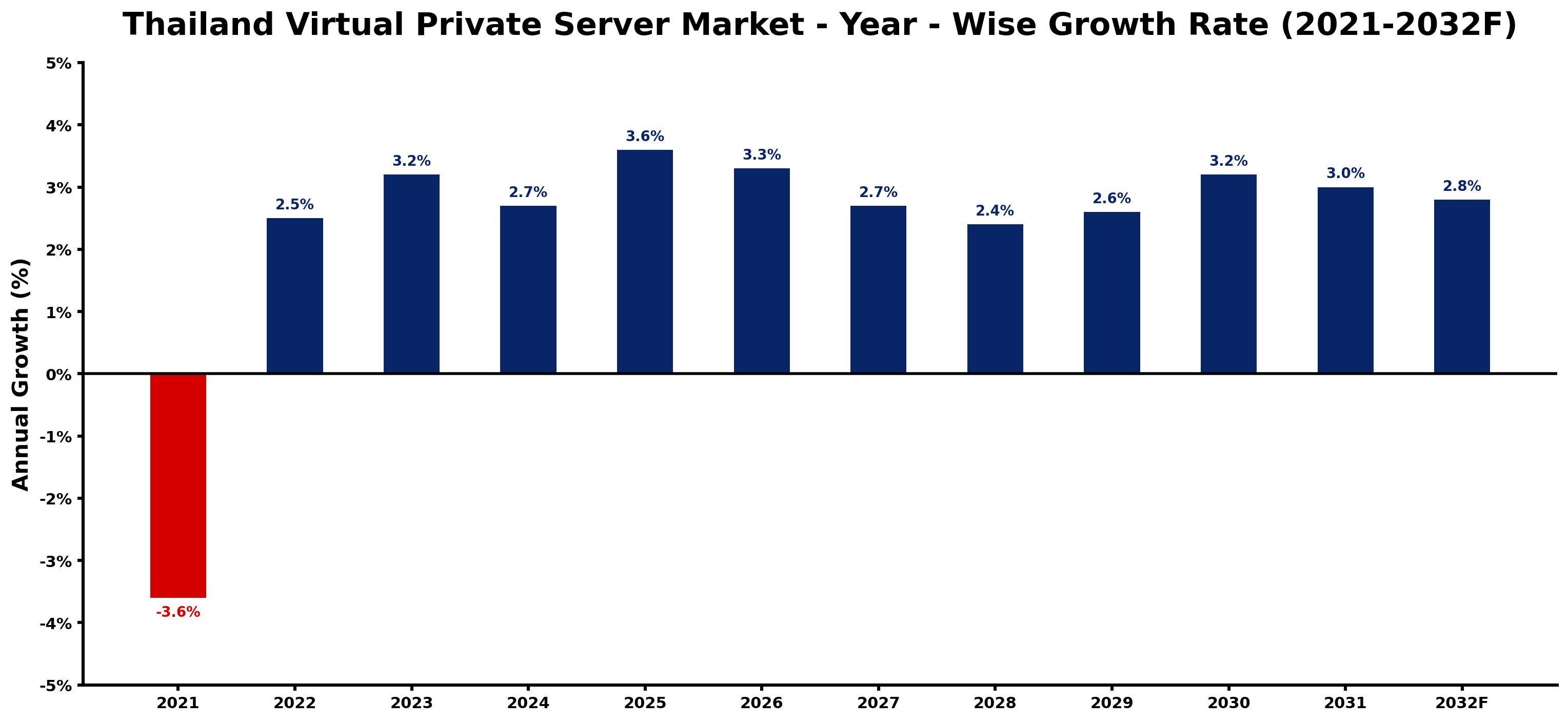
The table below presents the year‑wise growth rates along with the key drivers influencing the market
| Year | Growth Rate | Major Drivers |
| 2021 | -3.6% | Sharp currency depreciation affects international hosting costs. |
| 2022 | 2.5% | Thai Cybersecurity Agency enhancing digital infrastructure protections |
| 2023 | 3.2% | Increased remote workforce driving virtual server adoption |
| 2024 | 2.7% | Investment in digital payment systems boosting hosting requirements |
| 2025 | 3.6% | Emergence of local tech startups need for secure hosting |
| 2026 | 3.3% | Government support for tech education increasing developer pool |
| 2027 | 2.7% | Rising interest in cloud gaming platforms expands VPS usage |
| 2028 | 2.4% | New data privacy regulations increasing need for secure servers |
| 2029 | 2.6% | Local enterprises accelerating cloud migrations to enhance efficiency |
| 2030 | 3.2% | Strong growth in streaming services requiring reliable server solutions |
| 2031 | 3.0% | Thailand’s digital economy strategy prioritizing virtual infrastructure solutions |
| 2032 | 2.8% | Heightened demand for online education driving VPS growth |
Note: Market size estimations and growth projections presented in this report are based on 6Wresearch's proprietary forecasting methodology, utilizing the latest available industry data, government publications, and primary research inputs.
Thailand Virtual Private Server Market Key Takeaways
Below are some of the specific key takeaways from the market, including:
- The market is driven by a growing number of SMEs seeking affordable and customizable hosting solutions.
- Demand for VPS solutions has accelerated due to the COVID-19 pandemic, emphasizing the need for scalable IT infrastructure.
- Security concerns remain a top priority as businesses seek to protect their virtual environments.
- Major players are advancing technologies to enhance VPS offerings, ensuring better performance and reliability.
- Government initiatives are fostering a favorable environment for VPS adoption through digital infrastructure upgrades.
Evaluation of Restraints in Thailand Virtual Private Server Market
Despite its growth potential, the Thailand Virtual Private Server Market faces notable challenges. One major restraint is the balance between performance and cost-effectiveness; many businesses struggle to find VPS solutions that meet their needs without exceeding budget constraints. Additionally, ensuring the security of virtualized environments is crucial, yet complex, as cyber threats continue to evolve. Companies must invest in robust security measures to protect sensitive data and maintain customer trust, which can deter some from fully committing to VPS solutions.
Thailand Virtual Private Server Market Trends
Several trends are shaping the Thailand Virtual Private Server Market. The increasing shift to cloud-based solutions has prompted many businesses to explore VPS as a viable alternative for hosting. Automation and management tools are becoming more prevalent, enabling companies to optimize their server management processes. Additionally, the growing emphasis on cybersecurity is influencing VPS providers to incorporate advanced security features. This trend is crucial for businesses looking to enhance their online presence while safeguarding their operations.
Thailand Virtual Private Server Market Opportunities
The market presents numerous growth opportunities, particularly in sectors such as e-commerce, education, and digital services. As businesses increasingly transition to online models, the demand for VPS solutions that offer scalability and customization is set to rise. on top of that, the expansion of 5G technology in Thailand will likely enhance VPS performance, opening doors for innovative applications. Companies that can provide tailored VPS solutions will find a receptive market eager for enhanced digital capabilities.
Government Initiatives in the Thailand Virtual Private Server Market
The Thai government is actively promoting the digital economy, creating a supportive framework for the Virtual Private Server Market. Policies focused on enhancing digital infrastructure and improving access to technology are crucial for fostering growth in this sector. As businesses increasingly rely on VPS for their operations, government initiatives aimed at modernizing IT frameworks and encouraging investment will play a significant role in shaping the market.
- A national digital infrastructure upgrade programme recently launched to improve internet connectivity across urban and rural areas.
- Ongoing initiatives to establish cybersecurity standards for digital service providers, ensuring safer VPS environments.
- A public-private partnership expected to enhance data center capabilities by 2027, aimed at supporting the growing demand for VPS.
- Plans for a regulatory framework focusing on billing transparency and service quality to bolster consumer trust in VPS providers.
Future Insights of the Thailand Virtual Private Server Market
Looking ahead to 2026-2032, the Thailand Virtual Private Server Market is likely to witness sustained growth driven by continued digital transformation efforts across various sectors. As businesses prioritize agility and scalability, VPS solutions will become increasingly critical. Enhanced technology offerings and government support will further solidify VPS as a preferred hosting solution, paving the way for innovations that meet the evolving demands of organizations.
Thailand Virtual Private Server Market Latest Developments
Recent activity in the Thailand Virtual Private Server Market indicates a dynamic shift towards more advanced solutions. Over the past year, several initiatives have emerged as providers seek to enhance their offerings and meet the growing demands of businesses. This momentum reflects a broader trend towards digital adoption and infrastructure investment in the region.
- A leading regional operator launched an upgraded VPS service in early 2025, featuring enhanced security protocols and increased resource allocation.
- In mid-2025, a major technology vendor began rolling out AI-driven management tools for VPS, aimed at automating resource allocation and improving efficiency.
- An upcoming partnership between two key players is expected to be announced in Q3 2025, focusing on collaborative innovation in VPS technology.
- Currently, a pilot program is underway to integrate blockchain technology into VPS solutions, enhancing data security and transparency.
Thailand Virtual Private Server Market - Key Attractiveness of the Report
- 10 Years of Market Numbers
- Historical Data Starting from 2022 to 2025
- Base Year: 2025
- Forecast Data until 2032
- Key Performance Indicators Impacting the Market
- Major Upcoming Developments and Projects
Key Highlights of the Report:
- Thailand Virtual Private Server Market Outlook
- Market Size of Thailand Virtual Private Server Market, 2025
- Forecast of Thailand Virtual Private Server Market, 2032
- Historical Data and Forecast of Thailand Virtual Private Server Revenues & Volume for the Period 2022-2032F
- Thailand Virtual Private Server Market Trend Evolution
- Thailand Virtual Private Server Market Drivers and Challenges
- Thailand Virtual Private Server Price Trends
- Thailand Virtual Private Server Porter's Five Forces
- Thailand Virtual Private Server Industry Life Cycle
- Historical Data and Forecast of Thailand Virtual Private Server Market Revenues & Volume By Operating System for the Period 2022-2032F
- Historical Data and Forecast of Thailand Virtual Private Server Market Revenues & Volume By Windows for the Period 2022-2032F
- Historical Data and Forecast of Thailand Virtual Private Server Market Revenues & Volume By Linux for the Period 2022-2032F
- Historical Data and Forecast of Thailand Virtual Private Server Market Revenues & Volume By Vertical for the Period 2022-2032F
- Historical Data and Forecast of Thailand Virtual Private Server Market Revenues & Volume By BFSI for the Period 2022-2032F
- Historical Data and Forecast of Thailand Virtual Private Server Market Revenues & Volume By Government for the Period 2022-2032F
- Historical Data and Forecast of Thailand Virtual Private Server Market Revenues & Volume By Defense for the Period 2022-2032F
- Historical Data and Forecast of Thailand Virtual Private Server Market Revenues & Volume By IT for the Period 2022-2032F
- Historical Data and Forecast of Thailand Virtual Private Server Market Revenues & Volume By Telecommunication for the Period 2022-2032F
- Historical Data and Forecast of Thailand Virtual Private Server Market Revenues & Volume By Retail for the Period 2022-2032F
- Historical Data and Forecast of Thailand Virtual Private Server Market Revenues & Volume By Healthcare for the Period 2022-2032F
- Historical Data and Forecast of Thailand Virtual Private Server Market Revenues & Volume By Organization Size for the Period 2022-2032F
- Historical Data and Forecast of Thailand Virtual Private Server Market Revenues & Volume By SMEs for the Period 2022-2032F
- Historical Data and Forecast of Thailand Virtual Private Server Market Revenues & Volume By Large Enterprises for the Period 2022-2032F
- Thailand Virtual Private Server Import Export Trade Statistics
- Market Opportunity Assessment By Operating System
- Market Opportunity Assessment By Vertical
- Market Opportunity Assessment By Organization Size
- Thailand Virtual Private Server Top Companies Market Share
- Thailand Virtual Private Server Competitive Benchmarking By Technical and Operational Parameters
- Thailand Virtual Private Server Company Profiles
- Thailand Virtual Private Server Key Strategic Recommendations






































