Thailand Water Purifier Market Size, Share & Growth Rate
The Thailand Water Purifier Market was estimated at USD 185 Million in 2025 and is projected to reach USD 212 Million by 2032, growing at a CAGR of 2.0% from 2026 to 2032. This growth trajectory is largely driven by escalating concerns regarding water quality and safety, as urbanization and industrial activities continue to impact the integrity of local water sources. The rising health consciousness among consumers has further fueled demand, with many individuals seeking effective solutions to ensure safe drinking water at home.
Thailand Water Purifier Market Year-wise Growth Rate and Key Drivers
This graph highlights how the Thailand Water Purifier Market has steadily grown over the years, supported by major growth factors.
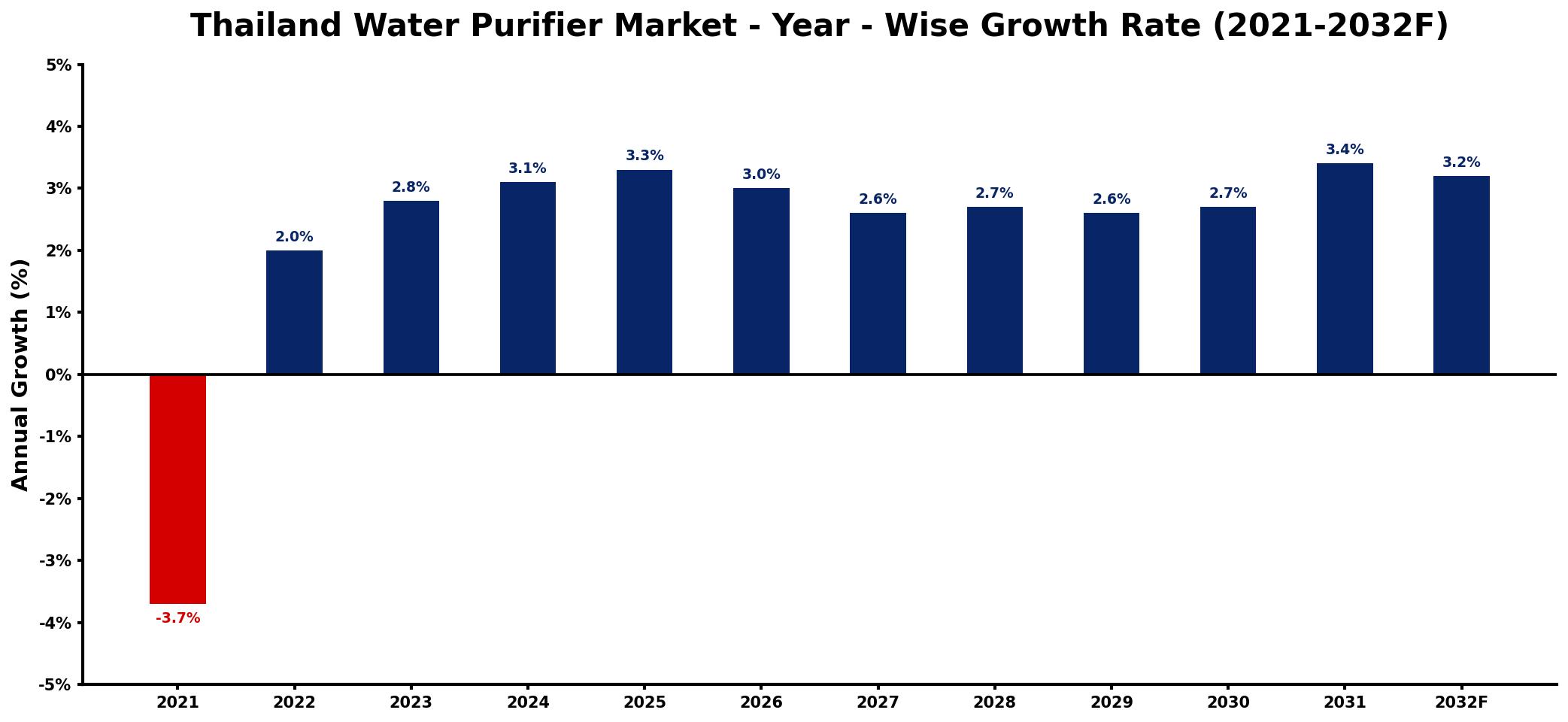
The table below presents the year‑wise growth rates along with the key drivers influencing the market
| Year | Growth Rate | Major Drivers |
| 2021 | -3.7% | decreased consumer health awareness |
| 2022 | 2.0% | rising demand for clean solutions |
| 2023 | 2.8% | increased urban population growth |
| 2024 | 3.1% | expansion of distribution networks |
| 2025 | 3.3% | growing environmental sustainability focus |
| 2026 | 3.0% | technological advancements in filtration |
| 2027 | 2.6% | increased disposable income levels |
| 2028 | 2.7% | rising concerns over contaminants |
| 2029 | 2.6% | enhanced government regulations implementation |
| 2030 | 2.7% | growing interest in home installations |
| 2031 | 3.4% | rising end-use demand growth |
| 2032 | 3.2% | increased investment in infrastructure |
Note: Market size estimations and growth projections presented in this report are based on 6Wresearch's proprietary forecasting methodology, utilizing the latest available industry data, government publications, and primary research inputs.
Thailand Water Purifier Market Synopsis
In Thailand, the demand for water purifiers is underscored by alarming rates of water pollution and the presence of harmful contaminants in drinking water. The market offers a range of purification technologies, including reverse osmosis, UV purification, and activated carbon filtration, catering to the varied preferences of consumers and businesses alike.
Growing consumer awareness regarding health and environmental issues significantly propels market expansion. Government initiatives aimed at enhancing water quality standards and promoting safe drinking water access are also instrumental in increasing the adoption of water purification systems across both residential and commercial sectors.
Thailand Water Purifier Market Key Takeaways
- Rising health consciousness is driving demand for effective water purification technologies.
- Government regulations are actively promoting access to clean and safe drinking water.
- Urbanization and industrialization are key factors contributing to water pollution concerns.
- Supply chain disruptions during the COVID-19 pandemic underscored the need for local manufacturing.
- Affordability and competition from traditional water sources remain critical market challenges.
Evaluation of Restraints in Thailand Water Purifier Market
Despite the robust growth potential of the Thailand Water Purifier Market, several constraints persist. One major limitation is the affordability of water purification systems, particularly for lower-income households, where budget constraints may restrict access to these essential technologies. Additionally, traditional water sources remain competitive, creating a challenge for companies to demonstrate the added value and benefits of investing in advanced purification systems. Furthermore, ongoing water quality issues necessitate constant innovation and development of cost-effective purification solutions, requiring significant investment in research and development.
Thailand Water Purifier Market Trends
A noticeable trend shaping the Thailand Water Purifier Market is the increased consumer preference for eco-friendly and sustainable purification options. Many companies are beginning to focus on environmentally friendly technologies and materials, aligning with the growing demand for green products. Additionally, advancements in smart technology are gaining traction, with more consumers seeking connected devices that offer real-time monitoring of water quality and usage patterns, enhancing user experience and satisfaction.
Thailand Water Purifier Market Opportunities
Opportunities within the Thailand Water Purifier Market are plentiful, particularly in underserved regions where access to clean water remains a significant issue. Companies that can develop affordable yet reliable purification solutions stand to capture a growing customer base. Furthermore, the ongoing government focus on enhancing water quality presents avenues for partnerships and collaborative ventures aimed at community-centric projects that promote safe drinking water access.
Government Initiatives in the Thailand Water Purifier Market
The Thai government is actively involved in improving water quality standards and facilitating public access to safe drinking water. Various initiatives include investment in infrastructure development and programs aimed at raising awareness about the importance of water purification. These efforts are designed to ensure that communities are well-informed about water safety and have access to the necessary technologies to improve their drinking water quality.
Future Insights of the Thailand Water Purifier Market
Looking ahead to 2026-2032, the Thailand Water Purifier Market is positioned for steady growth, driven by continued urbanization and the pressing need for safe drinking water solutions. As consumer awareness expands and technology advances, the market will likely see a shift towards more integrated purification systems that combine multiple purification methods. Sustainability will also remain a core focus, guiding innovation and strategic investments in the years to come.
Thailand Water Purifier Market Latest Developments (2025 - 2026)
Recent developments in the Thailand Water Purifier Market indicate a movement towards enhanced local manufacturing capabilities, aimed at reducing reliance on imported components. Companies are increasingly adopting digital marketing strategies to reach health-conscious consumers, showcasing the health benefits associated with purified water. The ongoing recovery from the pandemic has prompted a renewed focus on product innovation and sustainable practices within the sector, setting the stage for future growth.
Thailand Water Purifier Market - Key Attractiveness of the Report
- 10 Years of Market Numbers
- Historical Data Starting from 2022 to 2025
- Base Year: 2025
- Forecast Data until 2032
- Key Performance Indicators Impacting the Market
- Major Upcoming Developments and Projects
Key Highlights of the Report:
- Thailand Water Purifier Market Outlook
- Market Size of Thailand Water Purifier Market, 2025
- Forecast of Thailand Water Purifier Market, 2032
- Historical Data and Forecast of Thailand Water Purifier Revenues & Volume for the Period 2022-2032F
- Thailand Water Purifier Market Trend Evolution
- Thailand Water Purifier Market Drivers and Challenges
- Thailand Water Purifier Price Trends
- Thailand Water Purifier Porter's Five Forces
- Thailand Water Purifier Industry Life Cycle
- Historical Data and Forecast of Thailand Water Purifier Market Revenues & Volume By Type for the Period 2022-2032F
- Historical Data and Forecast of Thailand Water Purifier Market Revenues & Volume By Point-of-use Filters for the Period 2022-2032F
- Historical Data and Forecast of Thailand Water Purifier Market Revenues & Volume By Under The Counter Filters for the Period 2022-2032F
- Historical Data and Forecast of Thailand Water Purifier Market Revenues & Volume By Counter Top Filters for the Period 2022-2032F
- Historical Data and Forecast of Thailand Water Purifier Market Revenues & Volume By Pitcher Filters for the Period 2022-2032F
- Historical Data and Forecast of Thailand Water Purifier Market Revenues & Volume By Faucet-mounted Filters for the Period 2022-2032F
- Historical Data and Forecast of Thailand Water Purifier Market Revenues & Volume By Others for the Period 2022-2032F
- Historical Data and Forecast of Thailand Water Purifier Market Revenues & Volume By Point-of-entry Filters for the Period 2022-2032F
- Historical Data and Forecast of Thailand Water Purifier Market Revenues & Volume By Category for the Period 2022-2032F
- Historical Data and Forecast of Thailand Water Purifier Market Revenues & Volume By Ro Filters for the Period 2022-2032F
- Historical Data and Forecast of Thailand Water Purifier Market Revenues & Volume By Uv Filters for the Period 2022-2032F
- Historical Data and Forecast of Thailand Water Purifier Market Revenues & Volume By Gravity Filters for the Period 2022-2032F
- Historical Data and Forecast of Thailand Water Purifier Market Revenues & Volume By Others for the Period 2022-2032F
- Historical Data and Forecast of Thailand Water Purifier Market Revenues & Volume By Application for the Period 2022-2032F
- Historical Data and Forecast of Thailand Water Purifier Market Revenues & Volume By Residential for the Period 2022-2032F
- Historical Data and Forecast of Thailand Water Purifier Market Revenues & Volume By Light Commercial for the Period 2022-2032F
- Thailand Water Purifier Import Export Trade Statistics
- Market Opportunity Assessment By Type
- Market Opportunity Assessment By Category
- Market Opportunity Assessment By Application
- Thailand Water Purifier Top Companies Market Share
- Thailand Water Purifier Competitive Benchmarking By Technical and Operational Parameters
- Thailand Water Purifier Company Profiles
- Thailand Water Purifier Key Strategic Recommendations






































