Thailand Wine production Machinery Market Summary
The thailand wine production machinery market was estimated at USD 235 Million in 2025 and is projected to reach USD 270 Million by 2032, growing at a CAGR of 3.3% from 2026 to 2032.
Thailand Wine production Machinery Market Year-wise Growth Rate and Key Drivers
This graph highlights how the Thailand Wine production Machinery Market has steadily grown over the past five years, supported by major growth factors.
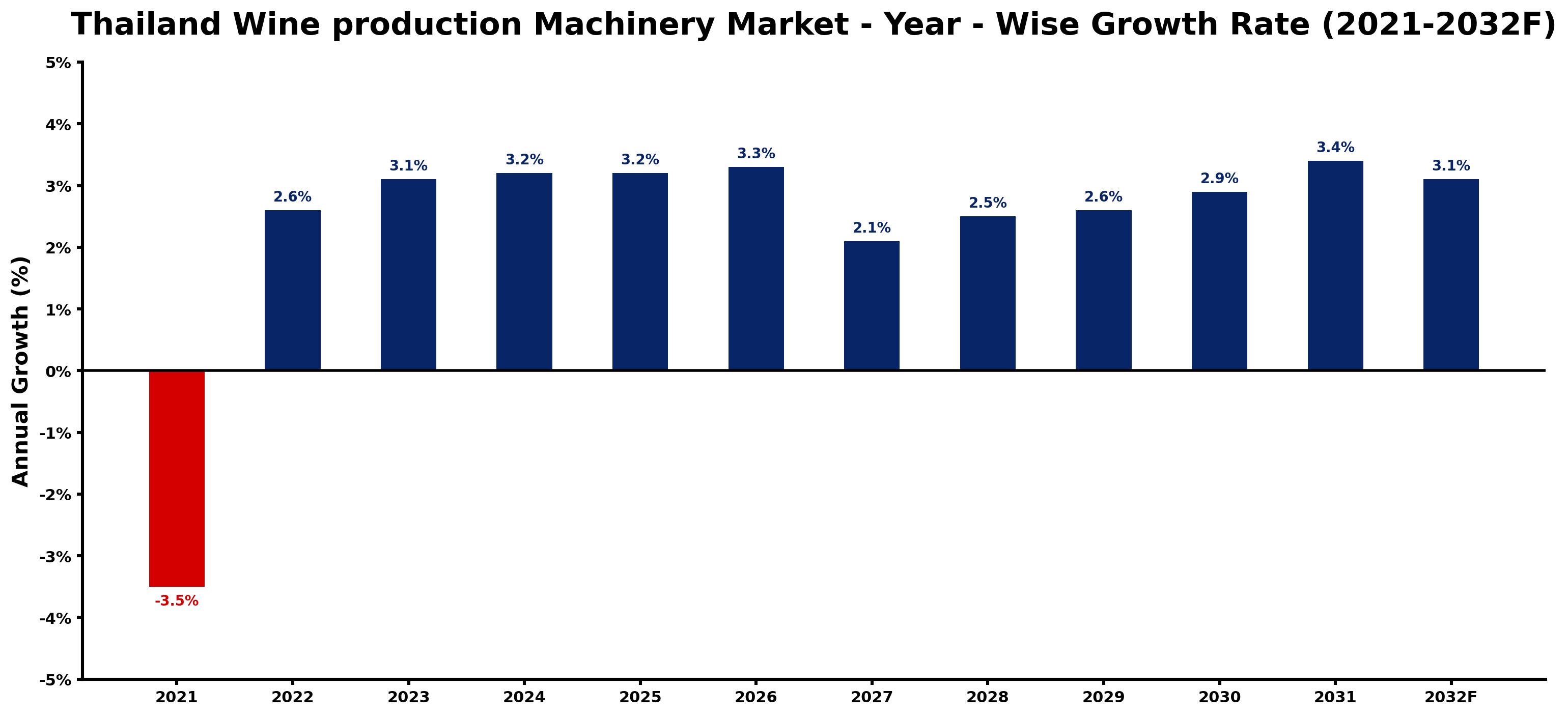
The table below presents the year wise growth rates along with the key drivers influencing the market
| Year | Growth Rate | Major Drivers |
| 2021 | -3.5% | Heightened import tariffs on machinery components stifled investment and diminished operational capacity for local producers. |
| 2022 | 2.6% | Global wine production challenges prompted Thai manufacturers to explore new machinery solutions. |
| 2023 | 3.1% | Local wineries prioritized quality improvements through upgraded fermentation and bottling equipment. |
| 2024 | 3.2% | Increased tourism stimulated demand for Thai wine, pushing machinery upgrades for efficiency. |
| 2025 | 3.2% | Growing awareness of Thai wine's potential attracted foreign partnerships for technology sharing. |
| 2026 | 3.3% | Online retail expansion created pressure for wineries to optimize production with advanced machinery. |
| 2027 | 2.1% | Local agricultural trends favored vineyard expansions, necessitating investment in better processing equipment. |
| 2028 | 2.5% | Sustainability goals influenced wineries to adopt eco-friendly machinery options in their operations. |
| 2029 | 2.6% | Technological innovations in automation made production processes more efficient and cost-effective. |
| 2030 | 2.9% | Rising consumer preferences for unique wine experiences encouraged diversification in production machinery. |
| 2031 | 3.4% | Increased competition among domestic wineries led to accelerated investments in state-of-the-art machinery. |
| 2032 | 3.1% | Economic recovery and rising export ambitions pushed wineries to modernize their production capabilities. |
Note - Market size estimations and growth projections presented in this report are based on 6Wresearch's advanced forecasting approach, validated with industry datasets as of June 2026.
Thailand Wine production Machinery Market Synopsis
The Thailand Wine production Machinery Market is projected to reach 3.3% and witness significant growth during the forecast period (2026-2032). This market encompasses an array of equipment vital for the various stages of wine production, including grape harvesting, crushing, fermentation, clarification, aging, and bottling. The machinery plays a crucial role in enhancing efficiency and precision across the entire winemaking process, thereby contributing to both product quality and production scalability.
Thailand Wine production Machinery Market Growth Drivers
Several factors are propelling the growth of the Thailand Wine production Machinery Market. The surge in wine consumption, particularly among domestic consumers, is driving a parallel increase in the number of wineries and vineyards throughout the country. A few key growth drivers include:
- The rise in domestic wine consumption, primarily among younger demographics with an inclination towards premium and craft wines, is directly impacting the demand for more advanced wine production machinery.
- Expansion of vineyard tourism, characterized by vineyard tours and wine tasting events, is pushing wineries to upscale their production capabilities to cater to a growing influx of tourists.
- A focus on producing high-quality wines capable of competing in international markets is motivating local wineries to invest in modern machinery that optimizes production processes.
- Innovative technologies in wine production machinery, such as automated grape sorting and temperature-controlled fermentation tanks, facilitate better product consistency and overall wine quality.
- The increasing number of wine-related events and festivals in Thailand acts as a catalyst for the growth of the wine industry and the associated machinery market.
Thailand Wine production Machinery Market Challenges and Restraints
Despite the positive outlook, the Thailand Wine production Machinery Market faces several challenges. These challenges include geographic constraints and financial barriers that may hinder market expansion:
- Wine production in Thailand is primarily concentrated in specific regions that possess favourable climatic conditions for grape cultivation, limiting the market's growth potential.
- The capital-intensive nature of acquiring and installing wine production machinery poses a significant barrier for smaller wine producers, potentially stifling competition.
- Regulatory hurdles and stringent quality standards must be met to ensure compliance, which can create additional financial burdens for wineries.
- The volatility of agricultural conditions, including climate change and pest infestations, can adversely affect grape yields, consequently impacting machinery utilization rates.
- Economic fluctuations may influence consumer spending patterns on non-essential items like wine, which could lead to reduced demand in certain segments of the market.
Thailand Wine production Machinery Market Government Investment and Initiatives
The Thai government has recognized the potential of the wine industry to contribute to economic growth through agricultural diversification and tourism. Various initiatives have been put in place to support the development of the Thailand Wine production Machinery Market:
- Investment in rural development programs that include incentives for wineries to modernize their equipment and expand production capacities.
- Support for research and development aimed at improving local grape varieties suitable for Thailand's unique climatic conditions.
- Collaboration with local universities and institutions to provide training for winemakers on modern production practices and machine operation.
- Promotion of wine-related tourism through tax benefits for wineries that host tourists and organize events, enhancing public interest in local wine production.
- Creation of regulatory frameworks that prioritize sustainability in wine production, encouraging investments in eco-friendly machinery.
Thailand Wine production Machinery Market Latest Developments (May 2025 - June 2026)
In the period from May 2025 to June 2026, the Thailand Wine production Machinery Market has experienced a series of developments that reflect ongoing changes in consumer preferences and industry dynamics. Notably, there has been an increase in the adoption of automated technologies that enhance production efficiency. Additionally, the market has seen collaborations between local wineries and international equipment suppliers to introduce advanced machinery tailored to Thailand's specific needs. Furthermore, the government has initiated programs aimed at promoting local wine production, which has positively influenced investment in machinery. The impact of a recovering tourism sector post-Covid-19 has also been evident, with wineries scaling up their operations to meet the growing demand from both domestic and international visitors.
Thailand Wine production Machinery Market - Key Attractiveness of the Report
- 10 Years of Market Numbers
- Historical Data Starting from 2022 to 2025
- Base Year: 2025
- Forecast Data until 2032
- Key Performance Indicators Impacting the Market
- Major Upcoming Developments and Projects
Key Highlights of the Report:
- Thailand Wine production Machinery Market Outlook
- Market Size of Thailand Wine production Machinery Market, 2025
- Forecast of Thailand Wine production Machinery Market, 2032
- Historical Data and Forecast of Thailand Wine production Machinery Revenues & Volume for the Period 2022-2032F
- Thailand Wine production Machinery Market Trend Evolution
- Thailand Wine production Machinery Market Drivers and Challenges
- Thailand Wine production Machinery Price Trends
- Thailand Wine production Machinery Porter's Five Forces
- Thailand Wine production Machinery Industry Life Cycle
- Historical Data and Forecast of Thailand Wine production Machinery Market Revenues & Volume By Type for the Period 2022-2032F
- Historical Data and Forecast of Thailand Wine production Machinery Market Revenues & Volume By Tanks & fermenters for the Period 2022-2032F
- Historical Data and Forecast of Thailand Wine production Machinery Market Revenues & Volume By Crushing & Pressing Equipment for the Period 2022-2032F
- Historical Data and Forecast of Thailand Wine production Machinery Market Revenues & Volume By Temperature Control Equipment for the Period 2022-2032F
- Historical Data and Forecast of Thailand Wine production Machinery Market Revenues & Volume By Filtration Equipment for the Period 2022-2032F
- Historical Data and Forecast of Thailand Wine production Machinery Market Revenues & Volume By Others for the Period 2022-2032F
- Thailand Wine production Machinery Import Export Trade Statistics
- Market Opportunity Assessment By Type
- Thailand Wine production Machinery Top Companies Market Share
- Thailand Wine production Machinery Competitive Benchmarking By Technical and Operational Parameters
- Thailand Wine production Machinery Company Profiles
- Thailand Wine production Machinery Key Strategic Recommendations






































