Thailand Wire Harness Market Size, Share & Growth Rate
The Thailand Wire Harness Market was estimated at USD 185 Million in 2025 and is projected to reach USD 212 Million by 2032, growing at a CAGR of 2.0% from 2026 to 2032. This growth trajectory is largely fueled by the robust expansion of the automotive sector in Thailand, which remains a key consumer of wire harness solutions. The increasing popularity of electric vehicles, coupled with rising demand for consumer electronics, further amplifies the necessity for efficient wire harness designs that can accommodate complex electrical systems.
Thailand Wire Harness Market Year-wise Growth Rate and Key Drivers
This graph highlights how the Thailand Wire Harness Market has steadily grown over the years, supported by major growth factors.
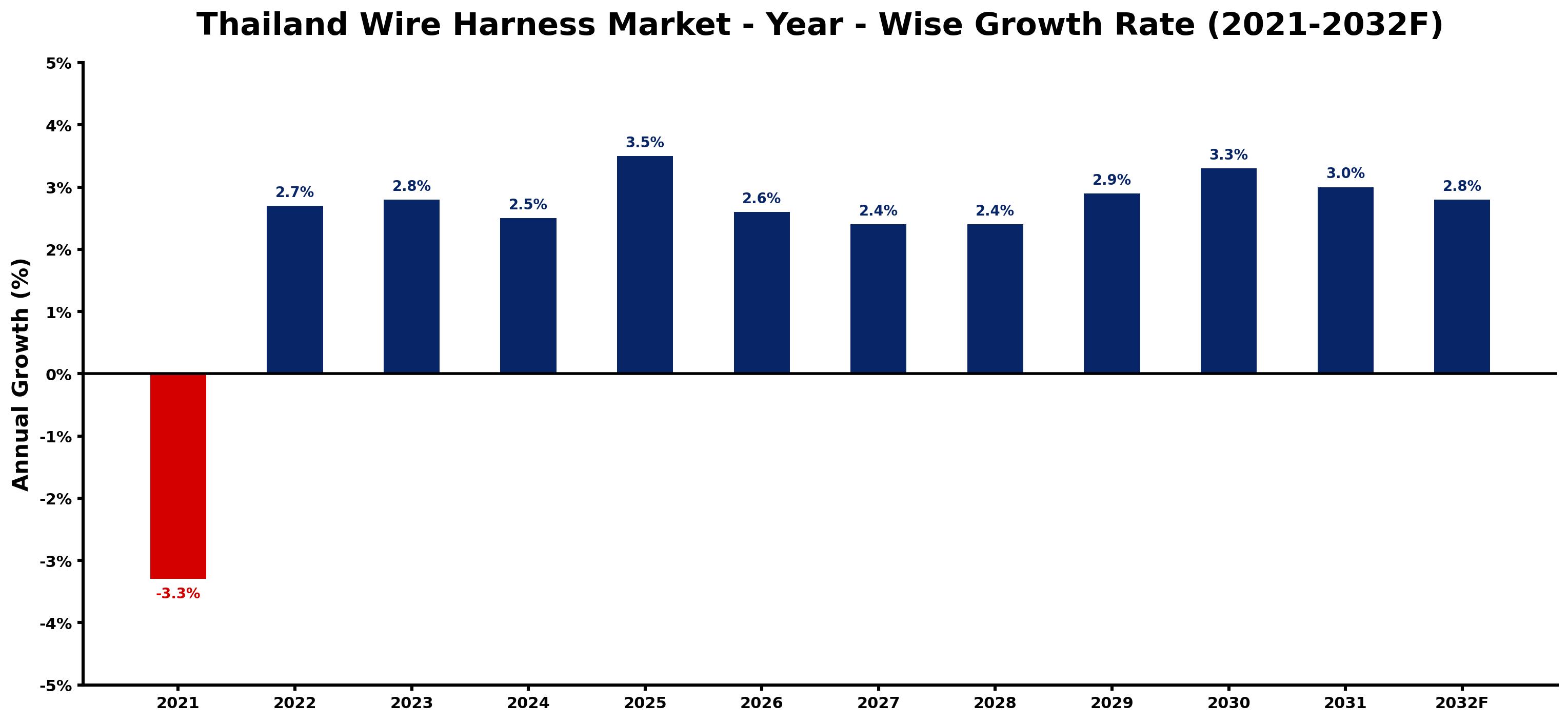
The table below presents the year‑wise growth rates along with the key drivers influencing the market
| Year | Growth Rate | Major Drivers |
| 2021 | -3.3% | Growing urbanization and commercial development |
| 2022 | 2.7% | Rising electricity demand across industries |
| 2023 | 2.8% | Rising electricity demand across industries |
| 2024 | 2.5% | Increasing industrial infrastructure investments |
| 2025 | 3.5% | Increasing industrial infrastructure investments |
| 2026 | 2.6% | Growing renewable energy integration projects |
| 2027 | 2.4% | Growing urbanization and commercial development |
| 2028 | 2.4% | Growing urbanization and commercial development |
| 2029 | 2.9% | Growing urbanization and commercial development |
| 2030 | 3.3% | Expansion of commercial construction activities |
| 2031 | 3.0% | Rapid growth in telecom and data center sectors |
| 2032 | 2.8% | Growing renewable energy integration projects |
Note - Market size estimations and growth projections presented in this report are based on 6Wresearch’s advanced forecasting approach, validated with industry datasets as of June 2026.
Thailand Wire Harness Market Synopsis
The demand for wire harnesses in Thailand is primarily driven by the automotive industry's shift toward higher connectivity and enhanced electrical performance in vehicles. As Thailand continues to establish itself as a manufacturing hub for both traditional and electric vehicles, the reliance on sophisticated wire harness systems is more pronounced than ever.
Moreover, the surge in consumer electronics manufacturing, encompassing everything from smartphones to home appliances, necessitates highly reliable wire harness solutions. This demand drives innovation in design and production techniques, reinforcing the significance of wire harnesses across multiple sectors.
Thailand Wire Harness Market Key Takeaways
- Growth driven by the expanding automotive sector and rising electric vehicle adoption.
- Consumer electronics demand significantly influences wire harness sales and innovations.
- Technological advancements enhance wire harness reliability and integration.
- Recent recovery from the Covid-19 pandemic is revitalizing market activities.
- Key players continue to innovate to meet the complexities of modern electrical systems.
Evaluation of Restraints in Thailand Wire Harness Market
Despite its positive outlook, the Thailand Wire Harness Market faces several restraints. Intense price competition among manufacturers threatens profit margins, compelling firms to optimize operational efficiencies continuously. Additionally, fluctuating raw material costs can strain production budgets and affect pricing strategies. The increasing complexity of automotive electrical systems also presents a challenge, as wire harness designs must continuously evolve to maintain compatibility and performance standards.
Thailand Wire Harness Market Trends
A notable trend in the Thailand Wire Harness Market is the rise of lightweight materials and advanced manufacturing techniques, aimed at improving fuel efficiency and performance in vehicles. Manufacturers are increasingly adopting automation and smart technologies to enhance production processes and reduce lead times. Furthermore, the integration of sustainable practices into wire harness manufacturing is becoming prevalent, aligning with global environmental standards and consumer preferences.
Thailand Wire Harness Market Opportunities
The transition to electric and hybrid vehicles presents substantial growth opportunities for the Thailand Wire Harness Market. With the government promoting electric mobility through incentives and infrastructure development, manufacturers can capitalize on this momentum. Additionally, the ongoing digitization of consumer electronics creates a fertile ground for innovative wire harness applications, enabling companies to explore new business avenues.
Government Initiatives in the Thailand Wire Harness Market
The Thai government has implemented various initiatives to bolster the automotive and electronics sectors, promoting the production of electric vehicles and the development of advanced manufacturing technologies. Public spending on infrastructure improvements supports the growth of industries reliant on wire harnesses, while various programs encourage research and development in electrical systems and components.
Future Insights of the Thailand Wire Harness Market
Looking ahead to 2026-2032, the Thailand Wire Harness Market is expected to experience steady growth driven by technological advancements and shifts in consumer preferences. As electric vehicle adoption increases, the market will likely see a corresponding rise in demand for specialized wire harness solutions. Moreover, innovation in manufacturing processes will continue to play a critical role in enhancing productivity and reducing costs, positioning the market for sustained expansion.
Thailand Wire Harness Market Latest Developments (May 2025 - June 2026)
Recent months have seen a surge in research collaborations focused on developing next-generation wire harness technologies. Industry participants are increasingly investing in automation and digital solutions to streamline operations. Additionally, manufacturers are emphasizing sustainability initiatives, aligning their production processes with environmental standards to attract eco-conscious consumers.
Thailand Wire Harness Market - Key Attractiveness of the Report
- 10 Years of Market Numbers
- Historical Data Starting from 2022 to 2025
- Base Year: 2025
- Forecast Data until 2032
- Key Performance Indicators Impacting the Market
- Major Upcoming Developments and Projects
Key Highlights of the Report:
- Thailand Wire Harness Market Outlook
- Market Size of Thailand Wire Harness Market, 2025
- Forecast of Thailand Wire Harness Market, 2032
- Historical Data and Forecast of Thailand Wire Harness Revenues & Volume for the Period 2022-2032F
- Thailand Wire Harness Market Trend Evolution
- Thailand Wire Harness Market Drivers and Challenges
- Thailand Wire Harness Price Trends
- Thailand Wire Harness Porter's Five Forces
- Thailand Wire Harness Industry Life Cycle
- Historical Data and Forecast of Thailand Wire Harness Market Revenues & Volume By Product Type for the Period 2022-2032F
- Historical Data and Forecast of Thailand Wire Harness Market Revenues & Volume By Wire Harness Connector for the Period 2022-2032F
- Historical Data and Forecast of Thailand Wire Harness Market Revenues & Volume By Wire Harness Terminal for the Period 2022-2032F
- Historical Data and Forecast of Thailand Wire Harness Market Revenues & Volume By Material for the Period 2022-2032F
- Historical Data and Forecast of Thailand Wire Harness Market Revenues & Volume By PVC for the Period 2022-2032F
- Historical Data and Forecast of Thailand Wire Harness Market Revenues & Volume By Vinyl for the Period 2022-2032F
- Historical Data and Forecast of Thailand Wire Harness Market Revenues & Volume By Thermoplast Elastomer for the Period 2022-2032F
- Historical Data and Forecast of Thailand Wire Harness Market Revenues & Volume By Polyurethane for the Period 2022-2032F
- Historical Data and Forecast of Thailand Wire Harness Market Revenues & Volume By Polyethylene for the Period 2022-2032F
- Historical Data and Forecast of Thailand Wire Harness Market Revenues & Volume By Application for the Period 2022-2032F
- Historical Data and Forecast of Thailand Wire Harness Market Revenues & Volume By Automotive for the Period 2022-2032F
- Historical Data and Forecast of Thailand Wire Harness Market Revenues & Volume By Marine and Marine Engine for the Period 2022-2032F
- Historical Data and Forecast of Thailand Wire Harness Market Revenues & Volume By Aerospace & Defense for the Period 2022-2032F
- Historical Data and Forecast of Thailand Wire Harness Market Revenues & Volume By Military Machines for the Period 2022-2032F
- Historical Data and Forecast of Thailand Wire Harness Market Revenues & Volume By Gaming & Amusements for the Period 2022-2032F
- Historical Data and Forecast of Thailand Wire Harness Market Revenues & Volume By Medical Equipment & Devices for the Period 2022-2032F
- Historical Data and Forecast of Thailand Wire Harness Market Revenues & Volume By Commercial Refrigeration & Food Machines for the Period 2022-2032F
- Historical Data and Forecast of Thailand Wire Harness Market Revenues & Volume By Others for the Period 2022-2032F
- Thailand Wire Harness Import Export Trade Statistics
- Market Opportunity Assessment By Product Type
- Market Opportunity Assessment By Material
- Market Opportunity Assessment By Application
- Thailand Wire Harness Top Companies Market Share
- Thailand Wire Harness Competitive Benchmarking By Technical and Operational Parameters
- Thailand Wire Harness Company Profiles
- Thailand Wire Harness Key Strategic Recommendations






































