Thailand Wireless Charging Market Size, Share & Growth Rate
The Thailand Wireless Charging Market was estimated at USD 240 Million in 2025 and is projected to reach USD 276 Million by 2032, growing at a CAGR of 2.0% from 2026 to 2032. This growth is primarily driven by the increasing demand for convenience in charging solutions, particularly as consumers embrace the proliferation of smartphones and portable electronics. Additionally, the rising adoption of electric vehicles in the region is expected to further fuel investments in wireless charging infrastructure.
Thailand Wireless Charging Market Year-wise Growth Rate and Key Drivers
This graph highlights how the Thailand Wireless Charging Market has steadily grown over the years, supported by major growth factors.
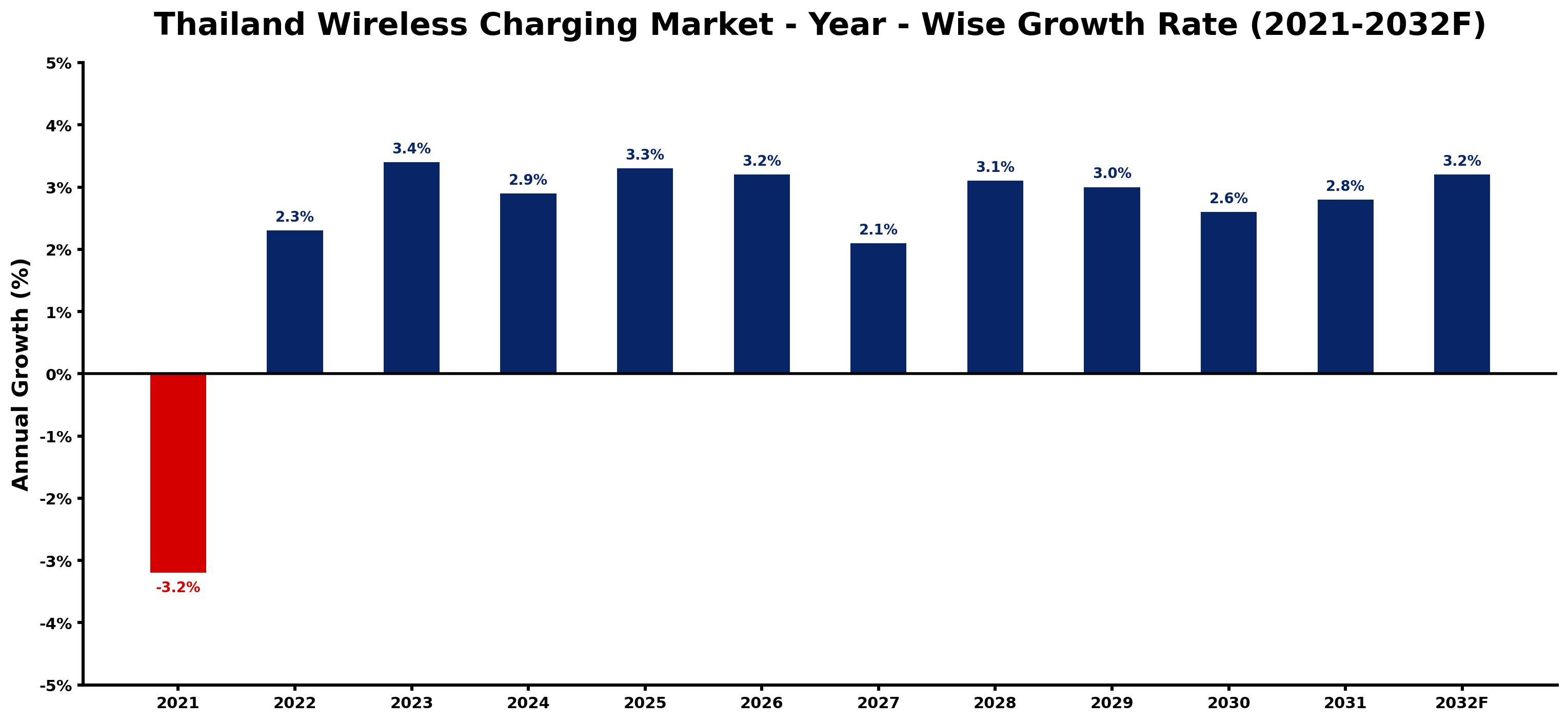
The table below presents the year‑wise growth rates along with the key drivers influencing the market
| Year | Growth Rate | Major Drivers |
| 2021 | -3.2% | Rapid growth in telecom and data center sectors |
| 2022 | 2.3% | Rising electricity demand across industries |
| 2023 | 3.4% | Growing renewable energy integration projects |
| 2024 | 2.9% | Increasing adoption of advanced technologies |
| 2025 | 3.3% | Rising electricity demand across industries |
| 2026 | 3.2% | Expansion of manufacturing activities |
| 2027 | 2.1% | Expansion of manufacturing activities |
| 2028 | 3.1% | Increasing industrial automation investments |
| 2029 | 3.0% | Increasing industrial automation investments |
| 2030 | 2.6% | Increasing industrial infrastructure investments |
| 2031 | 2.8% | Growing urbanization and commercial development |
| 2032 | 3.2% | Increasing smart city development projects |
Note - Market size estimations and growth projections presented in this report are based on 6Wresearch’s advanced forecasting approach, validated with industry datasets as of June 2026.
Thailand Wireless Charging Market Synopsis
A key force shaping the Thailand Wireless Charging Market is the rapid growth of consumer electronics, particularly smartphones and wearables. As users seek convenient charging solutions that eliminate the hassle of cables, wireless charging technology has gained significant traction. Moreover, the increasing awareness of eco-friendly solutions contributes to this trend, making wireless charging an appealing choice for environmentally conscious consumers.
The automotive sector also plays a pivotal role, with a noticeable rise in the adoption of electric vehicles. As more consumers transition to electric vehicles, there is a growing need for robust wireless charging infrastructure that enhances the user experience. The fusion of technological advancements with these consumer trends positions the Thailand Wireless Charging Market for sustained growth in the years to come.
Thailand Wireless Charging Market Key Takeaways
- The market is experiencing growth due to increasing smartphone usage and the need for convenient charging solutions.
- There is a significant push for wireless charging technology in the electric vehicle sector.
- Consumer demand for eco-friendly charging options is shaping product development and innovations.
- Standardization and compatibility remain critical challenges for widespread adoption.
- The Covid-19 pandemic has altered consumer behavior, enhancing the demand for wireless charging solutions at home.
Evaluation of Restraints in Thailand Wireless Charging Market
Despite its robust growth trajectory, the Thailand Wireless Charging Market faces noteworthy challenges. One significant restraint is the lack of uniform compatibility and standardization across different devices and manufacturers. This fragmentation can lead to consumer frustration, as various wireless charging standards may not work interchangeably. Additionally, the balance between charging efficiency and power consumption remains a pivotal concern. Ensuring that wireless charging systems are both fast and energy-efficient will be crucial in overcoming these barriers and driving further market acceptance.
Thailand Wireless Charging Market Trends
Current trends in the Thailand Wireless Charging Market include an increasing focus on technological advancements such as faster charging capabilities and more compact designs. The integration of wireless charging in public spaces, such as cafes and airports, is becoming more prevalent, enhancing accessibility for users. Moreover, as manufacturers explore innovative charging solutions for electric vehicles, including charging pads for home and public use, the market is expected to adapt rapidly to meet consumer needs.
Thailand Wireless Charging Market Opportunities
Significant growth opportunities lie within the integration of wireless charging technology in public infrastructure and consumer electronics. As electric vehicle adoption rises, the establishment of a comprehensive wireless charging network will be critical, presenting opportunities for investment and development. Additionally, partnerships between technology firms and automotive manufacturers could accelerate advancements, facilitating the introduction of new products that meet the evolving demands of consumers.
Government Initiatives in the Thailand Wireless Charging Market
The Thai government is actively promoting the adoption of electric vehicles, which encompasses the development of supporting infrastructure such as wireless charging stations. Policies encouraging sustainable energy practices and investments in technology R&D are pivotal in shaping this market. Public spending on green initiatives and incentives for electric vehicle manufacturers also supports the transition toward a more sustainable transport ecosystem, reinforcing the potential for wireless charging technologies.
Future Insights of the Thailand Wireless Charging Market
Looking ahead to 2026-2032, the Thailand Wireless Charging Market is poised for substantial evolution. Innovations in charging efficiency will play a pivotal role, as consumers demand faster and more eco-friendly solutions. Moreover, as the electric vehicle market continues to grow, the need for comprehensive wireless charging infrastructure will become increasingly urgent, paving the way for new investment opportunities and technological advancements. The confluence of consumer electronics and automotive sectors will likely yield novel applications, further driving market growth.
Thailand Wireless Charging Market Latest Developments (May 2025 - June 2026)
Recent developments in the Thailand Wireless Charging Market indicate a shift towards greater integration of this technology in public and private sectors. Increasing collaborations between technology and automotive industries are leading to innovative solutions and pilot projects aimed at enhancing user convenience. Additionally, consumer electronics manufacturers are exploring new wireless charging designs that cater to the growing demand for sleek and functional devices. Regulatory frameworks supporting the establishment of wireless charging infrastructures are also gaining traction, further signaling a positive outlook for the market.
Thailand Wireless Charging Market - Key Attractiveness of the Report
- 10 Years of Market Numbers
- Historical Data Starting from 2022 to 2025
- Base Year: 2025
- Forecast Data until 2032
- Key Performance Indicators Impacting the Market
- Major Upcoming Developments and Projects
Key Highlights of the Report:
- Thailand Wireless Charging Market Outlook
- Market Size of Thailand Wireless Charging Market, 2025
- Forecast of Thailand Wireless Charging Market, 2032
- Historical Data and Forecast of Thailand Wireless Charging Revenues & Volume for the Period 2022-2032F
- Thailand Wireless Charging Market Trend Evolution
- Thailand Wireless Charging Market Drivers and Challenges
- Thailand Wireless Charging Price Trends
- Thailand Wireless Charging Porter's Five Forces
- Thailand Wireless Charging Industry Life Cycle
- Historical Data and Forecast of Thailand Wireless Charging Market Revenues & Volume By Technology for the Period 2022-2032F
- Historical Data and Forecast of Thailand Wireless Charging Market Revenues & Volume By Resonant for the Period 2022-2032F
- Historical Data and Forecast of Thailand Wireless Charging Market Revenues & Volume By RF for the Period 2022-2032F
- Historical Data and Forecast of Thailand Wireless Charging Market Revenues & Volume By Inductive for the Period 2022-2032F
- Historical Data and Forecast of Thailand Wireless Charging Market Revenues & Volume By Others for the Period 2022-2032F
- Historical Data and Forecast of Thailand Wireless Charging Market Revenues & Volume By Applications for the Period 2022-2032F
- Historical Data and Forecast of Thailand Wireless Charging Market Revenues & Volume By Healthcare for the Period 2022-2032F
- Historical Data and Forecast of Thailand Wireless Charging Market Revenues & Volume By Automotive for the Period 2022-2032F
- Historical Data and Forecast of Thailand Wireless Charging Market Revenues & Volume By Consumer Electronics for the Period 2022-2032F
- Historical Data and Forecast of Thailand Wireless Charging Market Revenues & Volume By Industrial for the Period 2022-2032F
- Historical Data and Forecast of Thailand Wireless Charging Market Revenues & Volume By Others for the Period 2022-2032F
- Thailand Wireless Charging Import Export Trade Statistics
- Market Opportunity Assessment By Technology
- Market Opportunity Assessment By Applications
- Thailand Wireless Charging Top Companies Market Share
- Thailand Wireless Charging Competitive Benchmarking By Technical and Operational Parameters
- Thailand Wireless Charging Company Profiles
- Thailand Wireless Charging Key Strategic Recommendations






































