Thailand Wireless Connectivity Market Size, Share & Growth Rate
The Thailand Wireless Connectivity Market was estimated at USD 92 Million in 2025 and is projected to reach USD 105 Million by 2032, growing at a CAGR of 1.9% from 2026 to 2032. This upward trajectory is fueled by the rapid expansion of 5G networks and the increasing adoption of IoT devices among consumers and businesses alike. As sectors like manufacturing and healthcare embrace digital transformation, the demand for high-speed, reliable wireless connectivity continues to escalate.
Thailand Wireless Connectivity Market Year-wise Growth Rate and Key Drivers
This graph highlights how the Thailand Wireless Connectivity Market has steadily grown over the years, supported by major growth factors.
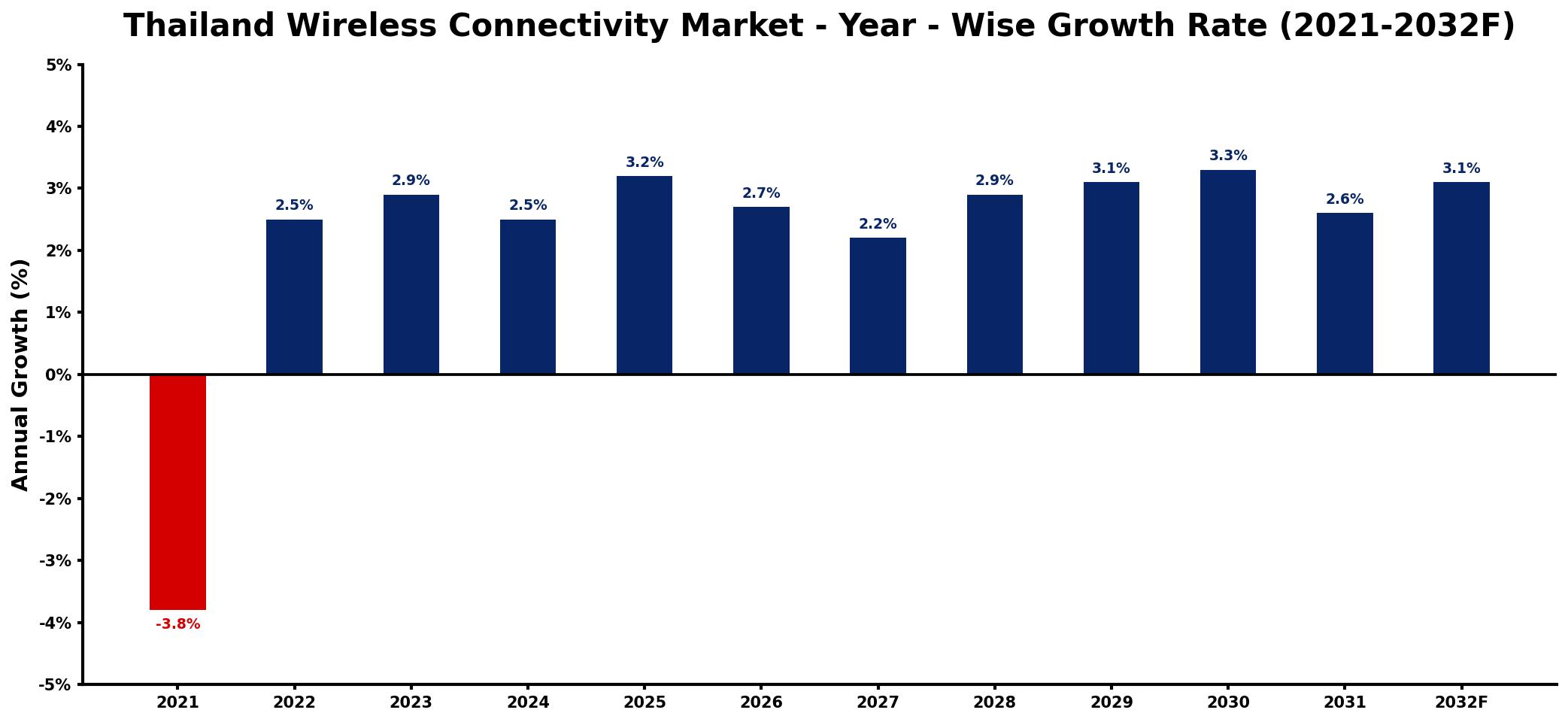
The table below presents the year‑wise growth rates along with the key drivers influencing the market
| Year | Growth Rate | Major Drivers |
| 2021 | -3.8% | decreased consumer technology spending |
| 2022 | 2.5% | increased smartphone adoption rates |
| 2023 | 2.9% | growing demand for mobile data |
| 2024 | 2.5% | expansion of digital services platforms |
| 2025 | 3.2% | rising investment in IoT solutions |
| 2026 | 2.7% | growing regional consumption patterns |
| 2027 | 2.2% | growing interest in smart homes |
| 2028 | 2.9% | stronger distribution network expansion |
| 2029 | 3.1% | increased remote work opportunities |
| 2030 | 3.3% | growth in e-commerce activities |
| 2031 | 2.6% | rising demand for streaming services |
| 2032 | 3.1% | increased focus on digital education |
Note: Market size estimations and growth projections presented in this report are based on 6Wresearch's proprietary forecasting methodology, utilizing the latest available industry data, government publications, and primary research inputs.
Thailand Wireless Connectivity Market Synopsis
A pivotal force shaping the Thailand Wireless Connectivity Market today is the rapid rollout of 5G technology. This advancement not only enhances mobile data speed and reliability but also supports the burgeoning IoT ecosystem, enabling smarter solutions across various industries. As consumers increasingly seek seamless connectivity, telecom providers are under pressure to modernize infrastructure and expand coverage.
In addition to 5G, the rising demand for smart devices in households and industries plays a crucial role in market dynamics. The growing inclination towards smart homes and automation is propelling businesses to invest in wireless solutions that ensure robust communication and integration. Consequently, this market is positioned as a vibrant space for growth and innovation.
Thailand Wireless Connectivity Market Key Takeaways
- The market is significantly influenced by the accelerated adoption of IoT devices and the push for 5G implementation.
- Consumer demand for high-speed internet continues to drive infrastructure development and service improvements.
- Telecom investments are vital for enhancing network reliability, particularly in underserved rural regions.
- As businesses leverage wireless connectivity, industries such as healthcare and logistics are poised for operational advancements.
- Cybersecurity measures are increasingly critical, given the growing concerns around data privacy in wireless communications.
Evaluation of Restraints in Thailand Wireless Connectivity Market
While the Thailand Wireless Connectivity Market demonstrates promising growth potential, several factors can restrain its expansion. Spectrum allocation remains a significant concern as the demand for wireless services escalates. Efficient management of frequency bands becomes increasingly complex, impacting service availability. Additionally, the need for substantial investments in wireless infrastructure, especially to cover rural areas, poses a challenge. Cybersecurity threats further complicate the landscape, as securing data and maintaining network integrity become critical priorities for stakeholders.
Thailand Wireless Connectivity Market Trends
Emerging trends in the Thailand Wireless Connectivity Market indicate a shift towards enhanced user experiences and innovative technologies. The rise of smart home devices is fostering an ecosystem where seamless connectivity is paramount, while advancements in AI and machine learning are facilitating better network management and predictive analytics. Moreover, telecom companies are increasingly focusing on sustainability initiatives as they expand their network footprints, integrating eco-friendly practices into their operations.
Thailand Wireless Connectivity Market Opportunities
Opportunities abound in the Thailand Wireless Connectivity Market, particularly in sectors that are undergoing digital transformation. Industries such as healthcare stand to gain substantially from the implementation of telehealth solutions and remote monitoring systems that rely on reliable wireless connections. Furthermore, the increasing demand for smart cities presents prospects for advanced infrastructure and connectivity solutions. As the government and private sector collaborate to enhance digital frameworks, investors can find lucrative avenues for growth.
Government Initiatives in the Thailand Wireless Connectivity Market
The Thai government is actively promoting the expansion of digital infrastructure through various initiatives. Policies aimed at enhancing 5G network deployment and improving broadband access, particularly in rural areas, underscore the commitment to advancing the digital economy. Public spending on infrastructure projects and programs designed to encourage innovation in telecommunications further bolster the wireless connectivity landscape. Incentives for private sector investments are also being introduced to catalyze growth in this dynamic market.
Future Insights of the Thailand Wireless Connectivity Market
Looking ahead to 2026-2032, the Thailand Wireless Connectivity Market is expected to witness continued expansion driven by technological advancements and increased consumer demand. The ongoing rollout of 5G networks will play a crucial role in enhancing user experience and enabling new applications in IoT and smart technologies. As industries leverage the benefits of wireless connectivity for operational efficiency and innovation, the market will likely evolve into a more integrated and robust ecosystem, fostering further investment and development.
Thailand Wireless Connectivity Market Latest Developments (2025 - 2026)
Recent developments within the Thailand Wireless Connectivity Market indicate a strong focus on 5G adoption and infrastructure enhancements. Telecom providers are actively pursuing partnerships to accelerate network deployment and improve service quality. There is also an uptick in investments directed towards expanding coverage in both urban and rural areas to meet the rising demand for high-speed internet. Additionally, cybersecurity measures are receiving increased attention, with companies prioritizing solutions that protect user data as they expand their networks.
Thailand Wireless Connectivity Market - Key Attractiveness of the Report
- 10 Years of Market Numbers
- Historical Data Starting from 2022 to 2025
- Base Year: 2025
- Forecast Data until 2032
- Key Performance Indicators Impacting the Market
- Major Upcoming Developments and Projects
Key Highlights of the Report:
- Thailand Wireless Connectivity Market Outlook
- Market Size of Thailand Wireless Connectivity Market, 2025
- Forecast of Thailand Wireless Connectivity Market, 2032
- Historical Data and Forecast of Thailand Wireless Connectivity Revenues & Volume for the Period 2022-2032F
- Thailand Wireless Connectivity Market Trend Evolution
- Thailand Wireless Connectivity Market Drivers and Challenges
- Thailand Wireless Connectivity Price Trends
- Thailand Wireless Connectivity Porter's Five Forces
- Thailand Wireless Connectivity Industry Life Cycle
- Historical Data and Forecast of Thailand Wireless Connectivity Market Revenues & Volume By Connectivity Type for the Period 2022-2032F
- Historical Data and Forecast of Thailand Wireless Connectivity Market Revenues & Volume By Wi-Fi for the Period 2022-2032F
- Historical Data and Forecast of Thailand Wireless Connectivity Market Revenues & Volume By Bluetooth Classic for the Period 2022-2032F
- Historical Data and Forecast of Thailand Wireless Connectivity Market Revenues & Volume By Bluetooth 4X for the Period 2022-2032F
- Historical Data and Forecast of Thailand Wireless Connectivity Market Revenues & Volume By Bluetooth 5X for the Period 2022-2032F
- Historical Data and Forecast of Thailand Wireless Connectivity Market Revenues & Volume By ZigBee for the Period 2022-2032F
- Historical Data and Forecast of Thailand Wireless Connectivity Market Revenues & Volume By Z-Wave for the Period 2022-2032F
- Historical Data and Forecast of Thailand Wireless Connectivity Market Revenues & Volume By UWB for the Period 2022-2032F
- Historical Data and Forecast of Thailand Wi-Fi Wireless Connectivity Market Revenues & Volume By NFC for the Period 2022-2032F
- Historical Data and Forecast of Thailand Wireless Connectivity Market Revenues & Volume By End Use for the Period 2022-2032F
- Historical Data and Forecast of Thailand Wireless Connectivity Market Revenues & Volume By Wearable Devices for the Period 2022-2032F
- Historical Data and Forecast of Thailand Wireless Connectivity Market Revenues & Volume By Healthcare for the Period 2022-2032F
- Historical Data and Forecast of Thailand Wireless Connectivity Market Revenues & Volume By Consumer Electronics for the Period 2022-2032F
- Historical Data and Forecast of Thailand Wireless Connectivity Market Revenues & Volume By Building Automation for the Period 2022-2032F
- Historical Data and Forecast of Thailand Wireless Connectivity Market Revenues & Volume By Automotive & Transportation for the Period 2022-2032F
- Historical Data and Forecast of Thailand Wireless Connectivity Market Revenues & Volume By Others for the Period 2022-2032F
- Historical Data and Forecast of Thailand Wireless Connectivity Market Revenues & Volume By Type for the Period 2022-2032F
- Historical Data and Forecast of Thailand Wireless Connectivity Market Revenues & Volume By LPWAN for the Period 2022-2032F
- Historical Data and Forecast of Thailand Wireless Connectivity Market Revenues & Volume By Cellular M2M for the Period 2022-2032F
- Historical Data and Forecast of Thailand Wireless Connectivity Market Revenues & Volume By WPAN for the Period 2022-2032F
- Historical Data and Forecast of Thailand Wireless Connectivity Market Revenues & Volume By Satellite (GNSS) for the Period 2022-2032F
- Historical Data and Forecast of Thailand Wireless Connectivity Market Revenues & Volume By WLAN for the Period 2022-2032F
- Thailand Wireless Connectivity Import Export Trade Statistics
- Market Opportunity Assessment By Connectivity Type
- Market Opportunity Assessment By End Use
- Market Opportunity Assessment By Type
- Thailand Wireless Connectivity Top Companies Market Share
- Thailand Wireless Connectivity Competitive Benchmarking By Technical and Operational Parameters
- Thailand Wireless Connectivity Company Profiles
- Thailand Wireless Connectivity Key Strategic Recommendations






































