Thailand Wooden Packaging Market Size, Share & Growth Rate
The Thailand Wooden Packaging Market was estimated at USD 120 Million in 2025 and is projected to reach USD 137 Million by 2032, growing at a CAGR of 1.9% from 2026 to 2032. This steady growth trajectory is largely fueled by the increasing demand from the manufacturing and export sectors, where wooden packaging solutions are valued for their strength and reusability. As Thailand's export activities ramp up, particularly in agriculture and manufacturing, the reliance on durable wooden packaging is expected to intensify.
Thailand Wooden Packaging Market Year-wise Growth Rate and Key Drivers
This graph highlights how the Thailand Wooden Packaging Market has steadily grown over the years, supported by major growth factors.
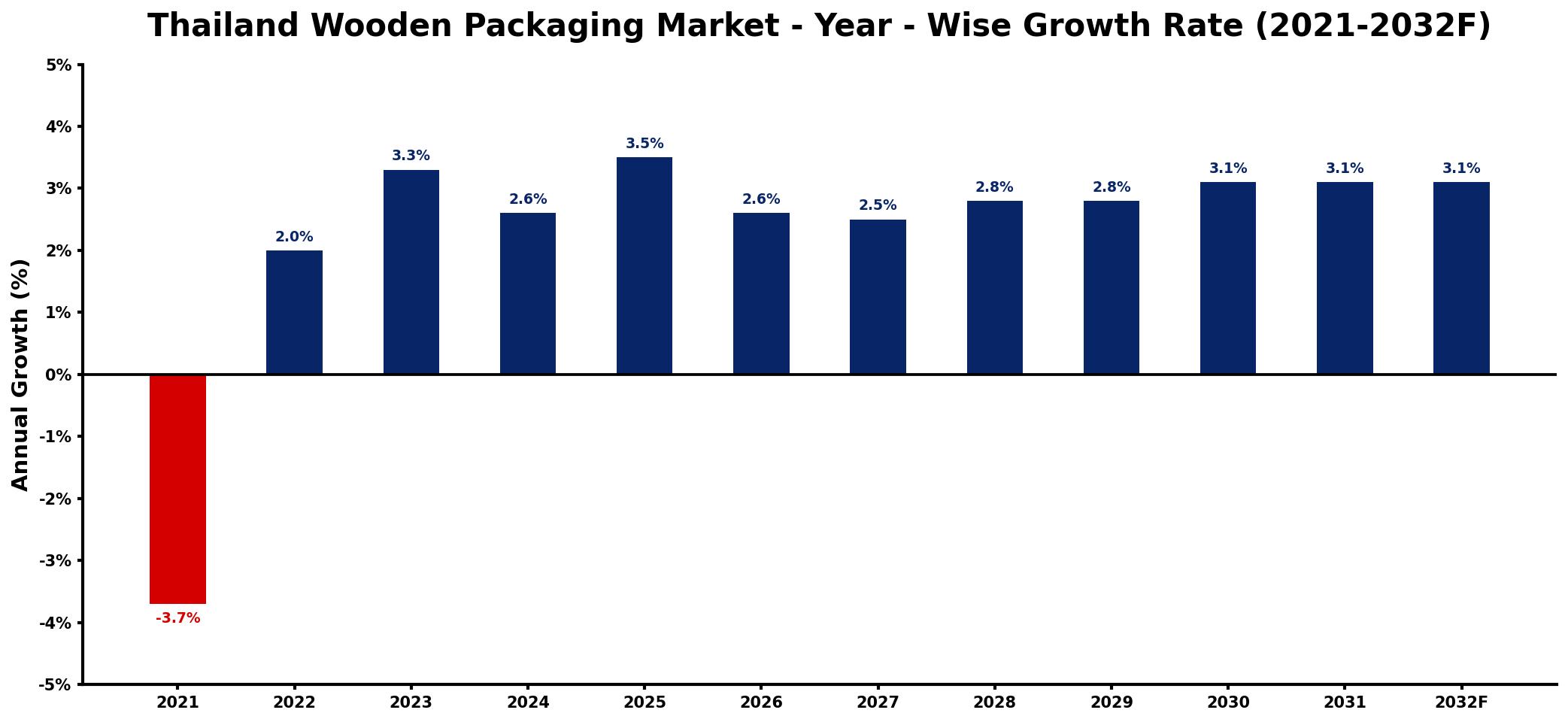
The table below presents the year‑wise growth rates along with the key drivers influencing the market
| Year | Growth Rate | Major Drivers |
| 2021 | -3.7% | decreased consumer spending on goods |
| 2022 | 2.0% | rising e-commerce market demand |
| 2023 | 3.3% | expansion of logistics networks |
| 2024 | 2.6% | increased exports to neighboring countries |
| 2025 | 3.5% | growth in sustainable materials sector |
| 2026 | 2.6% | rising demand from food industry |
| 2027 | 2.5% | increased investment in automation |
| 2028 | 2.8% | rising end-use demand growth |
| 2029 | 2.8% | growing automotive sector requirements |
| 2030 | 3.1% | increased focus on eco-friendly solutions |
| 2031 | 3.1% | rising consumer preference for sustainability |
| 2032 | 3.1% | increased production capacity utilization |
Note: Market size estimations and growth projections presented in this report are based on 6Wresearch's proprietary forecasting methodology, utilizing the latest available industry data, government publications, and primary research inputs.
Thailand Wooden Packaging Market Synopsis
In Thailand, wooden packaging serves as a critical component in the logistics of both local and international goods transportation. Crates, pallets, and boxes made from wood are particularly favored due to their durability, which ensures goods remain intact throughout transit. This is essential for industries that prioritize product integrity, particularly in food and agricultural sectors.
Moreover, the wooden packaging market aligns with a growing consumer awareness about sustainability. As renewable resources, wooden packaging solutions cater to the increasing demand for eco-friendly alternatives in packaging, presenting an attractive option for businesses that wish to enhance their environmental credentials.
Thailand Wooden Packaging Market Key Takeaways
- The market is buoyed by Thailands robust export sector, requiring reliable and durable packaging solutions.
- Sustainability trends are driving the demand for wooden packaging, appealing to environmentally conscious consumers.
- Wooden packaging materials comply with international phytosanitary standards, essential for food exports.
- While facing competition from alternative packaging materials, wooden solutions remain preferred for strength and reusability.
- Regulatory challenges, including sustainability and certification, are influencing market dynamics.
Evaluation of Restraints in Thailand Wooden Packaging Market
The Thailand wooden packaging market is not without its constraints. One of the predominant challenges is the ongoing scrutiny regarding environmental impact, particularly related to deforestation and sustainability. Regulatory frameworks are becoming more stringent, necessitating compliance with various environmental certifications. Furthermore, competition from recyclable plastic and cardboard alternatives poses a significant threat, as these materials are often perceived as more sustainable and economical, which could hinder the growth of wooden packaging solutions in specific sectors.
Thailand Wooden Packaging Market Trends
Current trends in the Thailand wooden packaging market reveal a shift towards more innovative and sustainable practices. Companies are increasingly adopting eco-friendly treatments and finishes for wooden products to enhance durability while minimizing environmental impact. Additionally, the integration of technology in supply chain processes, such as tracking systems for packaged goods, is gaining traction, ensuring enhanced security and efficiency in logistics. This trend not only improves operational efficiency but also aligns with global sustainability efforts.
Thailand Wooden Packaging Market Opportunities
Opportunities for growth within the Thailand wooden packaging market lie in expanding the range of applications across various industries, particularly in e-commerce and perishables. As the e-commerce sector continues to flourish, the demand for reliable packaging that can withstand the rigors of delivery logistics will soar. Moreover, tapping into niche markets, such as customized wooden packaging for luxury items, presents a lucrative avenue for innovation and differentiation, potentially attracting high-value clients.
Government Initiatives in the Thailand Wooden Packaging Market
The Thai government has demonstrated a commitment to enhancing the wooden packaging market through various initiatives aimed at promoting sustainable practices and protecting forests. Policies supporting responsible sourcing of timber and incentives for companies adopting eco-friendly manufacturing processes are becoming more prevalent. Furthermore, educational programs focusing on the benefits of sustainable packaging are being implemented to encourage best practices across industries, thereby aligning with global sustainability goals.
Future Insights of the Thailand Wooden Packaging Market
Looking ahead to 2026-2032, the Thailand wooden packaging market is poised for steady growth, with sustainability at the forefront. The increasing regulatory demands for environmentally friendly practices are likely to propel innovation in the sector. Additionally, as global trade expands, the necessity for durable and compliant packaging solutions will reinforce wooden packaging's value proposition. By adapting to technological advancements and consumer preferences, the market can position itself to capitalize on emerging trends, ensuring continued relevance and growth.
Thailand Wooden Packaging Market Latest Developments (2025 - 2026)
Recent developments in the Thailand wooden packaging market highlight a significant shift towards sustainability and efficiency. Companies are increasingly investing in research and development to create innovative wooden packaging solutions that meet both consumer expectations and regulatory requirements. Furthermore, collaborations with environmental organizations are being established to enhance the industry's sustainability credentials, while companies are exploring advanced technologies for better tracking and management of packaging throughout the supply chain.
Thailand Wooden Packaging Market - Key Attractiveness of the Report
- 10 Years of Market Numbers
- Historical Data Starting from 2022 to 2025
- Base Year: 2025
- Forecast Data until 2032
- Key Performance Indicators Impacting the Market
- Major Upcoming Developments and Projects
Key Highlights of the Report:
- Thailand Wooden Packaging Market Outlook
- Market Size of Thailand Wooden Packaging Market, 2025
- Forecast of Thailand Wooden Packaging Market, 2032
- Historical Data and Forecast of Thailand Wooden Packaging Revenues & Volume for the Period 2022-2032F
- Thailand Wooden Packaging Market Trend Evolution
- Thailand Wooden Packaging Market Drivers and Challenges
- Thailand Wooden Packaging Price Trends
- Thailand Wooden Packaging Porter's Five Forces
- Thailand Wooden Packaging Industry Life Cycle
- Historical Data and Forecast of Thailand Wooden Packaging Market Revenues & Volume By Type for the Period 2022-2032F
- Historical Data and Forecast of Thailand Wooden Packaging Market Revenues & Volume By Pallets for the Period 2022-2032F
- Historical Data and Forecast of Thailand Wooden Packaging Market Revenues & Volume By Boxes and Bins for the Period 2022-2032F
- Historical Data and Forecast of Thailand Wooden Packaging Market Revenues & Volume By Crates and Cases for the Period 2022-2032F
- Historical Data and Forecast of Thailand Wooden Packaging Market Revenues & Volume By Spools for the Period 2022-2032F
- Historical Data and Forecast of Thailand Wooden Packaging Market Revenues & Volume By Dunnage for the Period 2022-2032F
- Historical Data and Forecast of Thailand Wooden Packaging Market Revenues & Volume By Others for the Period 2022-2032F
- Historical Data and Forecast of Thailand Wooden Packaging Market Revenues & Volume By Application for the Period 2022-2032F
- Historical Data and Forecast of Thailand Wooden Packaging Market Revenues & Volume By Food & Beverages Storage for the Period 2022-2032F
- Historical Data and Forecast of Thailand Wooden Packaging Market Revenues & Volume By Transportation for the Period 2022-2032F
- Historical Data and Forecast of Thailand Wooden Packaging Market Revenues & Volume By Industrial for the Period 2022-2032F
- Historical Data and Forecast of Thailand Wooden Packaging Market Revenues & Volume By Shipping for the Period 2022-2032F
- Historical Data and Forecast of Thailand Wooden Packaging Market Revenues & Volume By Others for the Period 2022-2032F
- Thailand Wooden Packaging Import Export Trade Statistics
- Market Opportunity Assessment By Type
- Market Opportunity Assessment By Application
- Thailand Wooden Packaging Top Companies Market Share
- Thailand Wooden Packaging Competitive Benchmarking By Technical and Operational Parameters
- Thailand Wooden Packaging Company Profiles
- Thailand Wooden Packaging Key Strategic Recommendations






































