Thailand Wooden Toys Market Size, Share & Growth Rate
The Thailand Wooden Toys Market was estimated at USD 136 Million in 2025 and is projected to reach USD 156 Million by 2032, growing at a CAGR of 2.0% from 2026 to 2032. This growth trajectory is primarily driven by increasing consumer awareness regarding the environmental impact of toys, with a pronounced shift towards eco-friendly options. Furthermore, the educational benefits associated with wooden toys are resonating with parents eager to foster creativity and cognitive development in their children.
Thailand Wooden Toys Market Year-wise Growth Rate and Key Drivers
This graph highlights how the Thailand Wooden Toys Market has steadily grown over the years, supported by major growth factors.
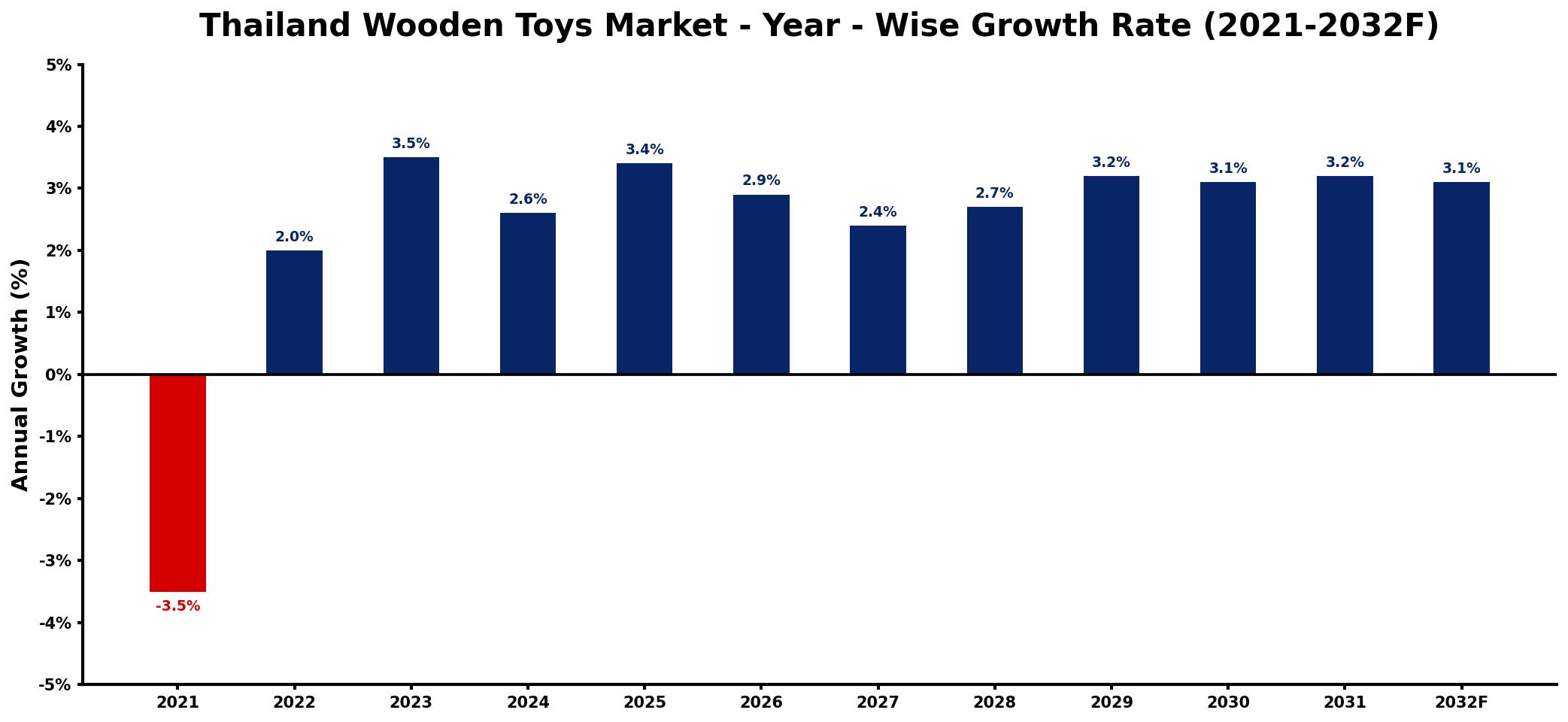
The table below presents the year‑wise growth rates along with the key drivers influencing the market
| Year | Growth Rate | Major Drivers |
| 2021 | -3.5% | decreased consumer spending patterns |
| 2022 | 2.0% | rising eco-friendly product demand |
| 2023 | 3.5% | increased investment in sustainability |
| 2024 | 2.6% | growth in online retail channels |
| 2025 | 3.4% | expansion of educational market segments |
| 2026 | 2.9% | heightened focus on craftsmanship quality |
| 2027 | 2.4% | growing popularity of artisanal goods |
| 2028 | 2.7% | increased parental awareness of benefits |
| 2029 | 3.2% | development of innovative design trends |
| 2030 | 3.1% | strengthened distribution network efficiency |
| 2031 | 3.2% | rising infrastructure development spending |
| 2032 | 3.1% | escalating collaborations with influencers |
Note: Market size estimations and growth projections presented in this report are based on 6Wresearch's proprietary forecasting methodology, utilizing the latest available industry data, government publications, and primary research inputs.
Thailand Wooden Toys Market Synopsis
Thailands wooden toys market is characterized by a diverse range of offerings, from classic building blocks to intricate puzzles and charming figurines. Local artisans often produce these toys, enhancing their appeal through craftsmanship that emphasizes safety and sustainability.
As parents increasingly prioritize non-toxic, durable products, the demand for handcrafted wooden toys continues to grow. This market is not just about play; it represents a movement towards more meaningful, eco-conscious childhood experiences, making it a unique segment within the broader toy industry.
Thailand Wooden Toys Market Key Takeaways
- Growing demand for eco-friendly toys is propelling market expansion.
- Handcrafted designs are increasingly valued for their educational benefits.
- Local artisans play a crucial role in diversifying product offerings.
- Consumer shift away from plastic toys boosts wooden toy appeal.
- Resilience shown during the pandemic underscores the market's adaptability.
Evaluation of Restraints in Thailand Wooden Toys Market
Despite its promising growth, the Thailand Wooden Toys Market faces certain restraints. Significant competition from electronic and plastic toys often diminishes market share for wooden alternatives. Moreover, sourcing wood sustainably raises environmental concerns, making it essential for manufacturers to adopt responsible practices. Additionally, the need for innovative and engaging designs presents a constant challenge in appealing to tech-savvy children and discerning parents in a highly competitive landscape.
Thailand Wooden Toys Market Trends
Current trends reflect a heightened focus on sustainability and education in toy selection. Manufacturers are increasingly creating toys that promote STEM learning and social skills development. Furthermore, the rise of eco-conscious parenting continues to steer consumer preferences toward artisanal and locally produced options. The integration of traditional design elements with modern aesthetics is also emerging as a key trend, appealing to both children and parents alike.
Thailand Wooden Toys Market Opportunities
Opportunities abound in the Thailand Wooden Toys Market, particularly in the realm of online retailing. The shift towards e-commerce has opened new channels for reaching a broader audience, enabling small artisans and manufacturers to showcase their products effectively. Additionally, partnerships with educational institutions could enhance the visibility of wooden toys as valuable learning tools. There is also potential for expanding product lines to include more culturally significant toys that resonate with local values and traditions.
Government Initiatives in the Thailand Wooden Toys Market
The Thai government has been supportive of small businesses and artisans through various initiatives aimed at promoting local craftsmanship. Public spending on educational toys, especially those that adhere to sustainability guidelines, has also increased, aligning with national efforts to foster eco-friendly industries. Additionally, government programs that encourage the responsible sourcing of materials are expected to bolster consumer confidence in the wooden toys market.
Future Insights of the Thailand Wooden Toys Market
Looking ahead to 2026-2032, the Thailand Wooden Toys Market is poised for continued growth driven by evolving consumer values. As sustainability becomes a foundational aspect of purchasing decisions, manufacturers who prioritize eco-friendly materials and practices will likely thrive. Additionally, the ongoing trend of integrating technology with traditional play through interactive and educational wooden toys will enhance their appeal, ensuring that they remain relevant in a digital era.
Thailand Wooden Toys Market Latest Developments (2025 - 2026)
Recent developments in the Thailand Wooden Toys Market indicate a surge in collaborations between local artisans and educational institutions, aimed at creating innovative learning tools. There has also been a noticeable increase in consumer interest for sustainable and ethically made toys, driving brands to enhance their product lines accordingly. Moreover, the shift towards online shopping continues to transform the market landscape, providing new opportunities for small businesses to gain visibility and reach consumers effectively.
Thailand Wooden Toys Market - Key Attractiveness of the Report
- 10 Years of Market Numbers
- Historical Data Starting from 2022 to 2025
- Base Year: 2025
- Forecast Data until 2032
- Key Performance Indicators Impacting the Market
- Major Upcoming Developments and Projects
Key Highlights of the Report:
- Thailand Wooden Toys Market Outlook
- Market Size of Thailand Wooden Toys Market, 2025
- Forecast of Thailand Wooden Toys Market, 2032
- Historical Data and Forecast of Thailand Wooden Toys Revenues & Volume for the Period 2022-2032F
- Thailand Wooden Toys Market Trend Evolution
- Thailand Wooden Toys Market Drivers and Challenges
- Thailand Wooden Toys Price Trends
- Thailand Wooden Toys Porter's Five Forces
- Thailand Wooden Toys Industry Life Cycle
- Historical Data and Forecast of Thailand Wooden Toys Market Revenues & Volume By Product Type for the Period 2022-2032F
- Historical Data and Forecast of Thailand Wooden Toys Market Revenues & Volume By Educational Toys for the Period 2022-2032F
- Historical Data and Forecast of Thailand Wooden Toys Market Revenues & Volume By Construction Toys for the Period 2022-2032F
- Historical Data and Forecast of Thailand Wooden Toys Market Revenues & Volume By Musical Toys for the Period 2022-2032F
- Historical Data and Forecast of Thailand Wooden Toys Market Revenues & Volume By Game Toys for the Period 2022-2032F
- Historical Data and Forecast of Thailand Wooden Toys Market Revenues & Volume By Dolls & Miniatures for the Period 2022-2032F
- Historical Data and Forecast of Thailand Wooden Toys Market Revenues & Volume By Automotive Toys for the Period 2022-2032F
- Historical Data and Forecast of Thailand Wooden Toys Market Revenues & Volume By Pretend Play Toys for the Period 2022-2032F
- Historical Data and Forecast of Thailand Wooden Toys Market Revenues & Volume By Wood Type for the Period 2022-2032F
- Historical Data and Forecast of Thailand Wooden Toys Market Revenues & Volume By Softwood for the Period 2022-2032F
- Historical Data and Forecast of Thailand Wooden Toys Market Revenues & Volume By Hardwood for the Period 2022-2032F
- Historical Data and Forecast of Thailand Wooden Toys Market Revenues & Volume By Age Group for the Period 2022-2032F
- Historical Data and Forecast of Thailand Wooden Toys Market Revenues & Volume By Below 1 Year for the Period 2022-2032F
- Historical Data and Forecast of Thailand Wooden Toys Market Revenues & Volume By Age 1-3 for the Period 2022-2032F
- Historical Data and Forecast of Thailand Wooden Toys Market Revenues & Volume By Age 3-5 for the Period 2022-2032F
- Historical Data and Forecast of Thailand Wooden Toys Market Revenues & Volume By Age 5-12 for the Period 2022-2032F
- Historical Data and Forecast of Thailand Wooden Toys Market Revenues & Volume By Age 12+ for the Period 2022-2032F
- Historical Data and Forecast of Thailand Wooden Toys Market Revenues & Volume By Distribution Channel for the Period 2022-2032F
- Historical Data and Forecast of Thailand Wooden Toys Market Revenues & Volume By Online for the Period 2022-2032F
- Historical Data and Forecast of Thailand Wooden Toys Market Revenues & Volume By Offline for the Period 2022-2032F
- Thailand Wooden Toys Import Export Trade Statistics
- Market Opportunity Assessment By Product Type
- Market Opportunity Assessment By Wood Type
- Market Opportunity Assessment By Age Group
- Market Opportunity Assessment By Distribution Channel
- Thailand Wooden Toys Top Companies Market Share
- Thailand Wooden Toys Competitive Benchmarking By Technical and Operational Parameters
- Thailand Wooden Toys Company Profiles
- Thailand Wooden Toys Key Strategic Recommendations






































