Thailand X-Ray Tube Market Size, Share & Growth Rate
The Thailand X-Ray Tube Market was estimated at USD 235 Million in 2025 and is projected to reach USD 268 Million by 2032, growing at a CAGR of 1.9% from 2026 to 2032. This growth trajectory is fueled primarily by increasing healthcare investments and rising demand for advanced imaging solutions within hospitals and clinics. Additionally, the expanding industrial applications, particularly in non-destructive testing, underscore the essential role that X-ray tubes play across diverse sectors in Thailand.
Thailand X-Ray Tube Market Year-wise Growth Rate and Key Drivers
This graph highlights how the Thailand X-Ray Tube Market has steadily grown over the years, supported by major growth factors.
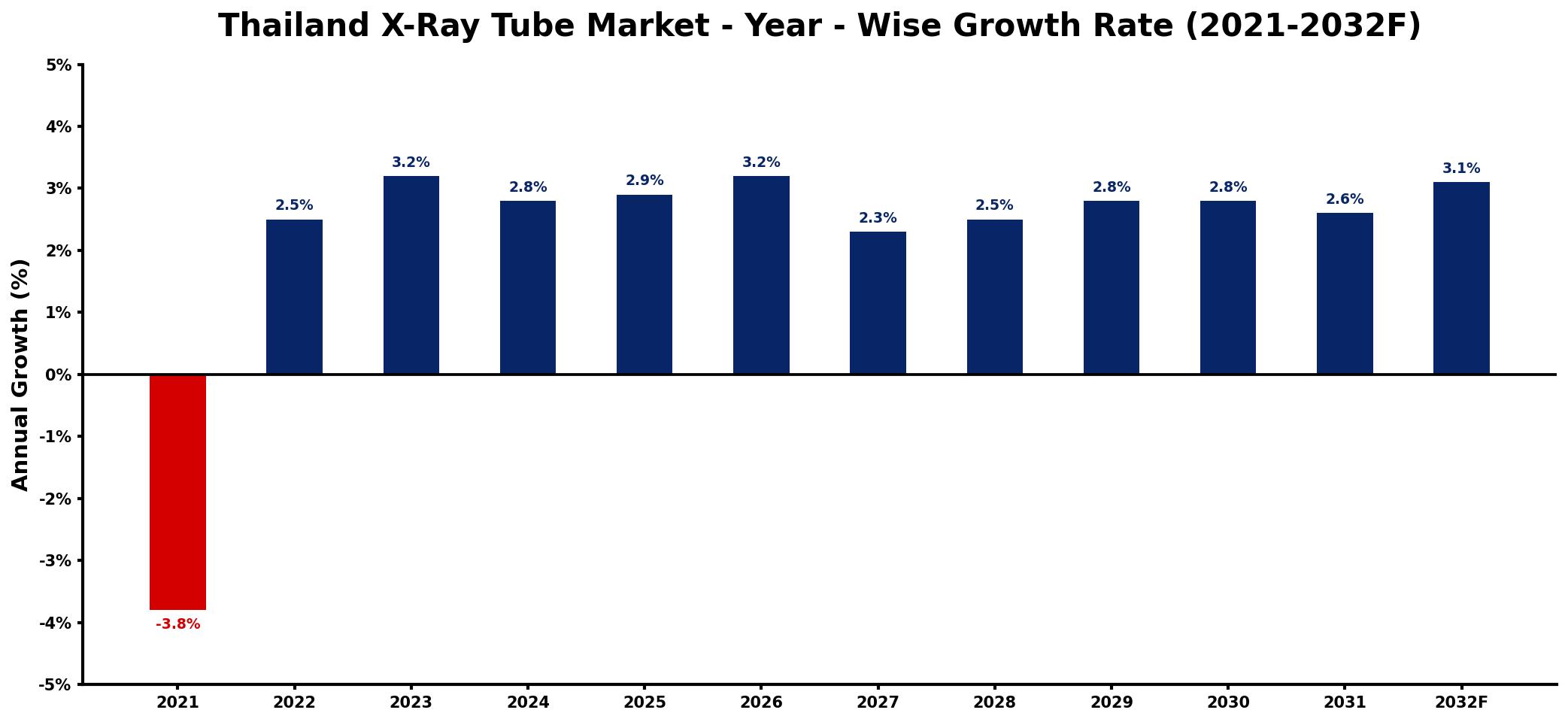
The table below presents the year‑wise growth rates along with the key drivers influencing the market
| Year | Growth Rate | Major Drivers |
| 2021 | -3.8% | decreased healthcare investments in facilities |
| 2022 | 2.5% | growing demand for medical imaging |
| 2023 | 3.2% | expansion of healthcare infrastructure projects |
| 2024 | 2.8% | increased funding for diagnostic tools |
| 2025 | 2.9% | rising adoption of advanced technologies |
| 2026 | 3.2% | surge in preventive healthcare services |
| 2027 | 2.3% | growing emphasis on patient safety |
| 2028 | 2.5% | increased partnerships with tech firms |
| 2029 | 2.8% | growing automotive sector requirements |
| 2030 | 2.8% | rising demand for outpatient services |
| 2031 | 2.6% | strengthening underlying market demand |
| 2032 | 3.1% | growing investments in health technology |
Note: Market size estimations and growth projections presented in this report are based on 6Wresearch's proprietary forecasting methodology, utilizing the latest available industry data, government publications, and primary research inputs.
Thailand X-Ray Tube Market Synopsis
The Thailand X-ray tube market has shown resilience and growth in recent years, particularly amid the shifting dynamics of the healthcare sector. While the onset of the COVID-19 pandemic disrupted routine imaging services, the recovery is driven by renewed investments in medical technologies and diagnostic imaging.
Looking ahead, the market is poised for sustained growth, buoyed by technological advancements and an expanding user base across both medical and industrial applications. As healthcare facilities increasingly prioritize advanced imaging capabilities, the demand for high-quality X-ray tubes is expected to surge.
Thailand X-Ray Tube Market Key Takeaways
- The market is closely tied to the healthcare sector, which is experiencing significant investment and expansion.
- Technological advancements in X-ray tube design are improving efficiency and durability, catering to diverse applications.
- Industrial demand, particularly for non-destructive testing, is becoming a substantial market driver.
- Regulatory and quality standards are increasingly stringent, emphasizing the need for reliable imaging equipment.
- Market participants are actively focusing on research and development to innovate and meet changing demands.
Evaluation of Restraints in Thailand X-Ray Tube Market
Despite the positive outlook, several constraints limit the Thailand X-ray tube market's growth. The necessity for regular maintenance and the high costs associated with X-ray tube procurement can hinder smaller healthcare facilities from acquiring the latest technology. Moreover, skilled radiographers are essential for optimal operation, and the shortage of trained professionals can create operational bottlenecks. Additionally, as the healthcare landscape evolves, competition from alternative imaging technologies presents a challenge for traditional X-ray tube applications.
Thailand X-Ray Tube Market Trends
Current trends indicate a strong focus on technological innovation, with manufacturers investing in the development of more energy-efficient X-ray tubes that enhance image quality and reduce radiation exposure. Additionally, the rising awareness of preventive healthcare is encouraging more facilities to adopt advanced imaging technologies. The integration of digital platforms for remote diagnostics and telemedicine is also gaining traction, influencing how X-ray tubes are utilized in both clinical and industrial settings.
Thailand X-Ray Tube Market Opportunities
Opportunities for growth within the Thailand X-ray tube market are abundant, particularly in the area of specialized imaging solutions tailored to specific medical conditions and industrial applications. The development of portable X-ray systems presents a promising avenue for both medical and field applications, enhancing accessibility. Additionally, the ongoing transition towards digital imaging technologies offers a unique opportunity for manufacturers to innovate and deliver high-value solutions to meet evolving customer needs.
Government Initiatives in the Thailand X-Ray Tube Market
The Thai government has been proactive in supporting healthcare modernization, which includes enhancing imaging technologies. Initiatives aimed at increasing healthcare accessibility and improving public health infrastructure are pivotal. These efforts typically involve increased public spending on medical equipment, incentives for healthcare facility upgrades, and programs encouraging the adoption of advanced diagnostic technologies, including X-ray imaging solutions.
Future Insights of the Thailand X-Ray Tube Market
As we look toward 2026-2032, the Thailand X-ray tube market is likely to witness steady advancements in technology and a rising focus on efficiency and sustainability. The integration of AI-driven imaging solutions is expected to revolutionize diagnostics, while the demand for portable and user-friendly devices will shape product development. Continued collaboration between healthcare providers and manufacturers will be essential in meeting the growing needs of the market and improving patient outcomes.
Thailand X-Ray Tube Market Latest Developments (2025 - 2026)
Recent developments in the Thailand X-ray tube market reflect a commitment to innovation and quality. Companies are increasingly focusing on the enhancement of tube performance and the introduction of eco-friendly materials in production. Collaborative efforts with healthcare providers aim to customize products that meet the specific imaging needs of diverse medical disciplines, while ongoing research is fostering advancements in tube durability and functionality.
Thailand X-Ray Tube Market - Key Attractiveness of the Report
- 10 Years of Market Numbers
- Historical Data Starting from 2022 to 2025
- Base Year: 2025
- Forecast Data until 2032
- Key Performance Indicators Impacting the Market
- Major Upcoming Developments and Projects
Key Highlights of the Report:
- Thailand X-Ray Tube Market Outlook
- Market Size of Thailand X-Ray Tube Market, 2025
- Forecast of Thailand X-Ray Tube Market, 2032
- Historical Data and Forecast of Thailand X-Ray Tube Revenues & Volume for the Period 2022-2032F
- Thailand X-Ray Tube Market Trend Evolution
- Thailand X-Ray Tube Market Drivers and Challenges
- Thailand X-Ray Tube Price Trends
- Thailand X-Ray Tube Porter's Five Forces
- Thailand X-Ray Tube Industry Life Cycle
- Historical Data and Forecast of Thailand X-Ray Tube Market Revenues & Volume By Type for the Period 2022-2032F
- Historical Data and Forecast of Thailand X-Ray Tube Market Revenues & Volume By Rotating Anode Tube for the Period 2022-2032F
- Historical Data and Forecast of Thailand X-Ray Tube Market Revenues & Volume By Stationary X-Ray Tube for the Period 2022-2032F
- Historical Data and Forecast of Thailand X-Ray Tube Market Revenues & Volume By End-user Industry for the Period 2022-2032F
- Historical Data and Forecast of Thailand X-Ray Tube Market Revenues & Volume By Manufacturing for the Period 2022-2032F
- Historical Data and Forecast of Thailand X-Ray Tube Market Revenues & Volume By Healthcare for the Period 2022-2032F
- Historical Data and Forecast of Thailand X-Ray Tube Market Revenues & Volume By Food for the Period 2022-2032F
- Historical Data and Forecast of Thailand X-Ray Tube Market Revenues & Volume By Aerospace and Defense for the Period 2022-2032F
- Historical Data and Forecast of Thailand X-Ray Tube Market Revenues & Volume By Other End-user Industries for the Period 2022-2032F
- Thailand X-Ray Tube Import Export Trade Statistics
- Market Opportunity Assessment By Type
- Market Opportunity Assessment By End-user Industry
- Thailand X-Ray Tube Top Companies Market Share
- Thailand X-Ray Tube Competitive Benchmarking By Technical and Operational Parameters
- Thailand X-Ray Tube Company Profiles
- Thailand X-Ray Tube Key Strategic Recommendations






































