Thailand Yerba Mate Market Size, Share & Growth Rate
The Thailand Yerba Mate Market was estimated at USD 217 Million in 2025 and is projected to reach USD 246 Million by 2032, growing at a CAGR of 1.8% from 2026 to 2032. This steady growth trajectory is primarily driven by the increasing consumer interest in herbal and wellness beverages, coupled with a rise in online retail channels that make these products more accessible. As awareness of yerba mate's unique health benefits expands, it is anticipated that more consumers will embrace this traditional South American drink.
Thailand Yerba Mate Market Growth Rate Analysis (2021-2032)
The Thai Yerba Mate market has shown resilience, recovering from a decline of -3.8% in 2021 to achieve a modest growth of 2.0% in 2022 and accelerating to 2.8% in 2023. This upward trend is fueled by increasing health consciousness among consumers, who are drawn to the beverage's caffeine content and antioxidant properties. Looking ahead, growth is projected to remain steady, with rates of 2.7% in 2024 and peaking at 3.4% by 2031. Investments in digital marketing and improved supply chain logistics are enhancing accessibility. Additionally, the shift toward more sustainable consumer choices is expected to bolster market demand as urbanization and lifestyle changes continue to shape beverage preferences in Thailand.
Thailand Yerba Mate Market Year-wise Growth Rate and Key Drivers
This graph highlights how the Thailand Yerba Mate Market has steadily grown over the past five years, supported by major growth factors.
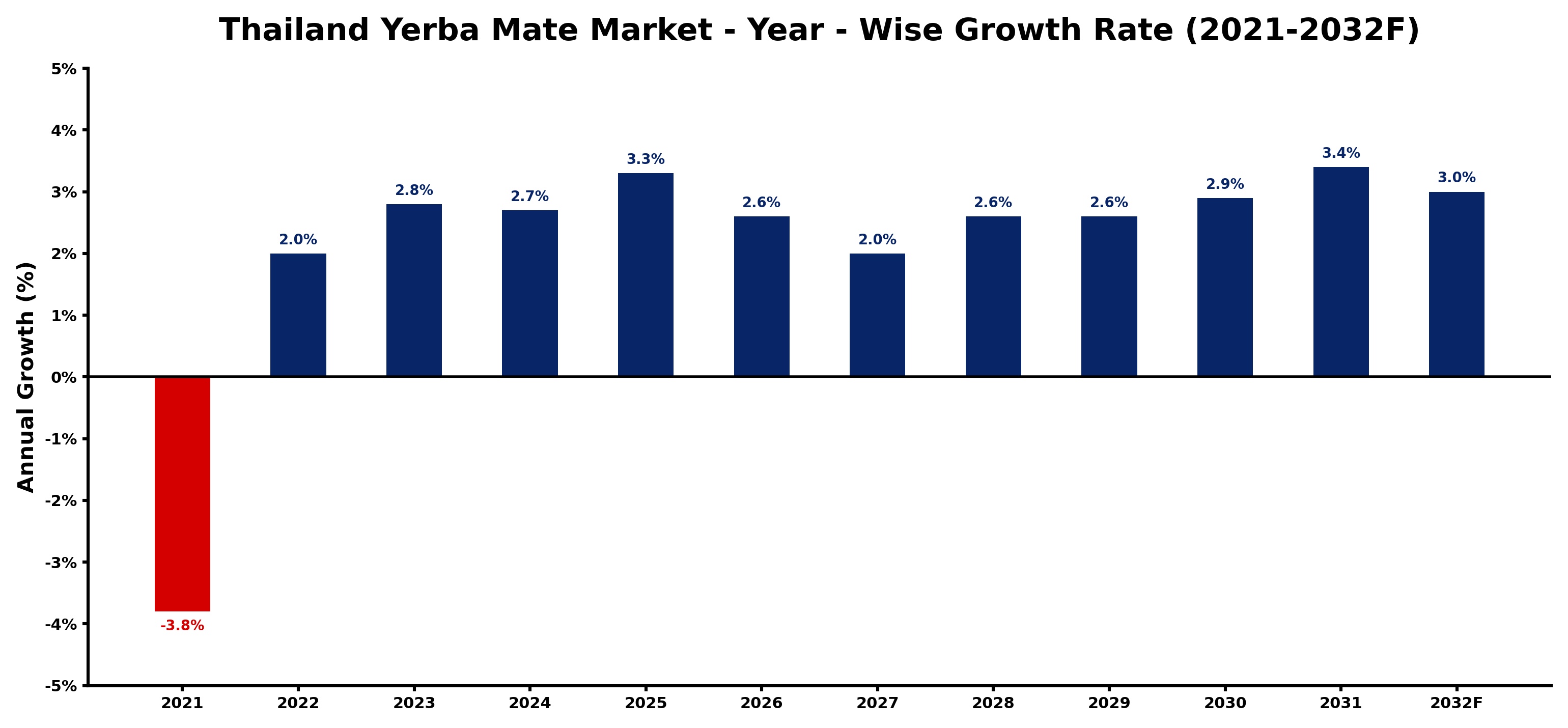
The table below presents the year‑wise growth rates along with the key drivers influencing the market
| Year | Growth Rate | Major Drivers |
| 2021 | -3.8% | Consumer interest in alternatives declined |
| 2022 | 2.0% | Health benefits awareness increased significantly |
| 2023 | 2.8% | Sustainable sourcing gained popularity |
| 2024 | 2.7% | Cultural integration enhanced market presence |
| 2025 | 3.3% | Innovative product launches attracted consumers |
| 2026 | 2.6% | Social media marketing expanded reach |
| 2027 | 2.0% | E-commerce growth improved accessibility |
| 2028 | 2.6% | Collaborations with cafes increased visibility |
| 2029 | 2.6% | Variety of flavors attracted interest |
| 2030 | 2.9% | Fitness trends boosted consumption rates |
| 2031 | 3.4% | Local sourcing initiatives gained traction |
| 2032 | 3.0% | Export opportunities expanded market reach |
Note - Market size estimations and growth projections presented in this report are based on 6Wresearch's advanced forecasting approach, validated with industry datasets as of June 2026.
Thailand Yerba Mate Market Synopsis
The Thailand yerba mate market, while still relatively nascent compared to larger Asian markets, has shown promising growth in recent years. With retail sales estimated at approximately $3.5 million USD in 2020 and nearly 40% of sales occurring through online platforms, the market is gradually finding its footing as consumer habits evolve.
Looking ahead, the market is poised for further expansion, driven by a growing inclination toward health-centric beverages among Thai consumers. However, educating the market about yerba mate and its origins will be crucial for sustaining this momentum and fostering broader acceptance of the beverage.
Thailand Yerba Mate Market Key Takeaways
- Retail sales of yerba mate in Thailand reached approximately $3.5 million in 2020, highlighting initial consumer interest.
- Online sales account for nearly 40% of total yerba mate consumption, reflecting shifting shopping preferences.
- The market is expected to grow at a CAGR of 1.8%, indicating stable growth potential over the coming years.
- Increased consumer awareness and interest in health and wellness beverages are vital growth drivers.
- The market faces challenges in educating consumers about the benefits and origins of yerba mate.
Evaluation of Restraints in Thailand Yerba Mate Market
The primary restraint affecting the Thailand yerba mate market lies in the relatively low consumer familiarity with the beverage. Unlike more traditional drinks within the region, yerba mate requires a significant educational push to convey its unique characteristics and health benefits. Additionally, the market has faced supply chain disruptions due to external factors such as the COVID-19 pandemic, impacting the availability of imports and limiting product variety. This combination of limited awareness and distribution challenges has hindered the market's full growth potential.
Thailand Yerba Mate Market Trends
Current trends indicate a rising consumer demand for functional beverages that offer health benefits, aligning well with yerba mate's reputation as a natural stimulant. Moreover, the growth of e-commerce has made yerba mate more accessible to the Thai population, allowing consumers to explore and purchase different brands and varieties without geographical limitations. Emerging trends, such as blending yerba mate with other local flavors or wellness ingredients, are also shaping product development strategies to cater to local tastes.
Thailand Yerba Mate Market Opportunities
The Thailand yerba mate market presents several compelling growth opportunities. Brands can capitalize on the burgeoning interest in health-focused beverages by developing innovative products that resonate with local preferences. Furthermore, marketing campaigns that emphasize the cultural heritage and health benefits of yerba mate could attract a wider audience. Collaborations with local influencers or health professionals could also enhance credibility and awareness, ultimately leading to increased market penetration.
Government Initiatives in the Thailand Yerba Mate Market
The Thai government is increasingly focused on promoting health and wellness initiatives, which could benefit the yerba mate market. Programs aimed at supporting local agriculture and herbal product development may encourage domestic production and reduce reliance on imports. Additionally, public health campaigns that emphasize the benefits of herbal beverages could foster greater consumer acceptance of yerba mate.
Future Insights of the Thailand Yerba Mate Market
Looking forward to the period from 2026 to 2032, the Thailand yerba mate market is likely to experience moderate growth driven by increasing health consciousness among consumers. As more products enter the market and awareness campaigns take effect, it is expected that yerba mate will become a more commonplace choice among health-oriented individuals. If brands can successfully navigate consumer education and tailor offerings to local preferences, the market may witness a more robust expansion than current projections suggest.
Thailand Yerba Mate Market Latest Developments (May 2025 - June 2026)
Recent developments in the Thailand yerba mate market include a notable increase in online product launches tailored to local tastes. Companies are innovating new blends that incorporate traditional Thai ingredients to appeal to consumers seeking unique flavor profiles. Additionally, local workshops and events focusing on the cultural significance of yerba mate have started to gain traction, promoting a deeper understanding of the beverage.
Thailand Yerba Mate Market - Key Attractiveness of the Report
- 10 Years of Market Numbers
- Historical Data Starting from 2022 to 2025
- Base Year: 2025
- Forecast Data until 2032
- Key Performance Indicators Impacting the Market
- Major Upcoming Developments and Projects
Key Highlights of the Report:
- Thailand Yerba Mate Market Outlook
- Market Size of Thailand Yerba Mate Market, 2025
- Forecast of Thailand Yerba Mate Market, 2032F
- Historical Data and Forecast of Thailand Yerba Mate Revenues & Volume for the Period 2022-2032F
- Thailand Yerba Mate Market Trend Evolution
- Thailand Yerba Mate Market Drivers and Challenges
- Thailand Yerba Mate Price Trends
- Thailand Yerba Mate Porter's Five Forces
- Thailand Yerba Mate Industry Life Cycle
- Historical Data and Forecast of Thailand Yerba Mate Market Revenues & Volume By Type for the Period 2022-2032F
- Historical Data and Forecast of Thailand Yerba Mate Market Revenues & Volume By Powder for the Period 2022-2032F
- Historical Data and Forecast of Thailand Yerba Mate Market Revenues & Volume By Concentrate for the Period 2022-2032F
- Historical Data and Forecast of Thailand Yerba Mate Market Revenues & Volume By Others for the Period 2022-2032F
- Historical Data and Forecast of Thailand Yerba Mate Market Revenues & Volume By Applications for the Period 2022-2032F
- Historical Data and Forecast of Thailand Yerba Mate Market Revenues & Volume By Dietary Supplements for the Period 2022-2032F
- Historical Data and Forecast of Thailand Yerba Mate Market Revenues & Volume By Functional Foods for the Period 2022-2032F
- Historical Data and Forecast of Thailand Yerba Mate Market Revenues & Volume By Food & Beverage for the Period 2022-2032F
- Historical Data and Forecast of Thailand Yerba Mate Market Revenues & Volume By Cosmetics & Personal Care for the Period 2022-2032F
- Historical Data and Forecast of Thailand Yerba Mate Market Revenues & Volume By Distribution Channel for the Period 2022-2032F
- Historical Data and Forecast of Thailand Yerba Mate Market Revenues & Volume By Retails Stores for the Period 2022-2032F
- Historical Data and Forecast of Thailand Yerba Mate Market Revenues & Volume By Hyper Market for the Period 2022-2032F
- Historical Data and Forecast of Thailand Yerba Mate Market Revenues & Volume By Online Sites for the Period 2022-2032F
- Thailand Yerba Mate Import Export Trade Statistics
- Market Opportunity Assessment By Type
- Market Opportunity Assessment By Applications
- Market Opportunity Assessment By Distribution Channel
- Thailand Yerba Mate Top Companies Market Share
- Thailand Yerba Mate Competitive Benchmarking By Technical and Operational Parameters
- Thailand Yerba Mate Company Profiles
- Thailand Yerba Mate Key Strategic Recommendations






































