Togo Decorative Glass Market Year-wise Growth Rate (2021-2031F)
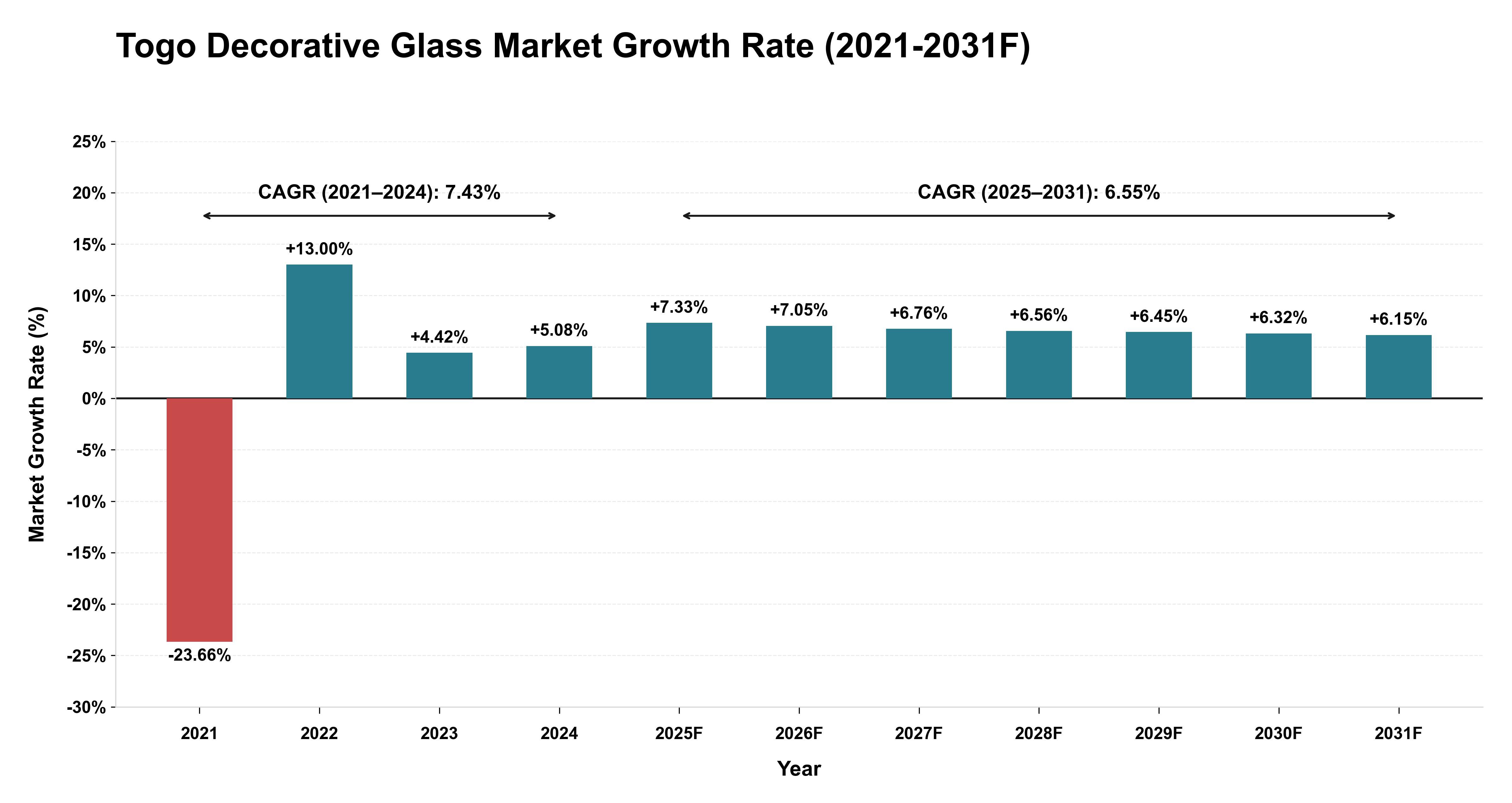
The Togo Decorative Glass Market faced a turbulent period from 2021 to 2024, with a sharp decline of -23.66% in 2021, possibly due to economic shocks or supply chain disruptions. However, the market rebounded strongly in 2022 with a growth of 13.00%, indicating resilience and potential pent-up demand. Subsequent years saw moderate growth rates of 4.42% in 2023 and 5.08% in 2024, reflecting stability and steady recovery. Looking ahead to 2025-2031, the market is forecasted to maintain a positive growth trajectory, albeit at a slightly slower pace with a CAGR of 6.55%. This deceleration could be attributed to factors such as market saturation in certain segments, shifting consumer preferences, or increased competition. Overall, the market is expected to continue expanding steadily, driven by factors like urbanization, infrastructure development, and interior design trends.
Key Highlights of the Report:
- Togo Decorative Glass Market Outlook
- Market Size of Togo Decorative Glass Market, 2025
- Forecast of Togo Decorative Glass Market, 2032
- Historical Data and Forecast of Togo Decorative Glass Revenues & Volume for the Period 2022 - 2032F
- Togo Decorative Glass Market Trend Evolution
- Togo Decorative Glass Market Drivers and Challenges
- Togo Decorative Glass Price Trends
- Togo Decorative Glass Porter`s Five Forces
- Togo Decorative Glass Industry Life Cycle
- Historical Data and Forecast of Togo Decorative Glass Market Revenues & Volume By Product for the Period 2022 - 2032F
- Historical Data and Forecast of Togo Decorative Glass Market Revenues & Volume By Low-e for the Period 2022 - 2032F
- Historical Data and Forecast of Togo Decorative Glass Market Revenues & Volume By Special for the Period 2022 - 2032F
- Historical Data and Forecast of Togo Decorative Glass Market Revenues & Volume By Other for the Period 2022 - 2032F
- Historical Data and Forecast of Togo Decorative Glass Market Revenues & Volume By Application for the Period 2022 - 2032F
- Historical Data and Forecast of Togo Decorative Glass Market Revenues & Volume By Commercial Building for the Period 2022 - 2032F
- Historical Data and Forecast of Togo Decorative Glass Market Revenues & Volume By Residential Building for the Period 2022 - 2032F
- Historical Data and Forecast of Togo Decorative Glass Market Revenues & Volume By Public Building for the Period 2022 - 2032F
- Togo Decorative Glass Import Export Trade Statistics
- Market Opportunity Assessment By Product
- Market Opportunity Assessment By Application
- Togo Decorative Glass Top Companies Market Share
- Togo Decorative Glass Competitive Benchmarking By Technical and Operational Parameters
- Togo Decorative Glass Company Profiles
- Togo Decorative Glass Key Strategic Recommendations






































