Togo Mining Lubricants Market Top 5 Importing Countries and Market Competition (HHI) Analysis
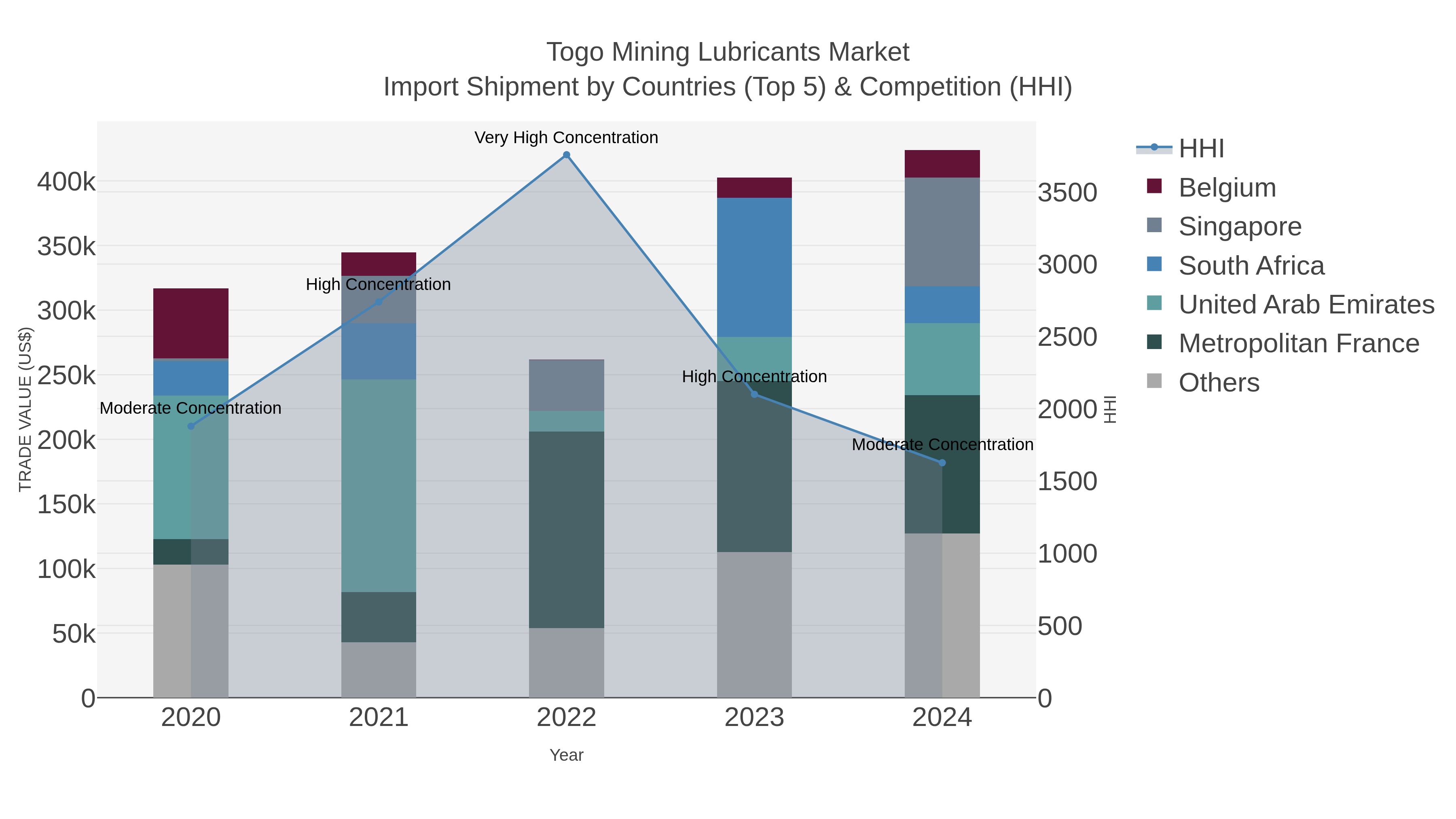
In 2024, Togo continued to source its mining lubricants from a diverse range of countries including Metropolitan France, Singapore, Morocco, United Arab Emirates, and Türkiye. The market remained competitive with very low concentration indicated by the Herfindahl-Hirschman Index (HHI). While the Compound Annual Growth Rate (CAGR) for the period 2020-2024 is not available, the specific growth rate for 2023-2024 is also not provided. Togo`s reliance on multiple suppliers reflects a strategy to ensure a stable and diversified supply chain for its mining lubricants needs.
Key Highlights of the Report:
- Togo Mining Lubricants Market Outlook
- Market Size of Togo Mining Lubricants Market, 2025
- Forecast of Togo Mining Lubricants Market, 2032
- Historical Data and Forecast of Togo Mining Lubricants Revenues & Volume for the Period 2022 - 2032F
- Togo Mining Lubricants Market Trend Evolution
- Togo Mining Lubricants Market Drivers and Challenges
- Togo Mining Lubricants Price Trends
- Togo Mining Lubricants Porter`s Five Forces
- Togo Mining Lubricants Industry Life Cycle
- Historical Data and Forecast of Togo Mining Lubricants Market Revenues & Volume By End Use Industry for the Period 2022 - 2032F
- Historical Data and Forecast of Togo Mining Lubricants Market Revenues & Volume By Coal Mining for the Period 2022 - 2032F
- Historical Data and Forecast of Togo Mining Lubricants Market Revenues & Volume By Iron ORE Mining for the Period 2022 - 2032F
- Historical Data and Forecast of Togo Mining Lubricants Market Revenues & Volume By Bauxite Mining for the Period 2022 - 2032F
- Historical Data and Forecast of Togo Mining Lubricants Market Revenues & Volume By Rare Earth Mineral Mining for the Period 2022 - 2032F
- Historical Data and Forecast of Togo Mining Lubricants Market Revenues & Volume By Precious Metals Mining for the Period 2022 - 2032F
- Historical Data and Forecast of Togo Mining Lubricants Market Revenues & Volume By Type for the Period 2022 - 2032F
- Historical Data and Forecast of Togo Mining Lubricants Market Revenues & Volume By Mineral Oil Lubricants for the Period 2022 - 2032F
- Historical Data and Forecast of Togo Mining Lubricants Market Revenues & Volume By Synthetic Lubricants for the Period 2022 - 2032F
- Togo Mining Lubricants Import Export Trade Statistics
- Market Opportunity Assessment By End Use Industry
- Market Opportunity Assessment By Type
- Togo Mining Lubricants Top Companies Market Share
- Togo Mining Lubricants Competitive Benchmarking By Technical and Operational Parameters
- Togo Mining Lubricants Company Profiles
- Togo Mining Lubricants Key Strategic Recommendations






































