Togo Secondary Refrigerants Market Top 5 Importing Countries and Market Competition (HHI) Analysis
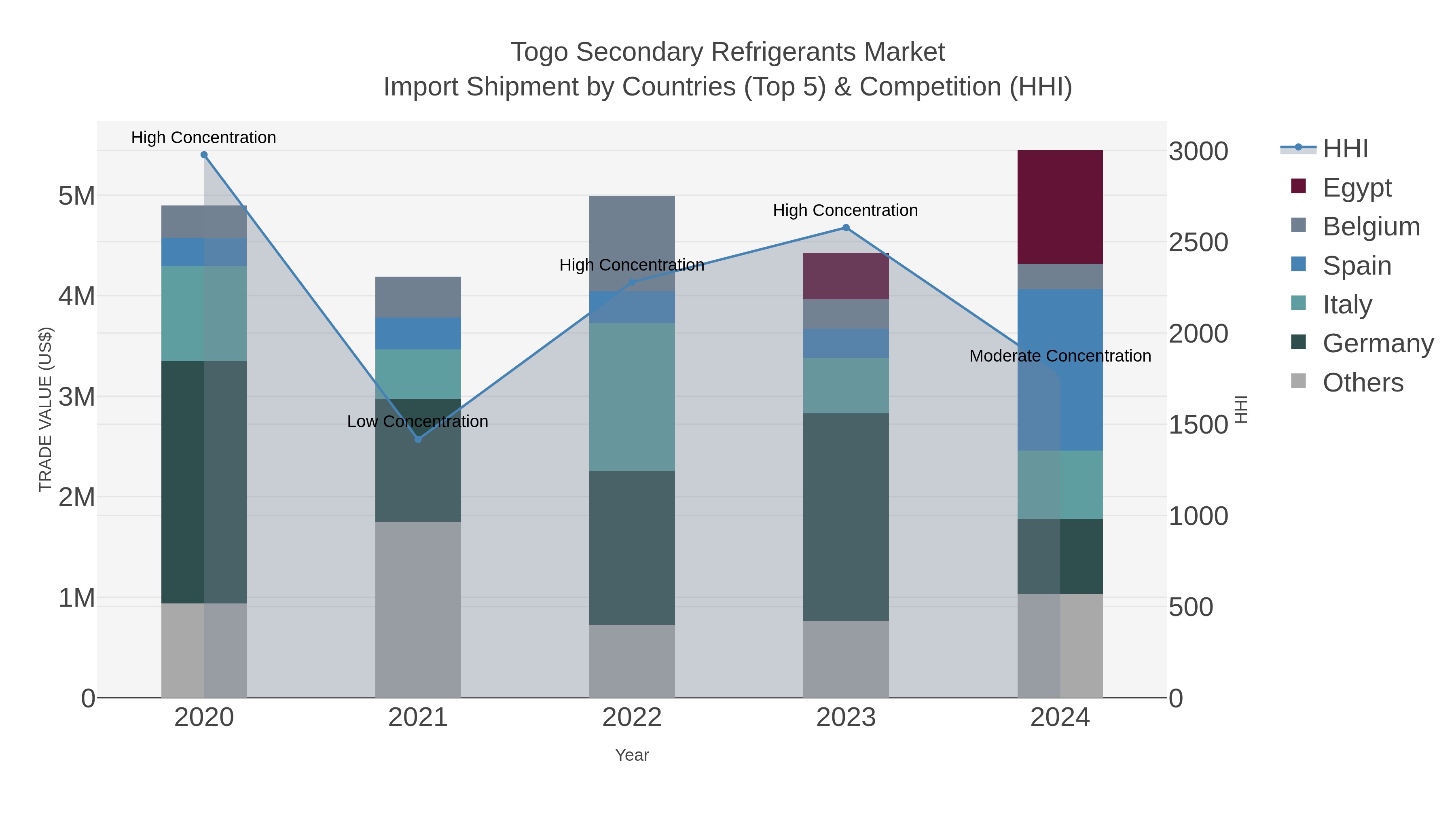
In 2024, Togo continued to source secondary refrigerants predominantly from Spain, Egypt, Germany, Italy, and Viet Nam. With a very low Herfindahl-Hirschman Index (HHI) indicating market fragmentation, the import market remains diverse. While specific growth data is not available for the period 2020-2024 or 2023-2024, the consistent presence of multiple exporting countries suggests a stable and competitive landscape for secondary refrigerants in Togo.
Key Highlights of the Report:
- Togo Secondary Refrigerants Market Outlook
- Market Size of Togo Secondary Refrigerants Market, 2025
- Forecast of Togo Secondary Refrigerants Market, 2032
- Historical Data and Forecast of Togo Secondary Refrigerants Revenues & Volume for the Period 2022 - 2032F
- Togo Secondary Refrigerants Market Trend Evolution
- Togo Secondary Refrigerants Market Drivers and Challenges
- Togo Secondary Refrigerants Price Trends
- Togo Secondary Refrigerants Porter`s Five Forces
- Togo Secondary Refrigerants Industry Life Cycle
- Historical Data and Forecast of Togo Secondary Refrigerants Market Revenues & Volume By Type for the Period 2022 - 2032F
- Historical Data and Forecast of Togo Secondary Refrigerants Market Revenues & Volume By Glycols for the Period 2022 - 2032F
- Historical Data and Forecast of Togo Secondary Refrigerants Market Revenues & Volume By Salt Brines for the Period 2022 - 2032F
- Historical Data and Forecast of Togo Secondary Refrigerants Market Revenues & Volume By Carbon Dioxide for the Period 2022 - 2032F
- Historical Data and Forecast of Togo Secondary Refrigerants Market Revenues & Volume By Application for the Period 2022 - 2032F
- Historical Data and Forecast of Togo Secondary Refrigerants Market Revenues & Volume By Commercial Refrigeration for the Period 2022 - 2032F
- Historical Data and Forecast of Togo Secondary Refrigerants Market Revenues & Volume By Industrial Refrigeration for the Period 2022 - 2032F
- Historical Data and Forecast of Togo Secondary Refrigerants Market Revenues & Volume By Heat Pumps for the Period 2022 - 2032F
- Historical Data and Forecast of Togo Secondary Refrigerants Market Revenues & Volume By Air Conditioning for the Period 2022 - 2032F
- Togo Secondary Refrigerants Import Export Trade Statistics
- Market Opportunity Assessment By Type
- Market Opportunity Assessment By Application
- Togo Secondary Refrigerants Top Companies Market Share
- Togo Secondary Refrigerants Competitive Benchmarking By Technical and Operational Parameters
- Togo Secondary Refrigerants Company Profiles
- Togo Secondary Refrigerants Key Strategic Recommendations






































