Togo Split Air Conditioners Market Year-wise Growth Rate (2021-2031F)
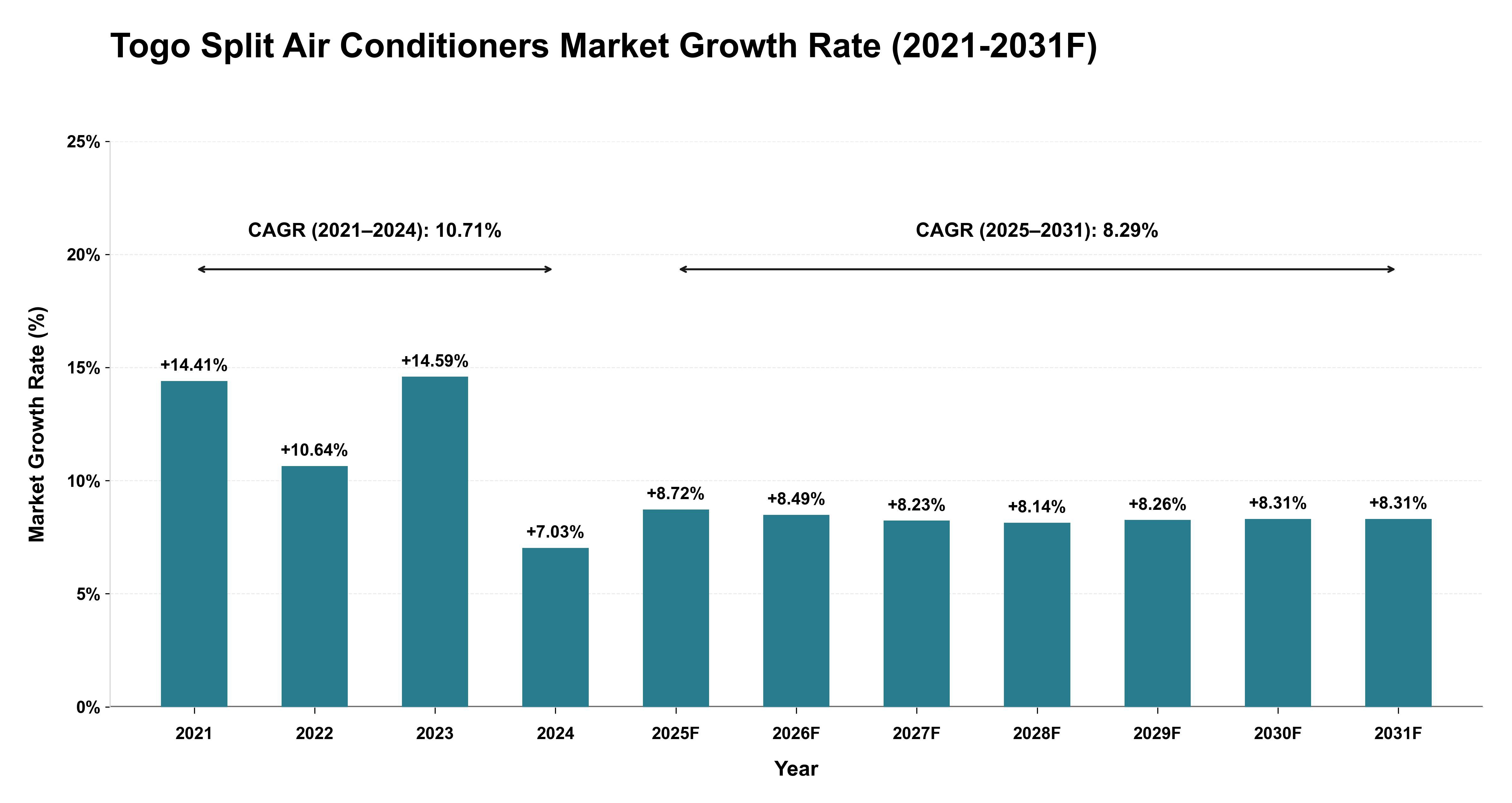
In the period 2021-2024, the Togo Split Air Conditioners Market experienced robust growth, with an average annual increase of 10.71%. This growth was primarily driven by increasing urbanization, rising disposable incomes, and a growing focus on energy-efficient cooling solutions. However, in 2024, the market saw a slight dip in growth at 7.03%, indicating some saturation in the existing customer base. Looking ahead to 2025-2031, the market is expected to continue expanding at a slightly slower pace with a forecasted CAGR of 8.29%. This deceleration can be attributed to market maturity, increased competition, and evolving consumer preferences towards more sustainable cooling technologies. Overall, while the market remains promising, players will need to innovate and adapt to maintain growth in the coming years.
Key Highlights of the Report:
- Togo Split Air conditioners Market Outlook
- Market Size of Togo Split Air conditioners Market, 2024
- Forecast of Togo Split Air conditioners Market, 2031
- Historical Data and Forecast of Togo Split Air conditioners Revenues & Volume for the Period 2021-2031
- Togo Split Air conditioners Market Trend Evolution
- Togo Split Air conditioners Market Drivers and Challenges
- Togo Split Air conditioners Price Trends
- Togo Split Air conditioners Porter`s Five Forces
- Togo Split Air conditioners Industry Life Cycle
- Historical Data and Forecast of Togo Split Air conditioners Market Revenues & Volume By Product Type for the Period 2021-2031
- Historical Data and Forecast of Togo Split Air conditioners Market Revenues & Volume By Ductless for the Period 2021-2031
- Historical Data and Forecast of Togo Split Air conditioners Market Revenues & Volume By VRF for the Period 2021-2031
- Historical Data and Forecast of Togo Split Air conditioners Market Revenues & Volume By Ducted for the Period 2021-2031
- Historical Data and Forecast of Togo Split Air conditioners Market Revenues & Volume By Application for the Period 2021-2031
- Historical Data and Forecast of Togo Split Air conditioners Market Revenues & Volume By Residential for the Period 2021-2031
- Historical Data and Forecast of Togo Split Air conditioners Market Revenues & Volume By Commercial for the Period 2021-2031
- Togo Split Air conditioners Import Export Trade Statistics
- Market Opportunity Assessment By Product Type
- Market Opportunity Assessment By Application
- Togo Split Air conditioners Top Companies Market Share
- Togo Split Air conditioners Competitive Benchmarking By Technical and Operational Parameters
- Togo Split Air conditioners Company Profiles
- Togo Split Air conditioners Key Strategic Recommendations






































