Tunisia Aerosol Market Size, Share & Growth Rate
The Tunisia Aerosol Market was estimated at USD 1126 Million in 2025 and is projected to reach USD 1611 Million by 2032, growing at a CAGR of 5.3% from 2026 to 2032. This trajectory is fueled by the rising consumer demand for efficient personal care and household products, as well as the increasing prevalence of innovative aerosol applications across various sectors. Additionally, factors such as urbanization and growing disposable incomes are contributing to the enhanced market penetration of aerosol solutions in Tunisia.
Tunisia Aerosol Market Year-wise Growth Rate and Key Drivers
This graph highlights how the Tunisia Aerosol Market has steadily grown over the years, supported by major growth factors.
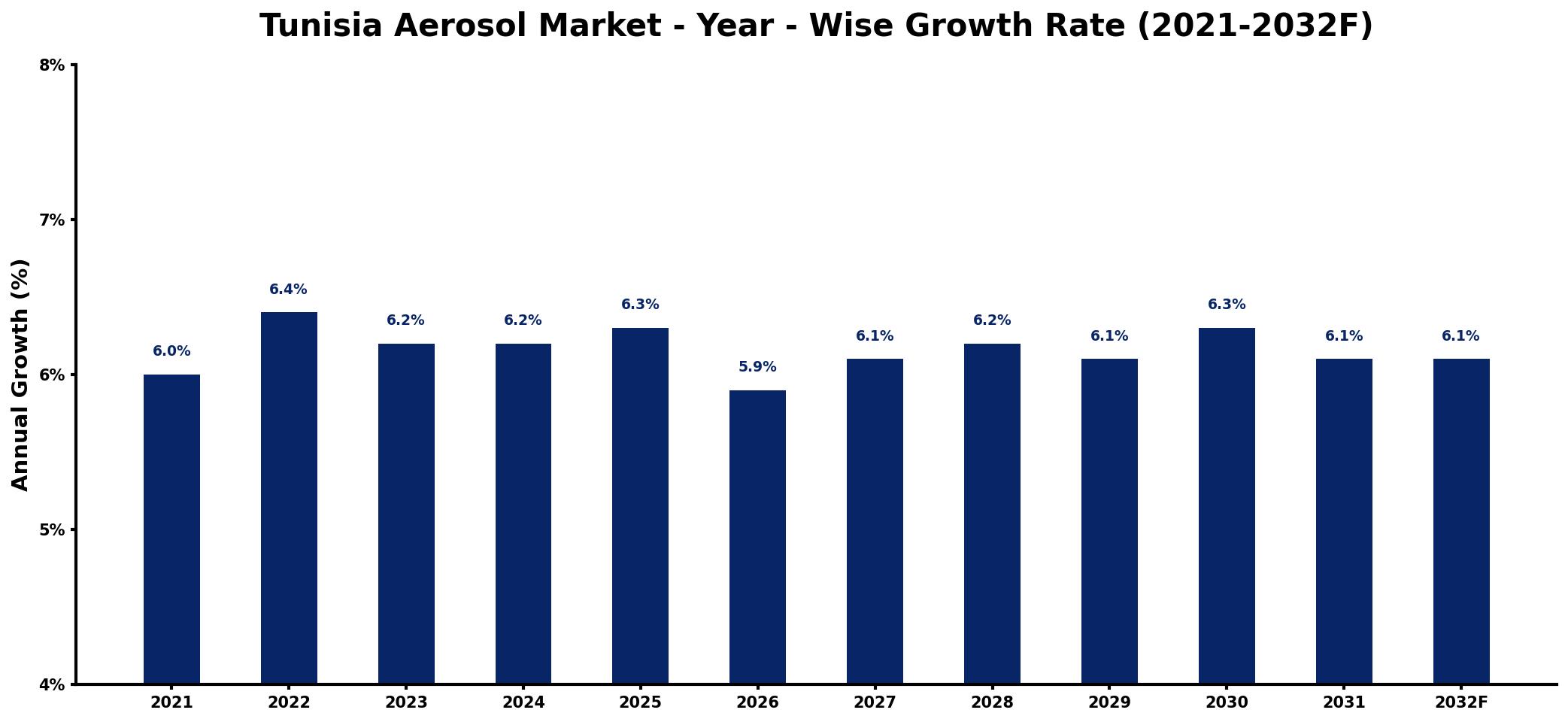
The table below presents the year‑wise growth rates along with the key drivers influencing the market
| Year | Growth Rate | Major Drivers |
| 2021 | 6.0% | Rising consumer demand for convenience |
| 2022 | 6.4% | Increased investment in manufacturing facilities |
| 2023 | 6.2% | improved processing technologies adoption |
| 2024 | 6.2% | Expansion of distribution channels nationwide |
| 2025 | 6.3% | Surge in home improvement projects |
| 2026 | 5.9% | Emerging trends in eco-friendly products |
| 2027 | 6.1% | Innovations in packaging technologies |
| 2028 | 6.2% | Higher disposable income among consumers |
| 2029 | 6.1% | Growth in online retail platforms |
| 2030 | 6.3% | Rising awareness of health benefits |
| 2031 | 6.1% | Increased focus on product diversification |
| 2032 | 6.1% | Strengthening supply chain efficiencies |
Note: Market size estimations and growth projections presented in this report are based on 6Wresearch's proprietary forecasting methodology, utilizing the latest available industry data, government publications, and primary research inputs.
Tunisia Aerosol Market Synopsis
The Tunisian aerosol market is witnessing a burgeoning demand for products that offer convenience and effectiveness, particularly in the personal care and household cleaning sectors. With a shift in consumer preferences towards multifunctional products, the market is diversifying its offerings to meet these evolving needs.
Innovative packaging designs and eco-friendly formulations are paramount in attracting environmentally-conscious consumers. Manufacturers are actively working on expanding their product portfolios to include sustainable options that resonate with the increasing awareness of environmental issues, all while ensuring compliance with local regulations.
Tunisia Aerosol Market Key Takeaways
- The market is set to experience significant growth due to rising demand for convenience in household and personal care products.
- Innovation in eco-friendly formulations and packaging design is driving competitive differentiation among manufacturers.
- Regulatory compliance regarding product safety and environmental impact is shaping market dynamics.
- Customization and personalization of aerosol products are becoming key trends to cater to diverse consumer preferences.
- Investment opportunities abound for both domestic and international players looking to leverage local consumer trends.
Evaluation of Restraints in Tunisia Aerosol Market
Despite the promising outlook, the Tunisia aerosol market faces several constraints. The presence of intense competition from both local and international brands poses a significant challenge for market entrants. Additionally, fluctuations in raw material prices can adversely affect production costs and profitability. Stringent regulations surrounding product formulation and safety require companies to stay vigilant in compliance efforts, often necessitating significant investment. Furthermore, rapid shifts in consumer demand and preferences require a nimble approach to product innovation, adding another layer of complexity for businesses seeking to thrive in this landscape.
Tunisia Aerosol Market Trends
Currently, a notable trend within the Tunisia aerosol market is the increasing consumer inclination toward eco-friendly products. Companies are actively developing formulations that utilize sustainable ingredients and recyclable packaging materials. Furthermore, innovations in aerosol technology are leading to more effective product applications, enhancing user experience. Personalized product offerings are also on the rise, as brands strive to meet specific consumer preferences in scent, efficacy, and packaging. These trends underscore a broader commitment to sustainability and convenience in product design.
Tunisia Aerosol Market Opportunities
The Tunisia aerosol market offers numerous investment avenues, particularly in developing eco-friendly and efficient aerosol products tailored to local preferences. As consumer interest in personal care and household cleaning products continues to grow, there is a clear opportunity for innovation and market penetration. Collaborations with local distributors or manufacturers can provide strategic advantages, enabling investors to better navigate market dynamics and consumer preferences. The emerging trend of customization further amplifies potential growth, allowing brands to cater to niche markets with tailored offerings.
Government Initiatives in the Tunisia Aerosol Market
The Tunisian government has implemented various policies to regulate the aerosol market, with a strong focus on health and environmental standards. Regulations surrounding the manufacturing and distribution of aerosol products ensure consumer safety and adherence to international norms. Additionally, initiatives promoting sustainable practices, such as monitoring the use of specific propellants, reflect a commitment to minimizing environmental impact. These governmental measures aim to foster a safe and responsible market that benefits both consumers and manufacturers alike.
Future Insights of the Tunisia Aerosol Market
Looking ahead to the period from 2026 to 2032, the Tunisia aerosol market is projected to sustain its growth trajectory. The increasing urban population and rising disposable incomes are expected to further boost demand for convenience-oriented aerosol products. As consumer awareness of environmental issues continues to grow, the market is likely to see a definitive shift towards sustainable and innovative aerosol solutions. Enhanced marketing strategies and product differentiation efforts will be crucial for companies aiming to capitalize on these evolving trends and maintain relevance in a competitive landscape.
Tunisia Aerosol Market Latest Developments (2025 - 2026)
In recent months, the Tunisia aerosol market has witnessed a flurry of activity, particularly around the development of new eco-friendly products. There has been a notable increase in partnerships aimed at enhancing distribution networks, which has streamlined the delivery of aerosol products to consumers. Additionally, several manufacturers are focusing on integrating advanced technologies into their formulations, enhancing product efficacy and user convenience. This period also reflects a growing commitment to sustainability as brands move towards greener production practices.
Tunisia Aerosol Market - Key Attractiveness of the Report
- 10 Years of Market Numbers
- Historical Data Starting from 2022 to 2025
- Base Year: 2025
- Forecast Data until 2032
- Key Performance Indicators Impacting the Market
- Major Upcoming Developments and Projects
Key Highlights of the Report:
- Tunisia Aerosol Market Outlook
- Market Size of Tunisia Aerosol Market, 2025
- Forecast of Tunisia Aerosol Market, 2032
- Historical Data and Forecast of Tunisia Aerosol Revenues & Volume for the Period 2022-2032F
- Tunisia Aerosol Market Trend Evolution
- Tunisia Aerosol Market Drivers and Challenges
- Tunisia Aerosol Price Trends
- Tunisia Aerosol Porter's Five Forces
- Tunisia Aerosol Industry Life Cycle
- Historical Data and Forecast of Tunisia Aerosol Market Revenues & Volume By Material for the Period 2022-2032F
- Historical Data and Forecast of Tunisia Aerosol Market Revenues & Volume By Steel for the Period 2022-2032F
- Historical Data and Forecast of Tunisia Aerosol Market Revenues & Volume By Aluminum for the Period 2022-2032F
- Historical Data and Forecast of Tunisia Aerosol Market Revenues & Volume By Others for the Period 2022-2032F
- Historical Data and Forecast of Tunisia Aerosol Market Revenues & Volume By Type for the Period 2022-2032F
- Historical Data and Forecast of Tunisia Aerosol Market Revenues & Volume By Bag-In-Valve for the Period 2022-2032F
- Historical Data and Forecast of Tunisia Aerosol Market Revenues & Volume By Standard for the Period 2022-2032F
- Historical Data and Forecast of Tunisia Aerosol Market Revenues & Volume By Application for the Period 2022-2032F
- Historical Data and Forecast of Tunisia Aerosol Market Revenues & Volume By Personal Care for the Period 2022-2032F
- Historical Data and Forecast of Tunisia Aerosol Market Revenues & Volume By Household for the Period 2022-2032F
- Historical Data and Forecast of Tunisia Aerosol Market Revenues & Volume By Automotive & Industrial for the Period 2022-2032F
- Historical Data and Forecast of Tunisia Aerosol Market Revenues & Volume By Food for the Period 2022-2032F
- Historical Data and Forecast of Tunisia Aerosol Market Revenues & Volume By Paints for the Period 2022-2032F
- Historical Data and Forecast of Tunisia Aerosol Market Revenues & Volume By Medical for the Period 2022-2032F
- Historical Data and Forecast of Tunisia Aerosol Market Revenues & Volume By Others for the Period 2022-2032F
- Tunisia Aerosol Import Export Trade Statistics
- Market Opportunity Assessment By Material
- Market Opportunity Assessment By Type
- Market Opportunity Assessment By Application
- Tunisia Aerosol Top Companies Market Share
- Tunisia Aerosol Competitive Benchmarking By Technical and Operational Parameters
- Tunisia Aerosol Company Profiles
- Tunisia Aerosol Key Strategic Recommendations






































