Tunisia Aluminium Sulphate Market Size, Share & Growth Rate
The Tunisia Aluminium Sulphate Market was estimated at USD 284 Million in 2025 and is projected to reach USD 372 Million by 2032, growing at a CAGR of 3.9% from 2026 to 2032. This growth is primarily fueled by the escalating demand from sectors such as water treatment and the expanding textile and paper industries. As industrial activities increase in Tunisia, the need for effective coagulants and water treatment solutions will further sustain this upward trajectory.
Tunisia Aluminium Sulphate Market Year-wise Growth Rate and Key Drivers
This graph highlights how the Tunisia Aluminium Sulphate Market has steadily grown over the years, supported by major growth factors.
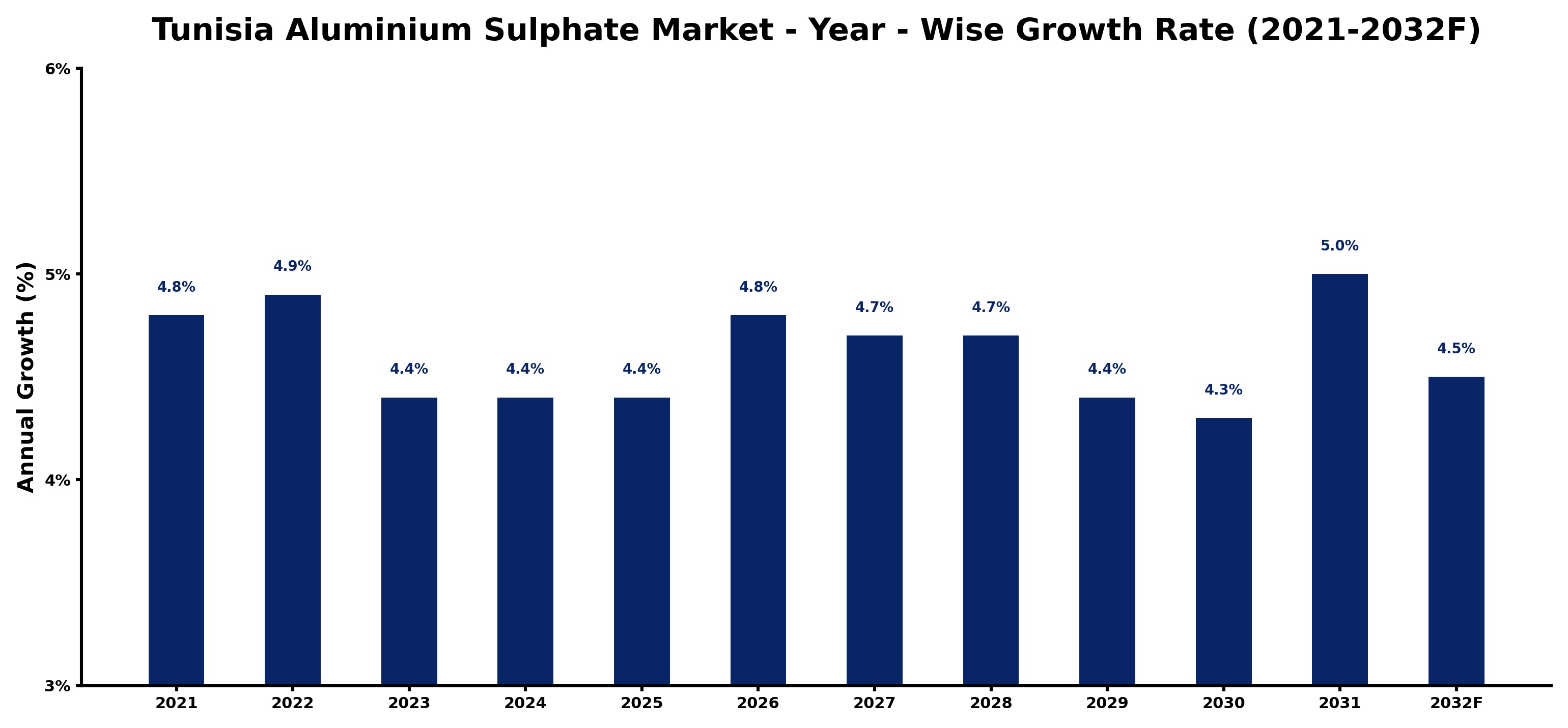
The table below presents the year‑wise growth rates along with the key drivers influencing the market
| Year | Growth Rate | Major Drivers |
| 2021 | 4.8% | Increased industrial applications emerged |
| 2022 | 4.9% | Water treatment demand surged upward |
| 2023 | 4.4% | Agricultural sector growth accelerated |
| 2024 | 4.4% | Construction projects expanded significantly |
| 2025 | 4.4% | Food processing industry thrived |
| 2026 | 4.8% | Environmental regulations drove adoption |
| 2027 | 4.7% | Chemical manufacturing expanded operations |
| 2028 | 4.7% | Export opportunities increased substantially |
| 2029 | 4.4% | Research and development investments grew |
| 2030 | 4.3% | Infrastructure development projects increased |
| 2031 | 5.0% | Market diversification strategies expanded |
| 2032 | 4.5% | Sustainability initiatives gained traction |
Note - Market size estimations and growth projections presented in this report are based on 6Wresearch’s advanced forecasting approach, validated with industry datasets as of June 2026.
Tunisia Aluminium Sulphate Market Synopsis
In Tunisia, aluminium sulphate serves a critical role in water purification, essential for addressing the country's water quality challenges. With the government's focus on improving water treatment facilities, the demand for aluminium sulphate is set to grow significantly.
The burgeoning manufacturing sector, particularly in textiles and paper, is also driving consumption. Companies are increasingly turning to aluminium sulphate as a preferred choice for coagulants, given its efficacy in enhancing the quality of processed materials and promoting sustainable production practices.
Tunisia Aluminium Sulphate Market Key Takeaways
- The market is propelled by strong demand across water treatment, paper, and textile industries.
- Government policies are supporting sustainable practices and enhancing water quality standards.
- Intense competition is shaping innovation and product development within the market.
- Challenges such as raw material price fluctuations are being navigated through strategic partnerships.
- Investment opportunities abound in expanding production capacities and exploring new applications.
Evaluation of Restraints in Tunisia Aluminium Sulphate Market
Despite the promising growth, the Tunisia Aluminium Sulphate Market faces several limitations. The competitive landscape, marked by both local and international players, exerts pressure on profit margins, prompting companies to innovate continuously. Furthermore, the market is susceptible to raw material price volatility, which can disrupt production and impact pricing strategies. Regulatory compliance regarding environmental standards adds another layer of complexity, requiring businesses to invest in sustainable practices while maintaining operational efficiency.
Tunisia Aluminium Sulphate Market Trends
Emerging trends in the Tunisia Aluminium Sulphate Market indicate a significant shift towards eco-friendly practices. Manufacturers are innovating to enhance the efficiency of aluminium sulphate in various applications, focusing on sustainability. Furthermore, as the textile and paper industries evolve, there is a growing preference for high-quality coagulants that not only meet regulatory standards but also enhance product performance. This trend is reshaping product offerings and driving investments in advanced manufacturing technologies.
Tunisia Aluminium Sulphate Market Opportunities
There are robust opportunities for growth in the Tunisia Aluminium Sulphate Market, particularly in expanding production capacity to meet rising water treatment demands. The ongoing challenges of water scarcity in the region present a critical avenue for investment. Additionally, exploring innovative applications of aluminium sulphate in sectors beyond traditional uses, such as pharmaceuticals and agriculture, could yield lucrative returns. Collaborations with local entities focused on sustainable water treatment solutions also represent promising prospects for market entrants.
Government Initiatives in the Tunisia Aluminium Sulphate Market
Government initiatives play a pivotal role in shaping the landscape of the Tunisia Aluminium Sulphate Market. Policies aimed at improving water quality have led to stringent regulations regarding the handling and disposal of aluminium sulphate, promoting environmentally sound practices within the industry. Moreover, trade agreements designed to protect domestic producers while ensuring fair competition have reinforced the market's stability. Continued public spending on infrastructure related to water treatment further underscores the government's commitment to enhancing the sector.
Future Insights of the Tunisia Aluminium Sulphate Market
Looking ahead to 2026-2032, the Tunisia Aluminium Sulphate Market is poised for steady advancement, driven by a confluence of factors. The government's commitment to infrastructure and industrial expansion is likely to bolster demand significantly. Increased awareness of the benefits of effective water treatment solutions will further drive adoption. However, stakeholders must remain vigilant to external challenges, including fluctuating raw material costs and evolving regulatory landscapes, to successfully navigate the market's future.
Tunisia Aluminium Sulphate Market Latest Developments (May 2025 - June 2026)
Recent developments in the Tunisia Aluminium Sulphate Market indicate a growing interest in sustainable production methods. Companies are increasingly focusing on innovating their product lines to meet environmental standards. Additionally, collaborative initiatives aimed at enhancing water quality and treatment efficacy are gaining traction, reflecting a sector-wide shift towards more sustainable practices. Stakeholders are actively engaging in dialogues to address challenges and explore synergies that could benefit the overall market landscape.
Tunisia Aluminium Sulphate Market - Key Attractiveness of the Report
- 10 Years of Market Numbers
- Historical Data Starting from 2022 to 2025
- Base Year: 2025
- Forecast Data until 2032
- Key Performance Indicators Impacting the Market
- Major Upcoming Developments and Projects
Key Highlights of the Report:
- Tunisia Aluminium Sulphate Market Outlook
- Market Size of Tunisia Aluminium Sulphate Market, 2025
- Forecast of Tunisia Aluminium Sulphate Market, 2032
- Historical Data and Forecast of Tunisia Aluminium Sulphate Revenues & Volume for the Period 2022-2032F
- Tunisia Aluminium Sulphate Market Trend Evolution
- Tunisia Aluminium Sulphate Market Drivers and Challenges
- Tunisia Aluminium Sulphate Price Trends
- Tunisia Aluminium Sulphate Porter's Five Forces
- Tunisia Aluminium Sulphate Industry Life Cycle
- Historical Data and Forecast of Tunisia Aluminium Sulphate Market Revenues & Volume By Applications for the Period 2022-2032F
- Historical Data and Forecast of Tunisia Aluminium Sulphate Market Revenues & Volume By Food and beverages industry for the Period 2022-2032F
- Historical Data and Forecast of Tunisia Aluminium Sulphate Market Revenues & Volume By Health care industry for the Period 2022-2032F
- Historical Data and Forecast of Tunisia Aluminium Sulphate Market Revenues & Volume By Water purification and water treatment plants for the Period 2022-2032F
- Historical Data and Forecast of Tunisia Aluminium Sulphate Market Revenues & Volume By Pepper industry for the Period 2022-2032F
- Historical Data and Forecast of Tunisia Aluminium Sulphate Market Revenues & Volume By Others for the Period 2022-2032F
- Historical Data and Forecast of Tunisia Aluminium Sulphate Market Revenues & Volume By Functionality for the Period 2022-2032F
- Historical Data and Forecast of Tunisia Aluminium Sulphate Market Revenues & Volume By As an additive for the Period 2022-2032F
- Historical Data and Forecast of Tunisia Aluminium Sulphate Market Revenues & Volume By As BOD and COD removal for the Period 2022-2032F
- Historical Data and Forecast of Tunisia Aluminium Sulphate Market Revenues & Volume By Colour removal for the Period 2022-2032F
- Historical Data and Forecast of Tunisia Aluminium Sulphate Market Revenues & Volume By Cell separation for the Period 2022-2032F
- Historical Data and Forecast of Tunisia Aluminium Sulphate Market Revenues & Volume By Product Form for the Period 2022-2032F
- Historical Data and Forecast of Tunisia Aluminium Sulphate Market Revenues & Volume By Liquid for the Period 2022-2032F
- Historical Data and Forecast of Tunisia Aluminium Sulphate Market Revenues & Volume By Solid for the Period 2022-2032F
- Tunisia Aluminium Sulphate Import Export Trade Statistics
- Market Opportunity Assessment By Applications
- Market Opportunity Assessment By Functionality
- Market Opportunity Assessment By Product Form
- Tunisia Aluminium Sulphate Top Companies Market Share
- Tunisia Aluminium Sulphate Competitive Benchmarking By Technical and Operational Parameters
- Tunisia Aluminium Sulphate Company Profiles
- Tunisia Aluminium Sulphate Key Strategic Recommendations






































