Tunisia Antiparasitics Drugs Market Size, Share & Growth Rate
The Tunisia Antiparasitics Drugs Market was estimated at USD 215 Million in 2025 and is projected to reach USD 279 Million by 2032, growing at a CAGR of 3.8% from 2026 to 2032. This upward trend is primarily driven by a notable increase in vector-borne diseases, spurred by climate change and its effects on disease transmission. Additionally, heightened consumer awareness about preventative healthcare, particularly in the pet sector, has further contributed to this positive trajectory, creating a vibrant environment for antiparasitics.
Tunisia Antiparasitics Drugs Market Growth Rate Analysis (2021-2032)
The Tunisian antiparasitics drugs market showed a stable growth pattern, marked by a yearly increase of 4.8% in 2021, gradually edging down to 4.2% in 2023, before rebounding to 4.6% in 2024. This fluctuation can be attributed to varying consumer demand driven by an uptick in parasitic infections and heightened public awareness surrounding healthcare. As investments in healthcare infrastructure and technology continue to rise, such as digital health initiatives, the market is expected to witness incremental growth, stabilizing around 4.3% to 4.5% from 2031 to 2032. Additionally, government policies promoting access to essential medicines further support long-term market stability in the region.
Tunisia Antiparasitics Drugs Market Year-wise Growth Rate and Key Drivers
This graph highlights how the Tunisia Antiparasitics Drugs Market has steadily grown over the past five years, supported by major growth factors.
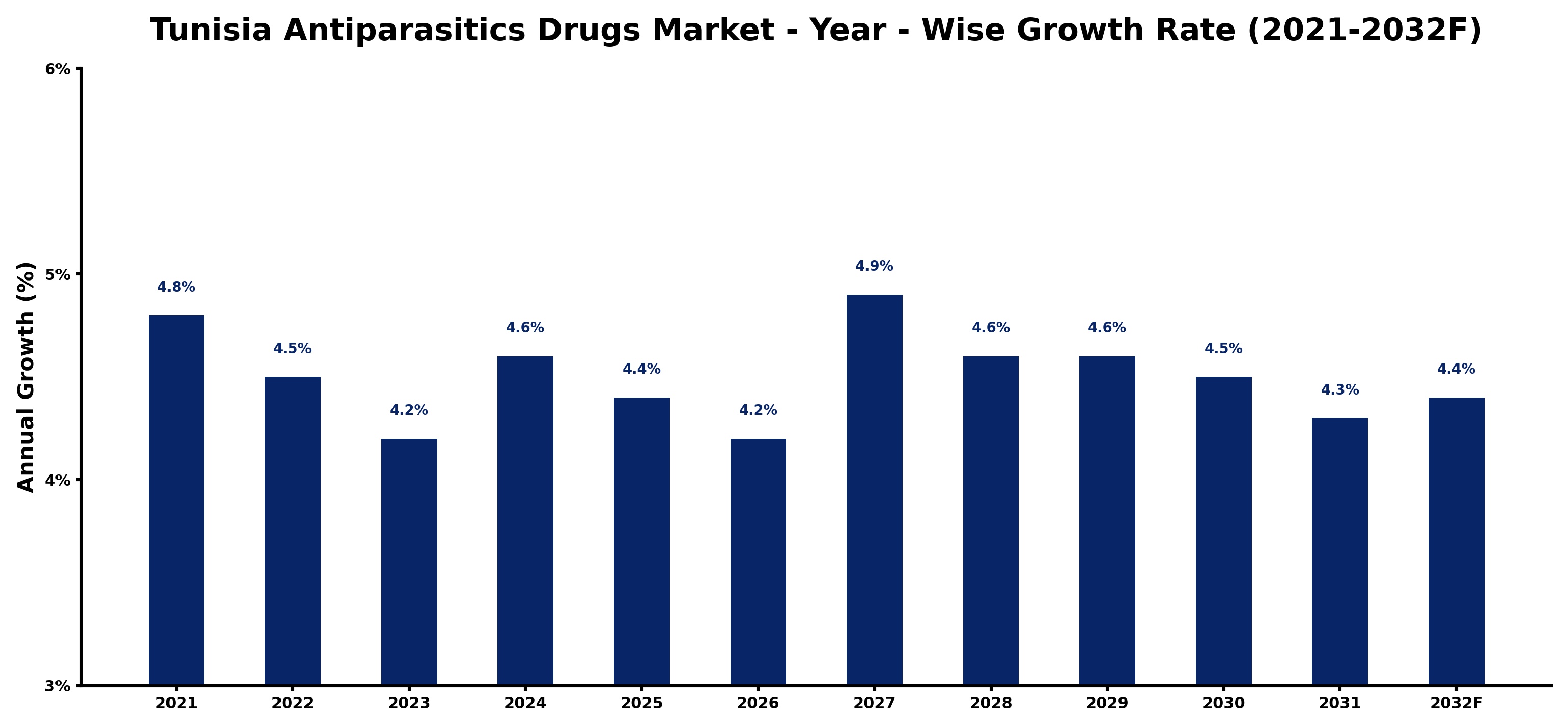
The table below presents the year‑wise growth rates along with the key drivers influencing the market
| Year | Growth Rate | Major Drivers |
| 2021 | 4.8% | New production lines boost capacity for antiparasitic drug exports |
| 2022 | 4.5% | Pharmaceutical manufacturing upgrades boosted antiparasitics production capacity significantly |
| 2023 | 4.2% | Local production facilities upgraded to boost antiparasitic drug output |
| 2024 | 4.6% | Advanced production technology adoption boosts antiparasitic drug efficacy |
| 2025 | 4.4% | Export driven investments in local manufacturing boost antiparasitic production capacity |
| 2026 | 4.2% | Pharmaceutical companies boost production capacities for antiparasitics in Tunisia |
| 2027 | 4.9% | Pharmaceutical manufacturing upgrades enhance antiparasitic production efficiency |
| 2028 | 4.6% | Biotechnology advancements drive innovative formulations for antiparasitics production |
| 2029 | 4.6% | Increased pharmaceutical manufacturing capacity boosted antiparasitic drug production |
| 2030 | 4.5% | Pharmaceutical manufacturers optimize processes to maximize antiparasitic production output |
| 2031 | 4.3% | New pharmaceutical manufacturing facilities boost antiparasitics production capacity |
| 2032 | 4.4% | Export driven livestock health demands boost antiparasitics production investments |
Note - Market size estimations and growth projections presented in this report are based on 6Wresearch's advanced forecasting approach, validated with industry datasets as of June 2026.
Tunisia Antiparasitics Drugs Market Synopsis
In recent years, the Tunisian antiparasitics drugs market has witnessed significant growth, propelled by an alarming rise in vector-borne infections. This situation demands urgent attention and innovative solutions, as the population becomes increasingly aware of the health risks posed by these diseases. Furthermore, the cultural shift towards pet ownership has led to a burgeoning demand for veterinary antiparasitic treatments, which is reshaping the market landscape.
The impact of climate change cannot be overstated, as it exacerbates the spread of various infectious diseases in Tunisia. The surge in demand for effective antiparasitic medications is not merely a trend but an essential response to the public health challenges facing the nation. As such, companies that adapt quickly to these market dynamics are likely to emerge as leaders in the coming years.
Tunisia Antiparasitics Drugs Market Key Takeaways
- The market is set for substantial growth driven by rising vector-borne diseases and increased pet ownership.
- Consumer awareness regarding preventative healthcare is fostering demand for antiparasitic treatments.
- Climate change remains a critical factor influencing disease prevalence and medication needs.
- Accessibility and education around antiparasitic drugs are paramount for market advancement.
- Strong competition is expected from companies investing in novel formulations and advanced delivery systems.
Evaluation of Restraints in Tunisia Antiparasitics Drugs Market
Despite the promising outlook, the Tunisia antiparasitics drugs market faces notable constraints. A lack of availability in local retail outlets often limits access to essential medications, particularly in rural areas where such products are in high demand. Moreover, the higher cost associated with many branded drugs, especially those featuring innovative active ingredients, can deter consumers from purchasing them. Compounding these challenges is the general lack of knowledge among some segments of the population regarding proper usage and dosage, which can further restrict the adoption of antiparasitic treatments.
Tunisia Antiparasitics Drugs Market Trends
Emerging trends in the Tunisia antiparasitics drugs market reflect a growing focus on innovative drug delivery systems and formulations. As companies vie for market share, the introduction of user-friendly, effective products tailored to local conditions becomes increasingly crucial. Additionally, digital marketing and telemedicine are redefining consumer engagement, allowing for better education and accessibility. The rise of e-commerce platforms is also enhancing product availability, providing consumers with easy access to a wider range of antiparasitic medications.
Tunisia Antiparasitics Drugs Market Opportunities
Significant opportunities exist within the Tunisia antiparasitics drugs market, particularly in expanding veterinary care and services. The increasing recognition of pet health as a priority is driving investment in research and development of new treatment options. Moreover, partnerships between government entities and private companies can facilitate the introduction of subsidized programs aimed at educating the population about the importance of antiparasitic treatments. Innovations in product formulations that respond to local ecological conditions also represent a promising frontier for growth.
Government Initiatives in the Tunisia Antiparasitics Drugs Market
The Tunisian government is actively engaged in initiatives to enhance public health awareness and combat the rising threat of vector-borne diseases. Programs aimed at educating the public about preventative measures and disease management are being prioritized. Additionally, policies that support the veterinary pharmaceutical sector, including potential subsidies and grants for research into antiparasitic medications, may further stimulate market growth. These initiatives reflect a commitment to safeguarding public health and improving access to essential medications.
Future Insights of the Tunisia Antiparasitics Drugs Market
Looking towards 2026-2032, the Tunisia antiparasitics drugs market is expected to evolve significantly. The integration of cutting-edge technologies in drug formulation and delivery will likely become standard practice, catering to the unique demands of the local population. With climate change continuing to influence disease patterns, a corresponding rise in awareness and preventive measures will shape consumer behavior. As a result, market players who invest in education and product accessibility will be best positioned to capitalize on the anticipated growth.
Tunisia Antiparasitics Drugs Market Latest Developments (May 2025 - June 2026)
Recent developments in the Tunisia antiparasitics drugs market indicate a shift towards innovative solutions and increased consumer engagement. Companies are rolling out initiatives that focus on enhancing awareness of the benefits of antiparasitic treatments, particularly for pets. Additionally, collaborations with local health organizations aim to improve distribution networks and product availability in underserved areas. The overall direction is clearly towards improving accessibility and education to empower consumers in making informed choices about their health and their pets' health.
Tunisia Antiparasitics Drugs Market - Key Attractiveness of the Report
- 10 Years of Market Numbers
- Historical Data Starting from 2022 to 2025
- Base Year: 2025
- Forecast Data until 2032
- Key Performance Indicators Impacting the Market
- Major Upcoming Developments and Projects
Key Highlights of the Report:
- Tunisia Antiparasitics Drugs Market Outlook
- Market Size of Tunisia Antiparasitics Drugs Market, 2025
- Forecast of Tunisia Antiparasitics Drugs Market, 2032F
- Historical Data and Forecast of Tunisia Antiparasitics Drugs Revenues & Volume for the Period 2022-2032F
- Tunisia Antiparasitics Drugs Market Trend Evolution
- Tunisia Antiparasitics Drugs Market Drivers and Challenges
- Tunisia Antiparasitics Drugs Price Trends
- Tunisia Antiparasitics Drugs Porter's Five Forces
- Tunisia Antiparasitics Drugs Industry Life Cycle
- Historical Data and Forecast of Tunisia Antiparasitics Drugs Market Revenues & Volume By Route of Administration for the Period 2022-2032F
- Historical Data and Forecast of Tunisia Antiparasitics Drugs Market Revenues & Volume By Oral for the Period 2022-2032F
- Historical Data and Forecast of Tunisia Antiparasitics Drugs Market Revenues & Volume By Injectable for the Period 2022-2032F
- Historical Data and Forecast of Tunisia Antiparasitics Drugs Market Revenues & Volume By Topical for the Period 2022-2032F
- Historical Data and Forecast of Tunisia Antiparasitics Drugs Market Revenues & Volume By Drug class for the Period 2022-2032F
- Historical Data and Forecast of Tunisia Antiparasitics Drugs Market Revenues & Volume By Anthelmintics for the Period 2022-2032F
- Historical Data and Forecast of Tunisia Antiparasitics Drugs Market Revenues & Volume By Antiprotozoals for the Period 2022-2032F
- Historical Data and Forecast of Tunisia Antiparasitics Drugs Market Revenues & Volume By Others for the Period 2022-2032F
- Historical Data and Forecast of Tunisia Antiparasitics Drugs Market Revenues & Volume By Distribution Channel for the Period 2022-2032F
- Historical Data and Forecast of Tunisia Antiparasitics Drugs Market Revenues & Volume By Hospital Pharmacies for the Period 2022-2032F
- Historical Data and Forecast of Tunisia Antiparasitics Drugs Market Revenues & Volume By Retail Pharmacies for the Period 2022-2032F
- Historical Data and Forecast of Tunisia Antiparasitics Drugs Market Revenues & Volume By Online Pharmacies for the Period 2022-2032F
- Tunisia Antiparasitics Drugs Import Export Trade Statistics
- Market Opportunity Assessment By Route of Administration
- Market Opportunity Assessment By Drug class
- Market Opportunity Assessment By Distribution Channel
- Tunisia Antiparasitics Drugs Top Companies Market Share
- Tunisia Antiparasitics Drugs Competitive Benchmarking By Technical and Operational Parameters
- Tunisia Antiparasitics Drugs Company Profiles
- Tunisia Antiparasitics Drugs Key Strategic Recommendations






































