Tunisia Apiculture Market Size, Share & Growth Rate
The Tunisia Apiculture Market was estimated at USD 1256 Million in 2025 and is projected to reach USD 1791 Million by 2032, growing at a CAGR of 5.2% from 2026 to 2032. This impressive growth trajectory is primarily driven by the rising global demand for natural and organic honey, coupled with an increase in local production capabilities. Furthermore, the government's proactive stance on sustainable practices is bolstering the overall market framework, allowing Tunisia to effectively leverage its unique floral biodiversity.
Tunisia Apiculture Market Year-wise Growth Rate and Key Drivers
This graph highlights how the Tunisia Apiculture Market has steadily grown over the years, supported by major growth factors.
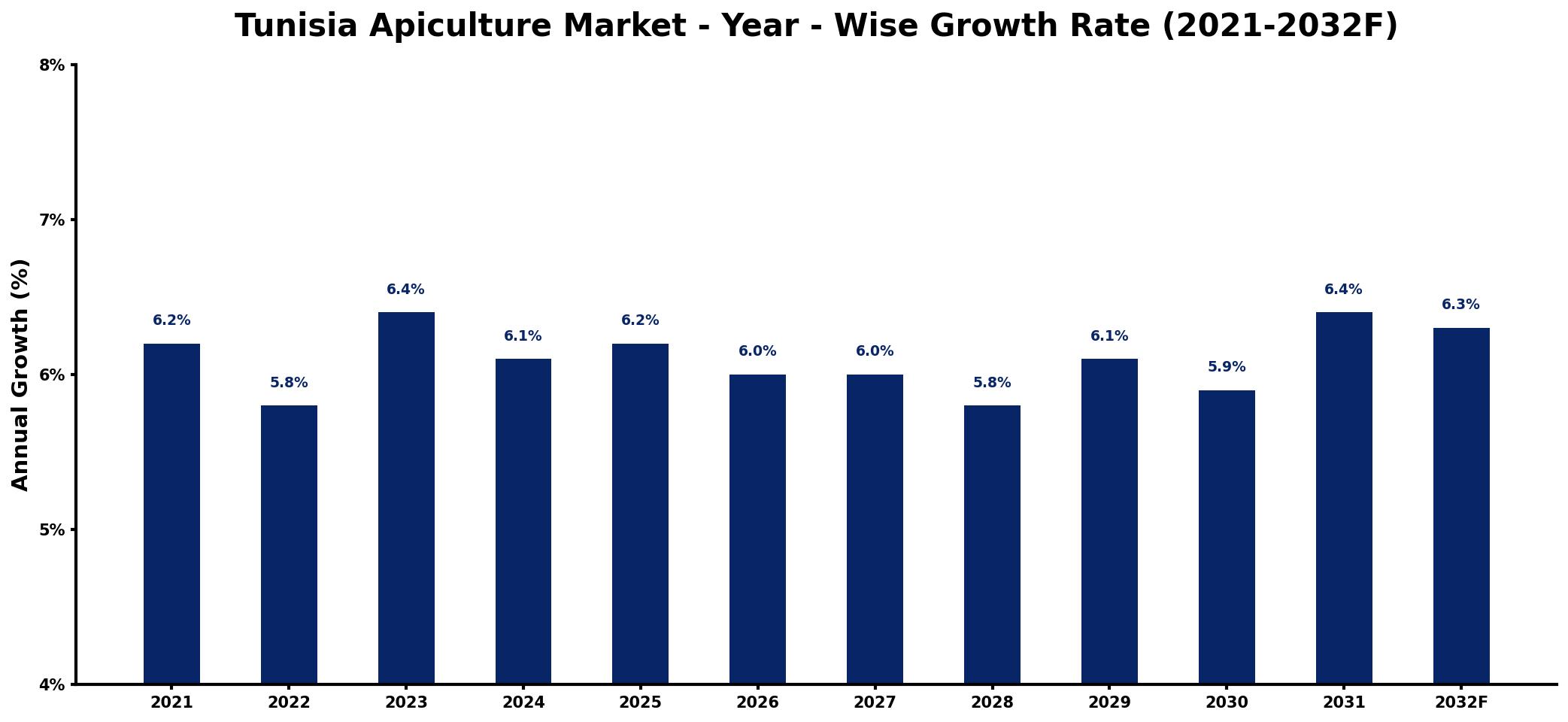
The table below presents the year‑wise growth rates along with the key drivers influencing the market
| Year | Growth Rate | Major Drivers |
| 2021 | 6.2% | Rising consumer health awareness |
| 2022 | 5.8% | Increased organic product demand |
| 2023 | 6.4% | Growing export market opportunities |
| 2024 | 6.1% | Expansion of local production capacity |
| 2025 | 6.2% | Investment in sustainable practices |
| 2026 | 6.0% | Technological advancements in farming |
| 2027 | 6.0% | Emerging niche market segments |
| 2028 | 5.8% | Strengthening of local cooperatives |
| 2029 | 6.1% | Enhanced distribution network efficiency |
| 2030 | 5.9% | Growing popularity of natural remedies |
| 2031 | 6.4% | Increased tourism driving interest |
| 2032 | 6.3% | Development of innovative product lines |
Note: Market size estimations and growth projections presented in this report are based on 6Wresearch's proprietary forecasting methodology, utilizing the latest available industry data, government publications, and primary research inputs.
Tunisia Apiculture Market Synopsis
The apiculture market in Tunisia is currently experiencing a notable upswing, propelled by an increasing number of beekeepers embracing modern techniques. As traditional methods meet innovation, producers are focusing on high-quality honey and diverse bee products to cater to evolving consumer preferences. However, the market is also on the brink of significant transformation, driven by the global trend toward sustainability and organic products.
Tunisia's favorable climate, rich flora, and supportive government initiatives position the market favorably for future growth. The country is renowned for its distinctive honey varieties, such as thyme and orange blossom, which not only enhance flavor profiles but also appeal to health-conscious consumers. Thus, the outlook for Tunisia's apiculture market appears robust, with ample potential for innovation and expansion.
Tunisia Apiculture Market Key Takeaways
- Growing consumer interest in natural and organic honey is reshaping production practices.
- Sustainable beekeeping methods are being increasingly adopted by local producers.
- The market is benefiting from government support through financial incentives and training programs.
- Unique floral sources contribute to a diverse range of honey flavors, enhancing product appeal.
- Opportunities for eco-tourism and pollination services are emerging within the apiculture sector.
Evaluation of Restraints in Tunisia Apiculture Market
Despite its promising outlook, the Tunisia Apiculture Market faces significant challenges that could hinder growth. Environmental factors such as climate change are disrupting flowering patterns, affecting nectar availability and thus honey production levels. Furthermore, bee health is under threat from pests and diseases, which require vigilant management. Limited access to modern beekeeping tools and training diminishes productivity and efficiency among beekeepers. Finally, competitive pricing pressure from imported honey adds an additional layer of complexity for local producers aiming for profitability.
Tunisia Apiculture Market Trends
Current trends within the Tunisia Apiculture Market are firmly rooted in sustainability and consumer health consciousness. There is a marked shift towards organic honey production, as consumers increasingly demand products free from pesticides and chemicals. Alongside this, the demand for a broader range of honey varieties—such as eucalyptus, thyme, and orange blossom—is gaining traction, driven by the desire for unique flavors and potential health benefits. Moreover, a growing awareness regarding the importance of bee conservation is fostering a collaborative approach to protect bee populations and their habitats.
Tunisia Apiculture Market Opportunities
The Tunisia Apiculture Market is rich with investment opportunities, particularly due to the countrys diverse flora and optimal climate for beekeeping. As both domestic and international demand for honey continues to rise, there is considerable potential for growth in beekeeping operations and honey production facilities. Additionally, innovative products such as beeswax candles and cosmetic applications are gaining popularity. There is also an exciting avenue for developing pollination services that can enhance agricultural yields, coupled with eco-tourism initiatives focused on beekeeping.
Government Initiatives in the Tunisia Apiculture Market
The Tunisian government has implemented various initiatives to fortify the apiculture market. These include financial incentives and subsidies designed to encourage beekeeping activities and ensure the sustainability of honey production. The government also promotes research and development in modern beekeeping techniques and provides training programs to help beekeepers adopt best practices. Furthermore, there are policies in place to monitor bee health and manage pests effectively, which aim to protect and enhance bee populations across the country.
Future Insights of the Tunisia Apiculture Market
Looking ahead, the Tunisia Apiculture Market is expected to see steady growth fueled by a consistent increase in the demand for honey and associated products. The health benefits of honey and the rising popularity of organic foods are likely to catalyze market expansion. Supportive government initiatives and a longstanding tradition of apiculture will also contribute positively. As consumer preferences continue to evolve, beekeepers in Tunisia are well-positioned to capitalize on the burgeoning interest in natural and sustainable bee products.
Tunisia Apiculture Market Latest Developments (2025 - 2026)
In recent months, the Tunisia Apiculture Market has witnessed an upsurge in interest from investors looking to capitalize on honey production and sustainable practices. Local workshops and training sessions focusing on modern beekeeping techniques are gaining traction, encouraging more beekeepers to participate. Moreover, there has been a noticeable increase in awareness campaigns promoting the environmental significance of bees, aiding in conservation efforts. These developments are setting the stage for a more vibrant and competitive market landscape.
Tunisia Apiculture Market - Key Attractiveness of the Report
- 10 Years of Market Numbers
- Historical Data Starting from 2022 to 2025
- Base Year: 2025
- Forecast Data until 2032
- Key Performance Indicators Impacting the Market
- Major Upcoming Developments and Projects
Key Highlights of the Report:
- Tunisia Apiculture Market Outlook
- Market Size of Tunisia Apiculture Market, 2025
- Forecast of Tunisia Apiculture Market, 2032
- Historical Data and Forecast of Tunisia Apiculture Revenues & Volume for the Period 2022-2032F
- Tunisia Apiculture Market Trend Evolution
- Tunisia Apiculture Market Drivers and Challenges
- Tunisia Apiculture Price Trends
- Tunisia Apiculture Porter's Five Forces
- Tunisia Apiculture Industry Life Cycle
- Historical Data and Forecast of Tunisia Apiculture Market Revenues & Volume By Product Type for the Period 2022-2032F
- Historical Data and Forecast of Tunisia Apiculture Market Revenues & Volume By Honey for the Period 2022-2032F
- Historical Data and Forecast of Tunisia Apiculture Market Revenues & Volume By Beeswax for the Period 2022-2032F
- Historical Data and Forecast of Tunisia Apiculture Market Revenues & Volume By Live-bees for the Period 2022-2032F
- Historical Data and Forecast of Tunisia Apiculture Market Revenues & Volume By Others for the Period 2022-2032F
- Historical Data and Forecast of Tunisia Apiculture Market Revenues & Volume By Application for the Period 2022-2032F
- Historical Data and Forecast of Tunisia Apiculture Market Revenues & Volume By Medical for the Period 2022-2032F
- Historical Data and Forecast of Tunisia Apiculture Market Revenues & Volume By Food Beverages for the Period 2022-2032F
- Historical Data and Forecast of Tunisia Apiculture Market Revenues & Volume By Cosmetics for the Period 2022-2032F
- Historical Data and Forecast of Tunisia Apiculture Market Revenues & Volume By Others for the Period 2022-2032F
- Tunisia Apiculture Import Export Trade Statistics
- Market Opportunity Assessment By Product Type
- Market Opportunity Assessment By Application
- Tunisia Apiculture Top Companies Market Share
- Tunisia Apiculture Competitive Benchmarking By Technical and Operational Parameters
- Tunisia Apiculture Company Profiles
- Tunisia Apiculture Key Strategic Recommendations






































