Tunisia Automotive Diecast Scale Model Market Size, Share & Growth Rate
The Tunisia Automotive Diecast Scale Model Market was estimated at USD 1164 Million in 2025 and is projected to reach USD 1673 Million by 2032, growing at a CAGR of 5.3% from 2026 to 2032. This growth trajectory is primarily driven by an increasing interest in automotive hobbies and a burgeoning community of collectors eager for high-quality scale models. Additionally, advancements in manufacturing technology and the proliferation of online sales platforms are making these collectibles more accessible to consumers across Tunisia.
Tunisia Automotive Diecast Scale Model Market Year-wise Growth Rate and Key Drivers
This graph highlights how the Tunisia Automotive Diecast Scale Model Market has steadily grown over the years, supported by major growth factors.
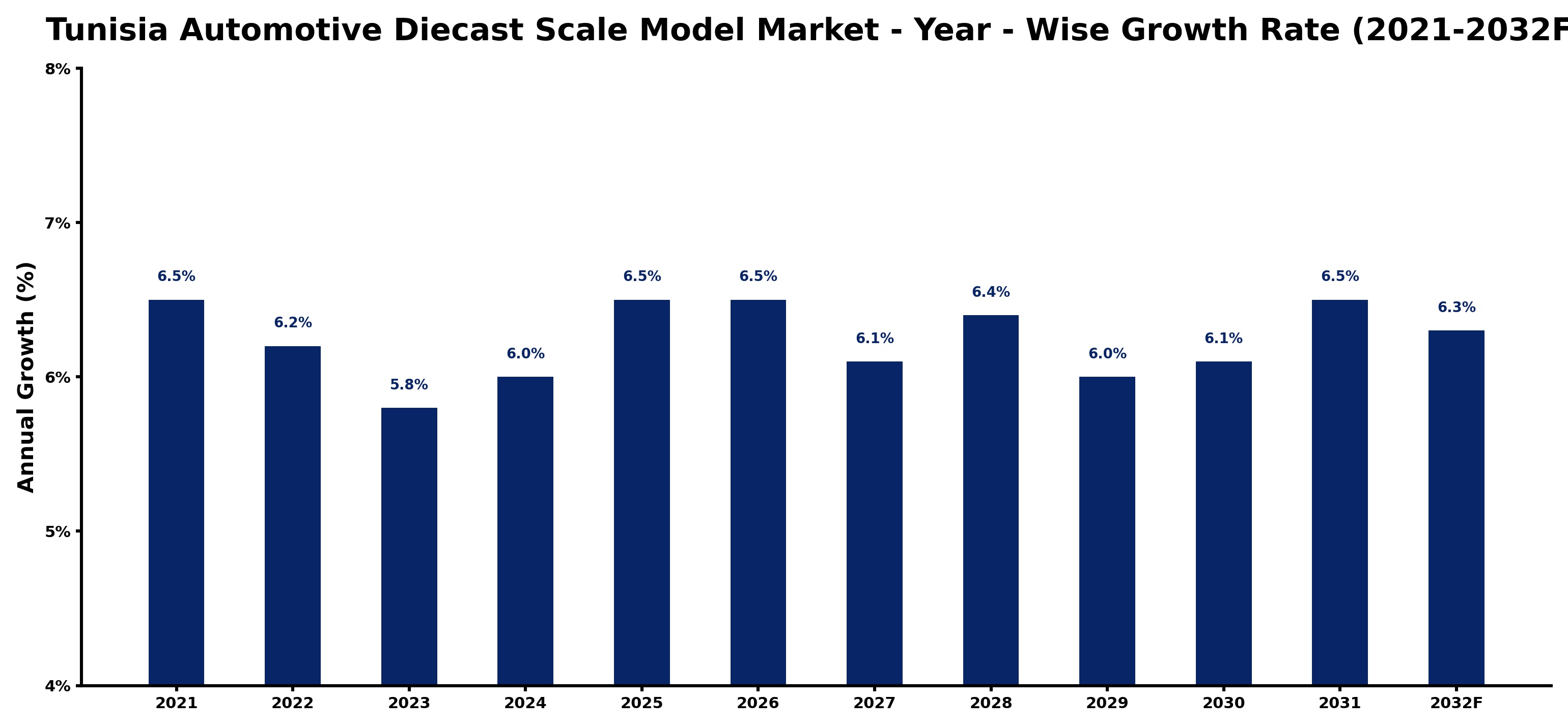
The table below presents the year‑wise growth rates along with the key drivers influencing the market
| Year | Growth Rate | Major Drivers |
| 2021 | 6.5% | Increasing smart city development projects |
| 2022 | 6.2% | Increasing adoption of advanced technologies |
| 2023 | 5.8% | Increasing adoption of advanced technologies |
| 2024 | 6.0% | Government infrastructure modernization initiatives |
| 2025 | 6.5% | Rising electricity demand across industries |
| 2026 | 6.5% | Rising electricity demand across industries |
| 2027 | 6.1% | Increasing industrial automation investments |
| 2028 | 6.4% | Increasing industrial infrastructure investments |
| 2029 | 6.0% | Growing urbanization and commercial development |
| 2030 | 6.1% | Expansion of commercial construction activities |
| 2031 | 6.5% | Rapid growth in telecom and data center sectors |
| 2032 | 6.3% | Expansion of transportation and logistics networks |
Note - Market size estimations and growth projections presented in this report are based on 6Wresearch’s advanced forecasting approach, validated with industry datasets as of June 2026.
Tunisia Automotive Diecast Scale Model Market Synopsis
The most influential force shaping the Tunisia Automotive Diecast Scale Model Market right now is the rising interest among enthusiasts for realistic and detailed models. Collectors are actively seeking out exclusive, limited-edition releases, which is pushing the market towards higher quality and authenticity.
Furthermore, the growing demand for vintage and classic car models reflects a nostalgic trend, appealing to both seasoned collectors and newcomers. Online platforms are increasingly vital for the market, facilitating an engaging community where collectors can buy, sell, and showcase their prized diecast models.
Tunisia Automotive Diecast Scale Model Market Key Takeaways
- Strong growth anticipated due to rising disposable income and interest in automotive collectibles.
- Increased demand for limited-edition and vintage models drives a trend toward high-quality offerings.
- Online retail platforms significantly enhance accessibility and market reach for consumers.
- Government incentives are fostering local production, helping to build consumer trust in domestic brands.
- A niche but dedicated community of collectors is emerging, contributing to market expansion.
Evaluation of Restraints in Tunisia Automotive Diecast Scale Model Market
Despite the promising growth, the market encounters specific restraints. One significant barrier is the limited availability of high-quality diecast models, alongside a restricted variety of makes and models. High import costs and taxes further inflate prices, making it challenging for average consumers to engage with the market. Additionally, there's a general lack of awareness and interest among the broader population, resulting in a primarily niche market with constrained demand. Competing collectibles also divert potential interest and funds away from diecast models, which can hinder overall market potential.
Tunisia Automotive Diecast Scale Model Market Trends
Key trends shaping the Tunisia Automotive Diecast Scale Model Market include a noticeable shift towards detailed and realistic designs. Collectors are increasingly prioritizing authenticity, gravitating towards premium brands that offer exceptional craftsmanship. Social media and online forums have also gained importance, serving as platforms for enthusiasts to connect, showcase collections, and discuss new releases, which in turn heightens market visibility. Additionally, there is an expansion in the variety of available scales, providing consumers with diverse options that suit their preferences and budgets.
Tunisia Automotive Diecast Scale Model Market Opportunities
The market is ripe with investment opportunities, especially considering the growing middle-class population and their increasing disposable incomes. Manufacturers can focus on partnering with local artisans to produce exclusive models that resonate with collectors, thereby increasing market appeal. Retailers should explore the potential for e-commerce expansion, while physical stores can leverage community engagement events to capture interest. Customization options and limited-edition releases are also avenues for attracting collectors in search of unique pieces.
Government Initiatives in the Tunisia Automotive Diecast Scale Model Market
The Tunisian government is actively promoting the automotive diecast scale model market through various initiatives aimed at bolstering local manufacturing. Incentives such as tax breaks and subsidies are designed to encourage investment in production capabilities. Regulations ensure product quality and safety, enhancing consumer trust in locally made models. Furthermore, government support for skill development initiatives within this sector aims to improve the competitiveness of Tunisian manufacturers, thus driving growth in the industry.
Future Insights of the Tunisia Automotive Diecast Scale Model Market
Looking ahead to 2026-2032, the Tunisia Automotive Diecast Scale Model Market is well-positioned for sustained growth. The rising interest in collectibles among automotive enthusiasts suggests that demand for high-quality scale models will continue to rise. Events such as automotive shows and exhibitions are expected to further stimulate interest and sales in this segment. With manufacturers introducing a wider range of models, including both classic and luxury cars, there are promising avenues for growth that cater to a diverse consumer base.
Tunisia Automotive Diecast Scale Model Market Latest Developments (May 2025 - June 2026)
Recent developments in the market indicate a growing trend towards collaboration between local manufacturers and international brands. Innovations in production techniques are being explored to enhance the quality and authenticity of models available to collectors. Moreover, the increasing integration of e-commerce platforms is allowing for greater accessibility, making it easier for consumers to purchase desired models. Social media engagement among collectors has also spiked, fostering a vibrant community of enthusiasts.
Tunisia Automotive Diecast Scale Model Market - Key Attractiveness of the Report
- 10 Years of Market Numbers
- Historical Data Starting from 2022 to 2025
- Base Year: 2025
- Forecast Data until 2032
- Key Performance Indicators Impacting the Market
- Major Upcoming Developments and Projects
Key Highlights of the Report:
- Tunisia Automotive Diecast Scale Model Market Outlook
- Market Size of Tunisia Automotive Diecast Scale Model Market, 2025
- Forecast of Tunisia Automotive Diecast Scale Model Market, 2032
- Historical Data and Forecast of Tunisia Automotive Diecast Scale Model Revenues & Volume for the Period 2022-2032F
- Tunisia Automotive Diecast Scale Model Market Trend Evolution
- Tunisia Automotive Diecast Scale Model Market Drivers and Challenges
- Tunisia Automotive Diecast Scale Model Price Trends
- Tunisia Automotive Diecast Scale Model Porter's Five Forces
- Tunisia Automotive Diecast Scale Model Industry Life Cycle
- Historical Data and Forecast of Tunisia Automotive Diecast Scale Model Market Revenues & Volume By Type for the Period 2022-2032F
- Historical Data and Forecast of Tunisia Automotive Diecast Scale Model Market Revenues & Volume By Plastic Model for the Period 2022-2032F
- Historical Data and Forecast of Tunisia Automotive Diecast Scale Model Market Revenues & Volume By Metal Model for the Period 2022-2032F
- Historical Data and Forecast of Tunisia Automotive Diecast Scale Model Market Revenues & Volume By End-users for the Period 2022-2032F
- Historical Data and Forecast of Tunisia Automotive Diecast Scale Model Market Revenues & Volume By Collectors for the Period 2022-2032F
- Historical Data and Forecast of Tunisia Automotive Diecast Scale Model Market Revenues & Volume By Non-collectors for the Period 2022-2032F
- Tunisia Automotive Diecast Scale Model Import Export Trade Statistics
- Market Opportunity Assessment By Type
- Market Opportunity Assessment By End-users
- Tunisia Automotive Diecast Scale Model Top Companies Market Share
- Tunisia Automotive Diecast Scale Model Competitive Benchmarking By Technical and Operational Parameters
- Tunisia Automotive Diecast Scale Model Company Profiles
- Tunisia Automotive Diecast Scale Model Key Strategic Recommendations






































