Tunisia Bathroom Products Market Summary
The tunisia bathroom products market was estimated at USD 895 Million in 2025 and is projected to reach USD 1309 Million by 2032, growing at a CAGR of 6.9% from 2026 to 2032.
Tunisia Bathroom Products Market Year-wise Growth Rate and Key Drivers
This graph highlights how the Tunisia Bathroom Products Market has steadily grown over the past five years, supported by major growth factors.
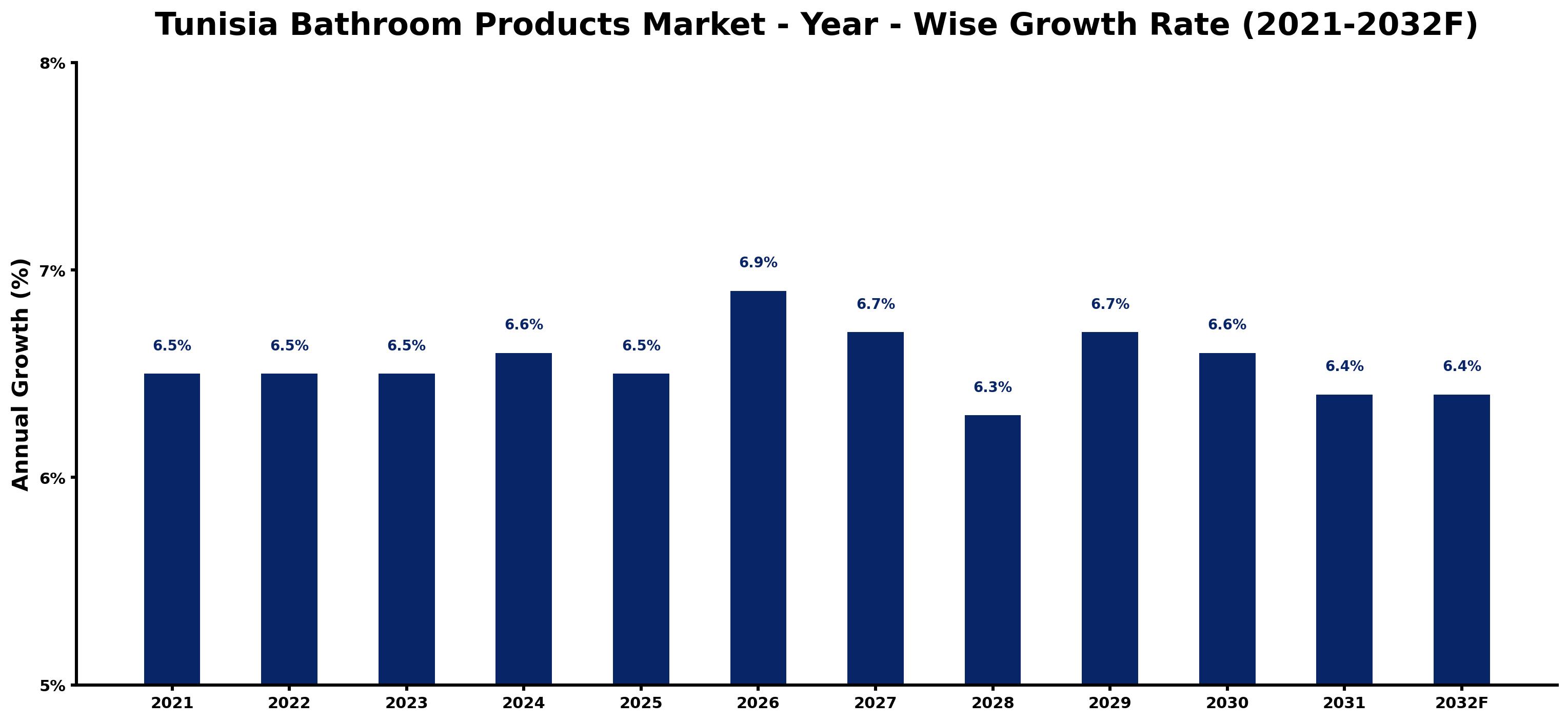
The table below presents the year wise growth rates along with the key drivers influencing the market
| Year | Growth Rate | Major Drivers |
| 2021 | 6.5% | Post-lockdown retail projects showcase increasing interest in luxury bathroom solutions. |
| 2022 | 6.5% | Consumer preferences favor eco-friendly materials for sustainable bathroom renovations. |
| 2023 | 6.5% | Emerging trends highlight smart technology integration in modern bathroom designs. |
| 2024 | 6.6% | Urbanization drives demand for compact and multifunctional bathroom fixtures. |
| 2025 | 6.5% | Enhanced distribution channels improve access to premium bathroom products nationwide. |
| 2026 | 6.9% | Local manufacturing initiatives reduce costs and support domestic entrepreneurs in Tunisia. |
| 2027 | 6.7% | E-commerce platforms expand, providing greater convenience for online bathroom product purchases. |
| 2028 | 6.3% | Tourism expansion boosts demand for high-quality bathroom amenities in hospitality sectors. |
| 2029 | 6.7% | Aging infrastructure necessitates upgrades, increasing investment in modern bathroom solutions. |
| 2030 | 6.6% | Consumer education campaigns raise awareness about hygiene and bathroom innovation. |
| 2031 | 6.4% | Government incentives for construction projects enhance demand for stylish bathroom upgrades. |
| 2032 | 6.4% | Rising disposable incomes facilitate trends toward luxury and customized bathroom experiences. |
Note - Market size estimations and growth projections presented in this report are based on 6Wresearch's advanced forecasting approach, validated with industry datasets as of June 2026.
Tunisia Bathroom Products Market Synopsis
The Tunisia Bathroom Products Market is projected to reach 6.9% and witness significant growth during the forecast period (2026-2032). This expansion is fueled by several dynamics, including increasing urbanization, improvements in disposable income levels, and a growing emphasis on home improvement initiatives among consumers. The market encompasses a variety of products, ranging from bathroom fixtures and sanitary ware to faucets, showers, and accessories, indicating a diverse consumer base and evolving preferences.
Tunisia Bathroom Products Market Growth Drivers
Several factors are actively driving growth in the Tunisia Bathroom Products Market. Firstly, urbanization continues to surge, leading to a considerable rise in residential construction and renovation activities. This shift underscores the demand for modern and functional bathroom solutions, as consumers seek to enhance their living spaces. Additionally, rising disposable incomes allow households to invest more in bathroom aesthetics and functionalities, aligning with contemporary lifestyle aspirations.
Furthermore, consumer awareness regarding home improvement is increasingly prominent, prompting more individuals to prioritize their bathroom environments. This awareness is complemented by a notable trend towards luxury bathroom products, where consumers are drawn to innovative designs and premium materials. The influence of global design trends also contributes to the demand for stylish bathroom products, as consumers become more discerning in their preferences.
Tunisia Bathroom Products Market Trends and Opportunities
The Tunisia Bathroom Products Market is witnessing significant shifts in consumer preferences towards eco-friendly and sustainable products. This trend is driven by growing environmental awareness among consumers, leading to an increased demand for products that minimize water usage and energy consumption. Touchless faucets, LED mirrors, and water-saving fixtures are becoming more popular, indicating a clear shift towards smart and innovative solutions.
The market is also observing a preference for modern, minimalist designs characterized by clean lines and neutral colors. This aesthetic appeal aligns with broader global design movements, further influencing product offerings. In addition, the rise of e-commerce platforms is reshaping the sales landscape in the Tunisia Bathroom Products Market, providing consumers with convenient access to a wider array of bathroom products.
Tunisia Bathroom Products Market Challenges and Restraints
Despite the growth prospects, the Tunisia Bathroom Products Market faces several challenges. Intense competition from both local and international brands creates a difficult landscape for market participants. Local manufacturers often find it challenging to compete effectively with established brands that offer superior pricing and quality. Additionally, the ever-evolving preferences of consumers demand continuous innovation, putting pressure on companies to stay ahead of trends and maintain product relevance.
Economic instability in the region further complicates the landscape. Fluctuations in consumer spending patterns may result in inconsistent demand for bathroom products, impacting sales forecasts. To navigate these challenges effectively, businesses must focus on product differentiation and develop strategic pricing models to adapt to changing market conditions.
Tunisia Bathroom Products Market Investment Opportunities
Investment opportunities in the Tunisia Bathroom Products Market are becoming increasingly attractive. The growing demand for modern, high-quality bathroom products presents a lucrative avenue for investors interested in faucets, shower systems, and sanitary ware. Additionally, the rising trend for eco-friendly solutions highlights a significant opportunity for investment in sustainable bathroom products that align with consumer preferences.
Renovation and remodeling projects in both residential and commercial sectors continue to drive the market, making it an appealing target for investment in innovative and space-saving bathroom solutions. Furthermore, collaboration with local manufacturers or distributors to introduce new and imported bathroom products can serve as a strategic investment move in the evolving Tunisia market.
Tunisia Bathroom Products Market Government Investment and Initiatives
Government policies in Tunisia are increasingly supportive of the bathroom products market. Initiatives aimed at promoting local manufacturing and enhancing product safety standards are at the forefront of government efforts. By providing incentives and subsidies to boost domestic production, the government aims to reduce reliance on imports, which can bolster economic growth and job creation.
Moreover, strict regulations are enforced to ensure that all bathroom products meet established quality and safety standards, thereby protecting consumer health. Environmental considerations are also a significant focus, with policies encouraging sustainable manufacturing practices and responsible disposal methods to mitigate environmental impacts. These initiatives are instrumental in creating a robust and competitive bathroom products market within Tunisia.
Tunisia Bathroom Products Market Latest Developments (May 2025 - June 2026)
In the period from May 2025 to June 2026, the Tunisia Bathroom Products Market has observed several key developments. A notable increase in the introduction of eco-friendly products has been seen, as businesses adapt to consumer demand for sustainable options. Additionally, improvements in e-commerce capabilities have expanded access to a broader range of bathroom products, facilitating consumer convenience.
Market players have also focused on product innovation, leading to the development of smart bathroom solutions that integrate technology for enhanced user experience. This trend reflects a shifting consumer base that increasingly prioritizes functionality alongside aesthetics. Overall, the developments during this period emphasize the market's commitment to adapting to trends while driving growth and innovation.
Tunisia Bathroom Products Market - Key Attractiveness of the Report
- 10 Years of Market Numbers
- Historical Data Starting from 2022 to 2025
- Base Year: 2025
- Forecast Data until 2032
- Key Performance Indicators Impacting the Market
- Major Upcoming Developments and Projects
Key Highlights of the Report:
- Tunisia Bathroom Products Market Outlook
- Market Size of Tunisia Bathroom Products Market, 2025
- Forecast of Tunisia Bathroom Products Market, 2032F
- Historical Data and Forecast of Tunisia Bathroom Products Revenues & Volume for the Period 2022-2032F
- Tunisia Bathroom Products Market Trend Evolution
- Tunisia Bathroom Products Market Drivers and Challenges
- Tunisia Bathroom Products Price Trends
- Tunisia Bathroom Products Porter's Five Forces
- Tunisia Bathroom Products Industry Life Cycle
- Historical Data and Forecast of Tunisia Bathroom Products Market Revenues & Volume By Product Type for the Period 2022-2032F
- Historical Data and Forecast of Tunisia Bathroom Products Market Revenues & Volume By Towel Rack for the Period 2022-2032F
- Historical Data and Forecast of Tunisia Bathroom Products Market Revenues & Volume By Shower for the Period 2022-2032F
- Historical Data and Forecast of Tunisia Bathroom Products Market Revenues & Volume By Soap Holder for the Period 2022-2032F
- Historical Data and Forecast of Tunisia Bathroom Products Market Revenues & Volume By Toilet Brushes and Holder for the Period 2022-2032F
- Historical Data and Forecast of Tunisia Bathroom Products Market Revenues & Volume By Others for the Period 2022-2032F
- Historical Data and Forecast of Tunisia Bathroom Products Market Revenues & Volume By Applications for the Period 2022-2032F
- Historical Data and Forecast of Tunisia Bathroom Products Market Revenues & Volume By Residential for the Period 2022-2032F
- Historical Data and Forecast of Tunisia Bathroom Products Market Revenues & Volume By Hotels for the Period 2022-2032F
- Historical Data and Forecast of Tunisia Bathroom Products Market Revenues & Volume By Others for the Period 2022-2032F
- Historical Data and Forecast of Tunisia Bathroom Products Market Revenues & Volume By Distribution Channel for the Period 2022-2032F
- Historical Data and Forecast of Tunisia Bathroom Products Market Revenues & Volume By Online for the Period 2022-2032F
- Historical Data and Forecast of Tunisia Bathroom Products Market Revenues & Volume By Offline for the Period 2022-2032F
- Tunisia Bathroom Products Import Export Trade Statistics
- Market Opportunity Assessment By Product Type
- Market Opportunity Assessment By Applications
- Market Opportunity Assessment By Distribution Channel
- Tunisia Bathroom Products Top Companies Market Share
- Tunisia Bathroom Products Competitive Benchmarking By Technical and Operational Parameters
- Tunisia Bathroom Products Company Profiles
- Tunisia Bathroom Products Key Strategic Recommendations






































