Tunisia Bulletproof Glass Market Size, Share & Growth Rate
The Tunisia Bulletproof Glass Market was estimated at USD 474 Million in 2025 and is projected to reach USD 644 Million by 2032, growing at a CAGR of 4.5% from 2026 to 2032. This robust growth trajectory is primarily driven by heightened security needs across sectors such as banking, government, and high-risk construction. Additionally, technological advancements in glass production enhance the capabilities of bulletproof glass, making it an increasingly vital component in security solutions.
Tunisia Bulletproof Glass Market Year-wise Growth Rate and Key Drivers
This graph highlights how the Tunisia Bulletproof Glass Market has steadily grown over the years, supported by major growth factors.
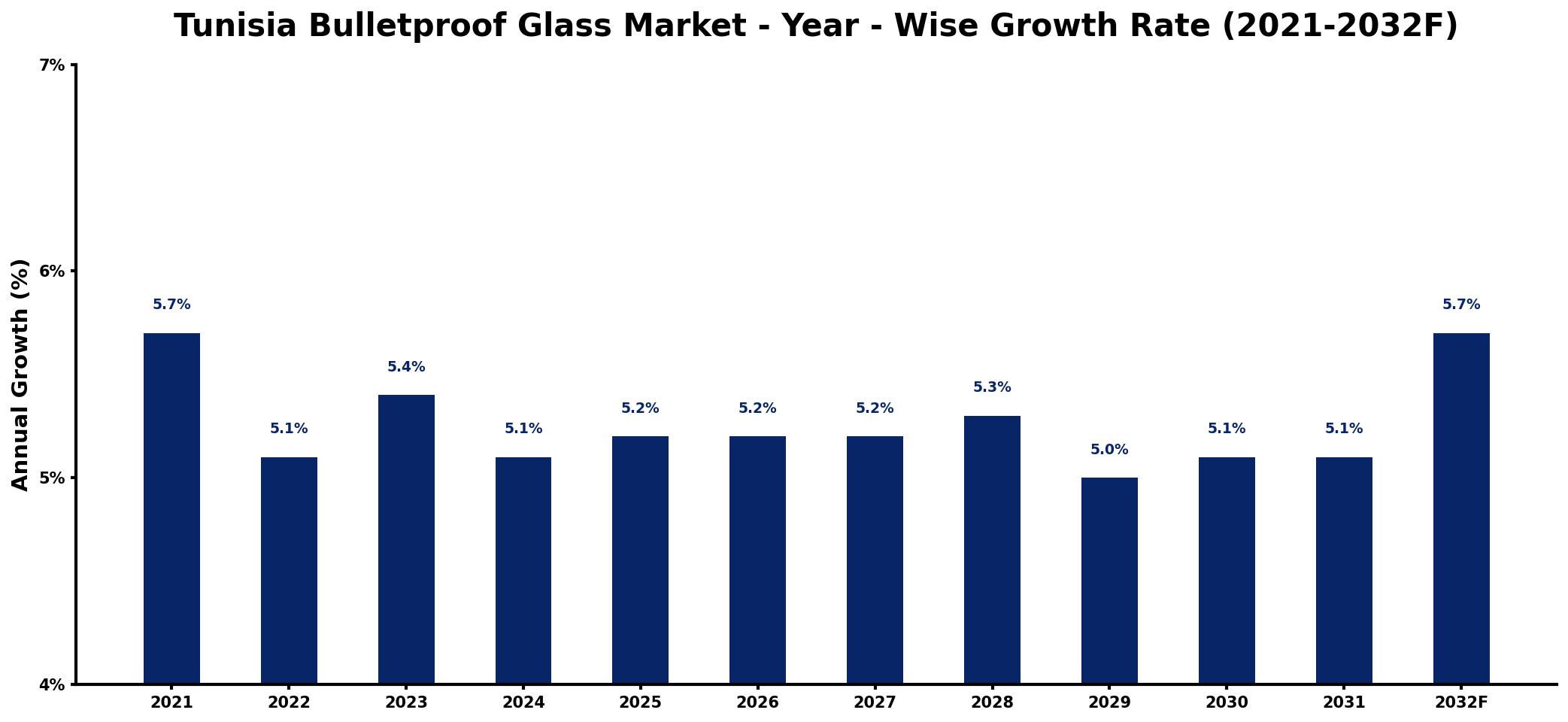
The table below presents the year‑wise growth rates along with the key drivers influencing the market
| Year | Growth Rate | Major Drivers |
| 2021 | 5.7% | Increased security infrastructure investments |
| 2022 | 5.1% | Growing demand for safety solutions |
| 2023 | 5.4% | Rising urbanization and development projects |
| 2024 | 5.1% | Expansion of construction sector initiatives |
| 2025 | 5.2% | Higher consumer awareness of safety |
| 2026 | 5.2% | Increased regulatory safety requirements |
| 2027 | 5.2% | Surge in private sector investments |
| 2028 | 5.3% | increased overall sector activity |
| 2029 | 5.0% | Emergence of new security technologies |
| 2030 | 5.1% | Strengthened international trade partnerships |
| 2031 | 5.1% | Rising demand from automotive sector |
| 2032 | 5.7% | Increased military and defense spending |
Note: Market size estimations and growth projections presented in this report are based on 6Wresearch's proprietary forecasting methodology, utilizing the latest available industry data, government publications, and primary research inputs.
Tunisia Bulletproof Glass Market Synopsis
In recent years, the Tunisia bulletproof glass market has gained significant momentum, fueled by the rising awareness of safety and security threats. As various sectors strive for higher protection standards, the demand for specialized glass solutions continues to grow. Looking ahead, the market is expected to expand further as the government implements supportive measures and manufacturers invest in cutting-edge technologies.
While the current landscape shows positive growth, challenges such as high production costs and stringent safety regulations remain. Nevertheless, these factors only emphasize the need for innovation in the bulletproof glass sector, propelling manufacturers toward advanced materials research and collaborative efforts with international entities.
Tunisia Bulletproof Glass Market Key Takeaways
- The market is growing due to rising security concerns in banking and high-risk environments.
- Technological advancements in glass production are enhancing the product offerings.
- The government is actively promoting initiatives to boost local manufacturing capabilities.
- High production costs pose challenges but create opportunities for material innovation.
- The increasing focus on safety in vehicles and buildings further fuels market demand.
Evaluation of Restraints in Tunisia Bulletproof Glass Market
Despite the robust growth potential of the bulletproof glass market in Tunisia, several restraints hinder its full realization. The high cost of production remains a critical barrier, limiting accessibility and adoption, particularly in price-sensitive sectors. Stringent safety standards also pose challenges, as manufacturers must navigate regulatory compliance, which can slow down the introduction of new products. This environment necessitates substantial investment in research and development to innovate more cost-effective, high-performance glass solutions.
Tunisia Bulletproof Glass Market Trends
The current trends shaping the Tunisia bulletproof glass market include an increasing emphasis on integrated security solutions that combine glass technology with advanced security systems. Additionally, growing awareness among consumers about the importance of safety is driving demand for transparent protective solutions in both residential and commercial applications. Emerging technologies, such as laminated glass with enhanced optical clarity and energy-efficient properties, are also gaining traction, aligning with global sustainability trends.
Tunisia Bulletproof Glass Market Opportunities
Significant growth opportunities lie in the automotive and construction sectors, where there is a rising demand for safety measures in vehicles and high-rise buildings. As the government continues to invest in national security and defense, collaboration between local manufacturers and international defense contractors will open pathways for advanced glass technologies. Additionally, the urbanization trends in Tunisia present new avenues for bulletproof glass applications in commercial and residential developments.
Government Initiatives in the Tunisia Bulletproof Glass Market
The Tunisian government has taken proactive measures to enhance the bulletproof glass market through various initiatives. These include financial incentives aimed at manufacturers to stimulate local production and partnerships with international companies for technology transfer. Subsidies for research and development are also being introduced to foster innovation in advanced glass technologies. Such policies are expected to strengthen the national security framework while positioning Tunisia as a key player in the regional defense material supply chain.
Future Insights of the Tunisia Bulletproof Glass Market
As we look toward 2026-2032, the Tunisia bulletproof glass market is poised for continued expansion, driven by increasing security investments and evolving consumer expectations. The integration of smart technologies in bulletproof solutions will likely shape product development, ensuring that manufacturers remain competitive. The emphasis on high-quality materials and innovative solutions will further underscore the market's resilience and potential for growth.
Tunisia Bulletproof Glass Market Latest Developments (2025 - 2026)
Recent developments in the Tunisia bulletproof glass market indicate a shift towards incorporating advanced materials technology. Manufacturers are collaborating with local universities to enhance R&D capabilities, focusing on cost-effective production methods. Furthermore, there is a noticeable increase in investment from both domestic and foreign entities aimed at advancing production facilities to meet the growing demand for high-quality bulletproof solutions.
Tunisia Bulletproof Glass Market - Key Attractiveness of the Report
- 10 Years of Market Numbers
- Historical Data Starting from 2022 to 2025
- Base Year: 2025
- Forecast Data until 2032
- Key Performance Indicators Impacting the Market
- Major Upcoming Developments and Projects
Key Highlights of the Report:
- Tunisia Bulletproof Glass Market Outlook
- Market Size of Tunisia Bulletproof Glass Market, 2025
- Forecast of Tunisia Bulletproof Glass Market, 2032
- Historical Data and Forecast of Tunisia Bulletproof Glass Revenues & Volume for the Period 2022-2032F
- Tunisia Bulletproof Glass Market Trend Evolution
- Tunisia Bulletproof Glass Market Drivers and Challenges
- Tunisia Bulletproof Glass Price Trends
- Tunisia Bulletproof Glass Porter's Five Forces
- Tunisia Bulletproof Glass Industry Life Cycle
- Historical Data and Forecast of Tunisia Bulletproof Glass Market Revenues & Volume By Type for the Period 2022-2032F
- Historical Data and Forecast of Tunisia Bulletproof Glass Market Revenues & Volume By Solid Acrylic for the Period 2022-2032F
- Historical Data and Forecast of Tunisia Bulletproof Glass Market Revenues & Volume By Traditional Laminated for the Period 2022-2032F
- Historical Data and Forecast of Tunisia Bulletproof Glass Market Revenues & Volume By Polycarbonate for the Period 2022-2032F
- Historical Data and Forecast of Tunisia Bulletproof Glass Market Revenues & Volume By Glass-clad Polycarbonate for the Period 2022-2032F
- Historical Data and Forecast of Tunisia Bulletproof Glass Market Revenues & Volume By Other Types for the Period 2022-2032F
- Historical Data and Forecast of Tunisia Bulletproof Glass Market Revenues & Volume By End-user Industry for the Period 2022-2032F
- Historical Data and Forecast of Tunisia Bulletproof Glass Market Revenues & Volume By Automotive for the Period 2022-2032F
- Historical Data and Forecast of Tunisia Bulletproof Glass Market Revenues & Volume By Buildings and Construction for the Period 2022-2032F
- Historical Data and Forecast of Tunisia Bulletproof Glass Market Revenues & Volume By Defense for the Period 2022-2032F
- Historical Data and Forecast of Tunisia Bulletproof Glass Market Revenues & Volume By Other End-user Industries for the Period 2022-2032F
- Tunisia Bulletproof Glass Import Export Trade Statistics
- Market Opportunity Assessment By Type
- Market Opportunity Assessment By End-user Industry
- Tunisia Bulletproof Glass Top Companies Market Share
- Tunisia Bulletproof Glass Competitive Benchmarking By Technical and Operational Parameters
- Tunisia Bulletproof Glass Company Profiles
- Tunisia Bulletproof Glass Key Strategic Recommendations






































